 © AFP/GETTY IMAGES
Timbuktu Institute – Week 1 – May 2026
Download the full Sahel weather report
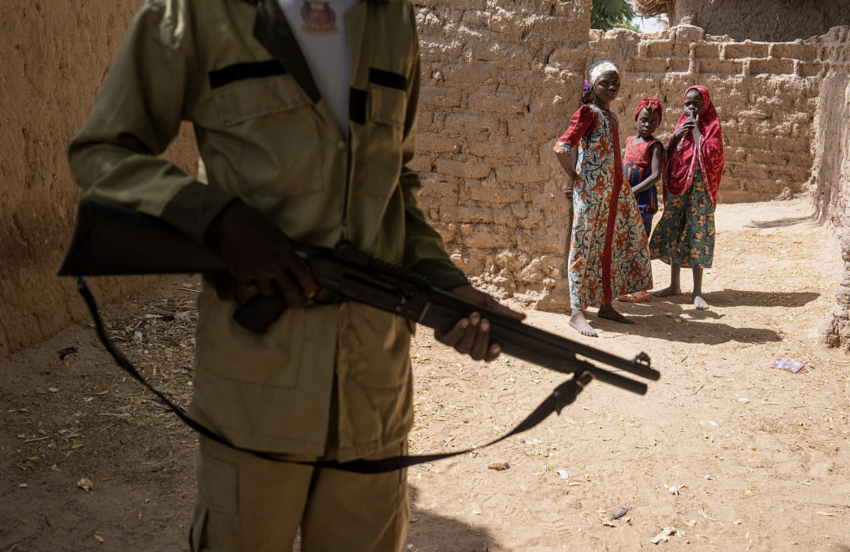
Whilst its neighbour Chad is once again facing bloody jihadist attacks, Nigeria is struggling to continue its counter-terrorism operations. In this instance, the campaign is in full swing. Nevertheless, as we know, these operations sometimes lead to incidents that humanitarian and human rights organisations denounce as abuses. On the night of 30 April 2026, around forty Fulani herders were killed in Niger State, in the country’s central-western region. The operation, carried out jointly by Nigerian and Beninese militiamen acting alongside the Nigerian army, targeted members of the Fulani community suspected of being informants for the jihadist group Ansaru. According to witness accounts, men who resisted arrest were shot dead on the spot, bringing the possible death toll to 41, according to a local traditional chief. Ansaru, which emerged in 2020 from a split with Boko Haram and is now affiliated with Al-Qaeda in the Islamic Maghreb, has been active on both sides of the Benin-Niger border for the past two years, which would explain the involvement of militiamen from neighbouring Benin. Neither the Nigerian army nor the Beninese army has commented on the incident. According to RFI Hausa, this was reportedly a “pre-emptive raid” carried out after Fulani herders allegedly threatened to disrupt farming activities in the area, in retaliation for the recent killing of two of their own in a neighbouring community, according to a local resident.
And yet, the intensification of pressure by Nigerian armed forces against jihadist groups is not without its setbacks. During the night of 7–8 May 2026, fighters from the Islamic State in West Africa (ISWAP) launched a large-scale coordinated assault on the headquarters of the Nigerian Army’s 27th Brigade in Buni Gari, in the north-east of the country. Attacking simultaneously from three directions (west, south and south-west) in an attempt to encircle the base, the insurgents were repelled by troops from Operation Hadin Kai, who held their positions using indirect fire before forcing the attackers into a disorderly retreat. According to the Nigerian army’s report, two soldiers were killed and 50 terrorists were neutralised.
Defections within the opposition
With less than two years to go before the Nigerian presidential election in January 2027, the opposition is struggling to get its house in order.
Against this backdrop, the African Democratic Congress (ADC) is positioning itself as a credible alternative. And yet, the party has just suffered two significant defections. Peter Obi and Rabiu Kwankwaso, who finished third and fourth respectively in the 2023 election, officially left on 4 May to join the ADC from the Nigerian Democratic Congress (NDC). For his part, Peter Obi justifies his departure by citing a climate he describes as “toxic” and “unstable” within the ADC, pointing to internal legal proceedings and attempts at destabilisation between rival factions. One of these factions is challenging the legitimacy of the party’s executive in the courts. Tensions with Atiku Abubakar, another opposition heavyweight who has remained in the ADC, are also said to be a factor. Against this backdrop, is this dual defection the prelude to a possible Obi-Kwankwaso ticket for the next presidential election? Be that as it may, it is a clear indication of the realignments and alliances currently taking shape within the opposition, with the aim of challenging the ruling party (APC) in 2027.