Presentation of Three Key Studies on Terrorism in Bouaké: AILCT Establishes Itself as a Regional Hub for Strategic Research Spécial
Timbuktu Institute
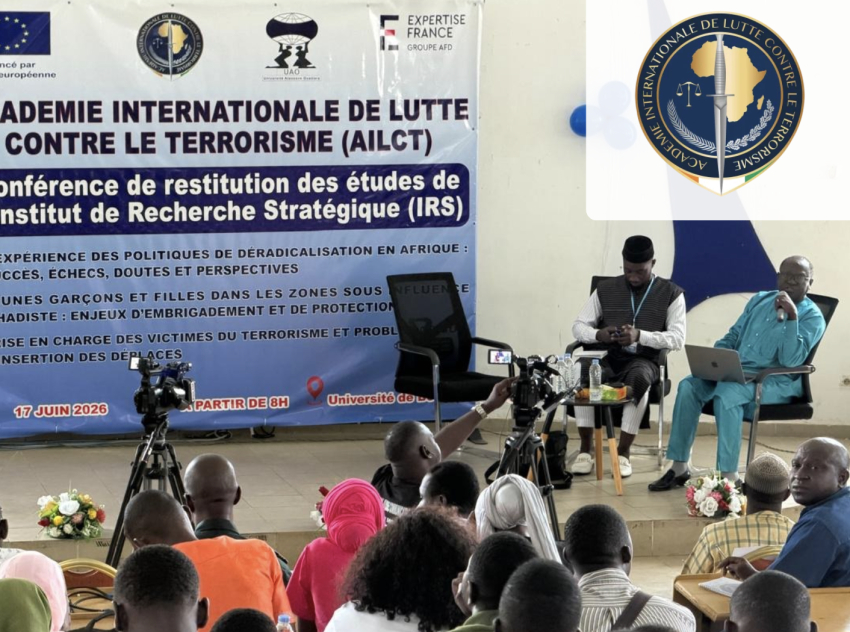
At a time when terrorist activities continue to reshape the security landscape in West Africa, a detailed understanding of the mechanisms of radicalization, resilience, and prevention has become a strategic necessity for the region’s states. With this in mind, the Institute for Strategic Research (IRS) of the International Academy for Counter-Terrorism (AILCT) organized a workshop on June 17 at Alassane Ouattara University in Bouaké (Ivory Coast) a workshop to present the findings of three strategic studies on the dynamics of terrorism and violent extremism in West Africa. This event, which aligns with the IRS’s mission to generate and disseminate knowledge in support of prevention, brought together professors, faculty researchers, and students from the university. Moreover, this forum for reflection aimed to raise awareness among academic stakeholders, stimulate scholarly debate, and formulate recommendations to strengthen policies on prevention and social cohesion.
If there is one finding on which there is broad consensus today in research on violent extremism, it is that young people are particularly vulnerable to the dynamics of radicalization and recruitment. These are the main points of the study presented by the regional director of the Timbuktu Institute, Bakary Sambe, on the topic: “Young Boys and Girls in Areas Under Jihadist Influence: Challenges of Recruiting and Protection.” Highlighting the relevance and timeliness of this workshop, Bakary emphasized that the IRS’s decision to present the findings of the three studies directly to faculty, researchers, and students at the University of Bouaké is significant: “The IRS does not merely produce knowledge in Abidjan; it disseminates and enriches it in collaboration with on-the-ground actors and future elites.” Thus, the study conducted by the Timbuktu Institute took its field teams to Ménaka (Mali) and Diffa (Niger) in the Lake Chad basin. For Bakary Sambe, “this immersion in these two different field settings allowed for a comparative analysis of two distinct jihadist recruitment dynamics, each with its own specific characteristics, underpinned by a multidisciplinary approach to complex issues.”
At the same time, the other two studies presented focused on “support for victims of terrorism and the challenge of reintegrating displaced persons” and “the experience of deradicalization policies in Africa: successes, failures, doubts, and prospects.” These two studies were presented, respectively, by Régis Hounkpè, a Beninese researcher and executive director of InterGlobe Conseils, and Barka Bâ, a Senegalese expert specializing in regional security issues and director of Sen Stratégies Consulting, who brings extensive field and research experience in the Sahel and West Africa. In this regard, the studies presented in Bouaké directly address the challenges identified in the regional context, namely: the territorialization of terrorism, the appeal of jihadist rhetoric to young people, and the need to transform universities into spaces for prevention and resilience.
Abidjan, an emerging hub for strategic research
According to Bakary Sambe, the regional significance of the event cannot be overstated: “Abidjan already has a major asset in AILCT in Jacqueville, which combines training and research activities. This event demonstrates that this institution can become a center where high-level analysis, lessons learned from the Sahel and the Gulf of Guinea, and concrete proposals converge.” This is what makes it “precisely a strategic hub, one that not only generates knowledge but also makes it useful and accessible to the entire subregion,” he added. Furthermore, the president of the Timbuktu Institute highlighted Côte d’Ivoire’s unique position: “It is today one of the most stable and economically integrated countries in ECOWAS and UEMOA. It benefits from a strategic geographic location, modern infrastructure in Abidjan, and a tradition of regional openness; and in a context where terrorism is spreading from the Sahel to coastal countries, having a research hub in Abidjan offers a dual advantage.”
“The knowledge generated can inform concrete frameworks for cooperation, whether through joint operations, intelligence sharing, or cross-border prevention programs,” he explained. He added that the involvement of universities and young people, as seen in this workshop, strengthens community resilience: “It is essential that security cooperation be not only military but also social and preventive. By becoming this research hub, Abidjan can provide the region’s states with shared and up-to-date analytical tools. This is a valuable contribution to smarter and more sustainable regional cooperation. ”
All in all, the workshop—which took an interactive format featuring presentations followed by discussions—helped identify tailored solutions and strengthen the capacity of academic actors in terrorism prevention. Beyond its scientific significance, this event confirms a genuine momentum that could continue to grow. It is worth noting that Abidjan, through the AILCT and its Institute for Strategic Research (IRS), is gradually establishing itself as a major regional hub for the production and dissemination of strategic knowledge on security, in support of an integrated approach combining scientific research, training for executives and practitioners, and prevention policies.