Between the IMF and the Street: Parliamentary Distrust and Budgetary Pressure in Senegal Spécial
 © Misper Apawu/REUTERS
Timbuktu Institute September 2026, Week 2
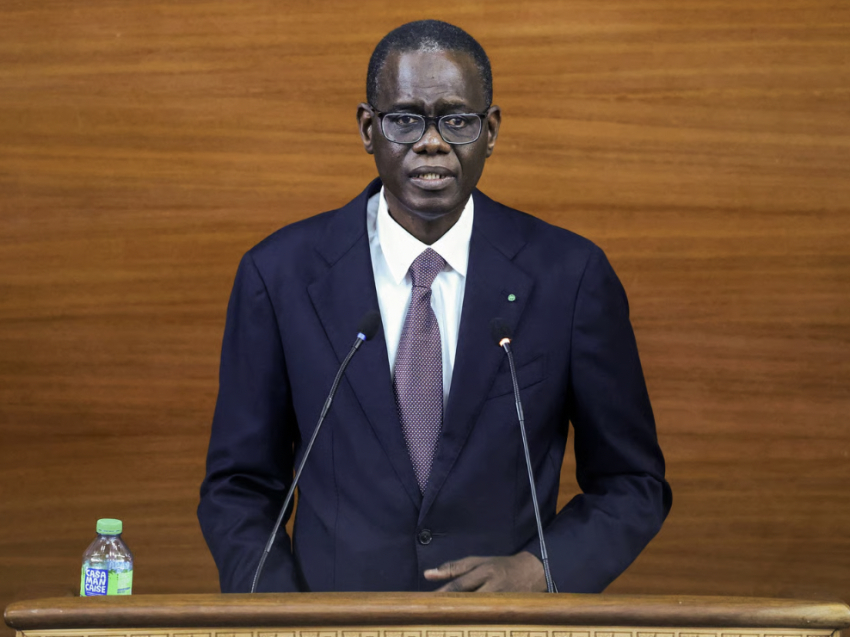
The exercise promised to be difficult, to say the least. Having led the government for three months, Prime Minister Ahmadou Al Aminou Mohamed Lô's general policy statement — a somewhat technocratic choice following Ousmane Sonko's removal from the post — had been long awaited. And for good reason: in a National Assembly dominated by Pastef, the exercise took on the air of a “face-off” between the executive and the legislature. On September 8, over the course of eight hours, Prime Minister Lô delivered a fairly disciplined and diligent performance, whose measured tone and balancing act deserve recognition. Indeed, the head of government was keen to claim continuity with the “Senegal 2050” framework, whose implementation his predecessor Ousmane Sonko had begun. “I have not come to announce another vision for Senegal,” he assured, while promising “a change of method,” which he linked in particular to his professional background. But behind this stated commitment to continuity, it was the question of the country's economic trajectory that crystallized disagreements.
As Senegal faces intense financial pressure, notably marked by the downgrading of its sovereign rating, the head of government summed up the situation in a few words: “We are a poor country that is currently heavily indebted.” Moreover, the term “restructuring” continues to be subtly avoided — which has not been without its share of comical missteps. Indeed, while Prime Minister Lô stated in his general policy address that the country is “under structural adjustment,” he corrected himself the next day, assuring that “there is no structural adjustment in Senegal.”
Debt Management Put to the Social Test
If, in form, Prime Minister Lô thus delivered a fairly clean performance, in substance, it is fair to say he did not reassure lawmakers much. This is evidenced by the criticism of Pastef MP Guy Marius Sagna, who accused the government of having “given Senegal's voice to the IMF without discussing it with the National Assembly.” APR MP Abdou Mbow struck a similar note, describing the general policy statement as a “shallow summary drafted by a consultancy firm” and, in his words, disconnected from the realities experienced by Senegalese people. As is well known, the management of this debt has now become one of the main sources of friction between the executive and the parliamentary majority.
Following the recently concluded agreement with the IMF, Dakar's objective is to restore macroeconomic stability, improve debt sustainability and create new fiscal space. This appears to be what the government means by the term “reprofiling,” preferred over “restructuring,” which should make it possible to significantly extend maturities and reduce the average cost of debt. The rating agency S&P Global Ratings, however, considers it “extremely likely” that there will be a distressed debt exchange or a default on foreign-currency commercial debt, underscoring just how narrow Dakar's room for maneuver currently is.
Moreover, the government also intends to gradually reduce general energy subsidies and better target support toward vulnerable households, while notably preserving support for domestic butane gas. At the same time, it plans to contain public spending by acting on the wage bill, recruitment and operating expenses. The elimination of nineteen agencies, the merger of seven structures into three entities, and the strategic repositioning of ten others are expected by the end of November. Ahmadou Al Aminou Lô presents this reorganization as a requirement of “economic rationality” and insists it is not dictated by the IMF, but rather consistent with the Senegal 2050 Agenda. In the face of concerns raised by the risk of a new round of social adjustment, he is keen to distance himself from past experiences: “We are not sacrificing the interests of the Senegalese people. There will be no brutal adjustment like in the 1980s.”
These assurances nonetheless run up against an increasingly sensitive social reality. On September 5, the “empty-basket march”, organized in Dakar as part of the “Thirty Days for Fair Prices” mobilization, reflected the exasperation of part of the population in the face of rising prices for food, electricity, fuel and rent. The cost of living could thus become the meeting point between the State's financial constraints and households' everyday concerns, just as the government is preparing to translate its commitments to the IMF into upcoming budget legislation.
Is the Executive Playing Its Cards Right?
The rupture between former Prime Minister Ousmane Sonko and President Diomaye Faye, sealed by the creation of his own party (Kiiraay), looks set to set the tempo of political vicissitudes for years to come. And in this duel, President Diomaye Faye, seeking to build his own political apparatus, may not hold back on the levers at his disposal. It is in this context that the announcement by the Sénégal Solidaire Foundation (led by the head of state's wives) of a 500 million CFA franc donation raised questions about the origin of the funds. While Kiiraay maintains that the money does not come from the State budget, but was raised from “international donors, companies and patrons,” suspicions do not appear to be subsiding. Created by decree in October 2025, the foundation is indeed not registered in the public budget, and the First Lady holds no official status, salary or budget. Beyond the fact that Senegalese First Ladies' foundations have often drawn criticism over the opacity of fund management, this generous donation comes at a particularly inopportune moment, when spending transparency and the cost-of-living issue are more sensitive than usual.
At the same time, the last Council of Ministers meeting on September 10 was marked by a sweeping series of appointments (87 in total) to the heads of general directorates, boards of directors and several public bodies. This wave of changes affects notably SOGEPA, SENELEC, Customs, Dakar Dem Dikk, AGEROUTE, SONAGED, the Autonomous Port of Dakar and ANPEJ, as well as numerous territorial and mining administrations. Several officials were replaced, while some figures made a return to public affairs, including Cheikh Issa Sall, Gallo Ba, Modou Bara Gaye and Babacar Abba Mbaye. The appointment of Ibrahima Barry, a member of the APR's national executive secretariat, as CEO of SICAP SA, also illustrates the presence of figures from the former ruling majority. A sweeping “clean sweep,” to use the popular expression, that some do not hesitate to view as a process of “de-Pastefization” and the consolidation of “Kiiraay.”
It is against this backdrop that files inherited from the previous administration continue to fuel questions about the State's financial and contractual commitments. The Yaakaar-Teranga case offers an illustration of this. During his general policy statement, the Prime Minister referred to a dispute valued at $55 million, citing a letter dated June 1 presented as evidence of the existence of the dispute. The case, which reportedly involves the oil company Kosmos Energy, could carry financial, legal and political dimensions alike, particularly should the arbitration mechanisms provided for in the contractual agreements be triggered. Former Minister of Petroleum and Mines Birame Soulèye Diop has sincegiven his own account, asserting that he holds documents establishing that Senegal's interests are protected and that the amount claimed is owed by Kosmos Energy. Head of State Diomaye Faye has referred the matter to the General State Inspectorate (IGE) to shed light on the case.
In sum, the succession of parliamentary debates, tensions over debt, mobilizations against the high cost of living, and changes at the head of public institutions reveals an underlying equation: the authorities' capacity to turn financial constraint into a new economic trajectory without opening a new social and political front. As such, in the coming months, it cannot be ruled out that the political-institutional architecture's stability, held together somewhat haphazardly until now, will have to weather fresh upheavals.