Algorithms at war : how generative aI is reshaping the malian conflict Spécial
Timbuktu Institute September 2026
For more than a decade, the Malian conflict has been characterized by a permanent recomposition of alliances, balances of power and modes of confrontation. The alliance concluded between Jama'at Nusrat al-Islam wal-Muslimin (JNIM) and the Front de libération de l'Azawad (FLA), despite clear ideological divergences, is one of the most recent illustrations of this. In this sense, the coordinated assaults of April 2026 confirmed this evolution of a conflict in which strategic calculations are increasingly taking precedence over traditional divides. That said, this recomposition is no longer playing out solely on the military terrain. It now extends into the information space, where generative artificial intelligence (AI) is, in turn, beginning to change the rules of the game.
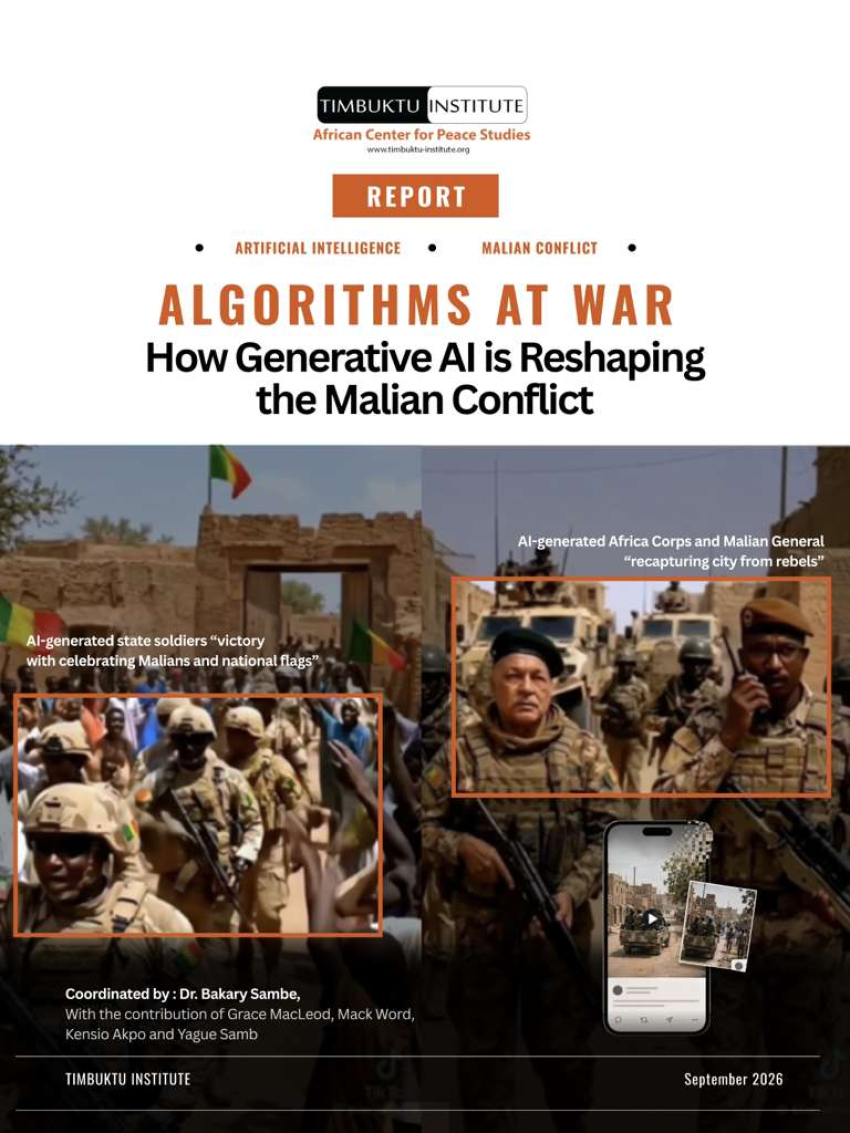
Far from being a uniformly adopted technology, generative AI is being mobilized differently depending on each actor's capabilities, resources and objectives. JNIM's use of it remains limited for now, notably through visual materials designed to reinforce already well-established propaganda. The release, in June 2026, of AI-generated posters by its media wing Az-Zallaqa nonetheless points to a development worth monitoring. By considerably reducing production costs and timeframes, AI could enable the group to multiply its content, translate it into local languages and further personalize its recruitment messaging. This shift could thus favor the emergence of a communicational jihadism that is faster, more targeted and better adapted to local realities. On the FLA side and among its support networks, use appears more decentralized. TikTok accounts feature recurring synthetic characters designed to carry narratives favorable to Azawad and hostile to Africa Corps. The appeal of these tools lies as much in their amplification capacity as in the difficulty of establishing their origin. By artificially humanizing a cause and giving the illusion of broad popular support, this content can contribute to the normalization of extremist narratives and create, among vulnerable audiences, forms of proximity conducive to later mobilization.
At the same time, the most sophisticated use appears to be on the side of Russia and its information apparatus. The documented operations surrounding African Initiative and the "AI-Freak" operation show that AI can be integrated into structured disinformation campaigns, combining generated content, fake accounts and optimized distribution. The Malian regime and, more broadly, the members of the Alliance of Sahel States are gradually settling into this ecosystem, using these methods to consolidate their legitimacy and further control the information space. From this point on, the stakes go beyond the mere production of false or misleading content. As AI becomes more accessible, it could also facilitate personalized recruitment, automated translation, anonymization, and even certain targeting and military-support functions. One nuance remains essential, however: the risk lies above all in the growing gap between the sophistication of these tools and the detection and resilience capacities of the population. The more refined the instruments become, the more uncertain the boundary between what is real, fabricated and manipulated becomes, making mastery of the information space a stake of the conflict in its own right.
It would therefore not be far-fetched to suggest that Mali could become a veritable laboratory of AI-assisted information warfare. That said, while the most advanced kinetic uses remain largely prospective for now, the battle of narratives is already underway. In an information space that is increasingly saturated, the ability to distinguish the real from the fabricated is itself becoming a security issue. And for Sahelian states in general, the response can therefore no longer be limited to conventional disinformation-countering mechanisms. It will also need to strengthen digital literacy, detection capacities and prevention strategies in the face of a technology set to durably redraw the contours of the conflicts at hand.