Guinea : a diplomatic offensive serving Simandou, a hardening stance towards the media Spécial
 © MAP
© MAP
Timbuktu Institute - Week 3 September 2026
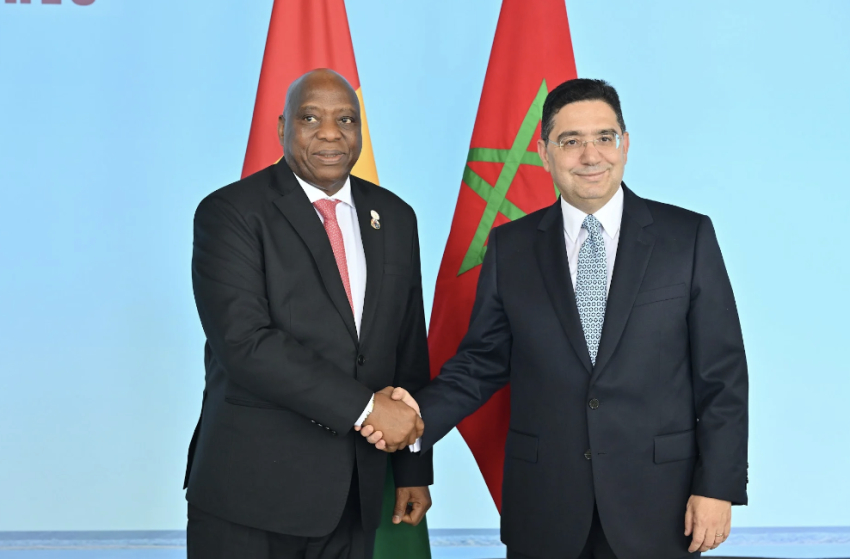
On 8 September, the Guinean Minister of Foreign Affairs reaffirmed Conakry’s support for the Moroccan sovereignty over the Sahara, on the sidelines of the eighth Joint Cooperation Commission with the Sharifian Kingdom. The meeting resulted in the signing of 25 agreements covering, among other areas, the economy, finance, agriculture and higher education. In addition, students of Guinea’s Military Prytaneum completed on 16 September a one-week study trip to China. Led by presidential adviser Diaka Sidibé, the trip allowed them to learn about the process by which Chinese plants transform iron ore from the Simandou deposit.
Conakry steps up diplomatic overtures to serve its economic ambitions
The President of the Republic, for his part, travelled to Côte d’Ivoire from 11 to 13 September on an official visit aimed at strengthening economic relations as well as security and intelligence cooperation between the two States. On this occasion, Alassane Ouattara reaffirmed his support for the “process under way in Guinea”, thereby providing de facto significant regional backing to the country’s authorities. As a sign of this rapprochement between Conakry and Yamoussoukro, Mamadi Doumbouya invited Côte d’Ivoire to take part in the celebrations of Guinea’s national day on 2 October, as guest of honour alongside Rwanda.
These three sequences illustrate the policy of diversifying international partnerships pursued by Conakry. By strengthening its regional anchoring and expanding its cooperation network beyond its immediate neighbourhood, Guinea intends to continue its process of normalisation on the international stage. This return follows its reinstatement in ECOWAS earlier this year, almost five years after the coup that brought Mamadi Doumbouya to power. But this active foreign policy also gives the president an opportunity to mobilise new support for his economic ambitions, starting with the Simandou 2040 programme, to which the ECOWAS Bank for Investment and Development (EBID) recently granted financing of nearly 177 billion CFA francs. On Thursday, a Russian delegation received by the president also expressed its willingness to contribute to this project for the local processing of mineral resources.
The Foreign Minister calls for reform of regional institutions
On 14 September, in Conakry, the Guinean Minister of Foreign Affairs called for an overhaul of the governing bodies of ECOWAS and the African Union, at a ceremony held to celebrate the days of these two organisations. Before the accredited diplomatic corps, Morissanda Kouyaté gave a mixed assessment of the two regional institutions, calling for a “restructuring of their governing bodies” and a “revision of some of their protocols”. This statement is in line with the approach Conakry has adopted since its reinstatement in ECOWAS: challenging how the institutions work without breaking with them, unlike the stance taken by the AES States. The head of Guinean diplomacy also took the opportunity to legitimise Mamadi Doumbouya’s military and then electoral trajectory, placing it within a regional history marked by the army’s recurrent involvement in politics. Morissanda Kouyaté thus pointed out that when ECOWAS was created, several countries were themselves led by the military, and concluded by quoting his president: “it is not the uniform that makes the leader, but the leader who makes the uniform”.
The authorities take a tougher line against independent media
The High Authority for Communication (HAC) stepped up measures this week against media outlets and journalists present in Guinea. On 17 September, France 24 was thus banned from broadcasting in the country after using the term “putschist” president in its news bulletin to refer to Mamadi Doumbouya. The day before, the body had withdrawn the accreditation of the permanent correspondent of Jeune Afrique, accusing him of “serious breaches of ethical and professional obligations”. It had also tightened its control of Web TVs, denouncing the proliferation of these outlets, whose operation requires prior authorisation. The increased oversight of traditional players and digital media is part of a general context of declining press freedom in Guinea. Between 2025 and 2026, the country thus fell from 103rd to 111th place in Reporters Without Borders’ annual ranking.