 © AFP
© AFP
Timbuktu Institute – Week 1 - February 2026
Burkina Faso continues to draw on the legacy of Thomas Sankara, a central figure in the country's political history, to build the nation. On 5 February 2026, the fourth military tribute ceremony was held at the Thomas Sankara Memorial in Ouagadougou, attended by several institutions of the Republic. It was a moment of contemplation and solemnity marked by the changing of the guard, the appearance of the national gendarmerie's horses and a hymn sung by children, including pupils involved in the ‘My brick for Sankara’ citizenship project.
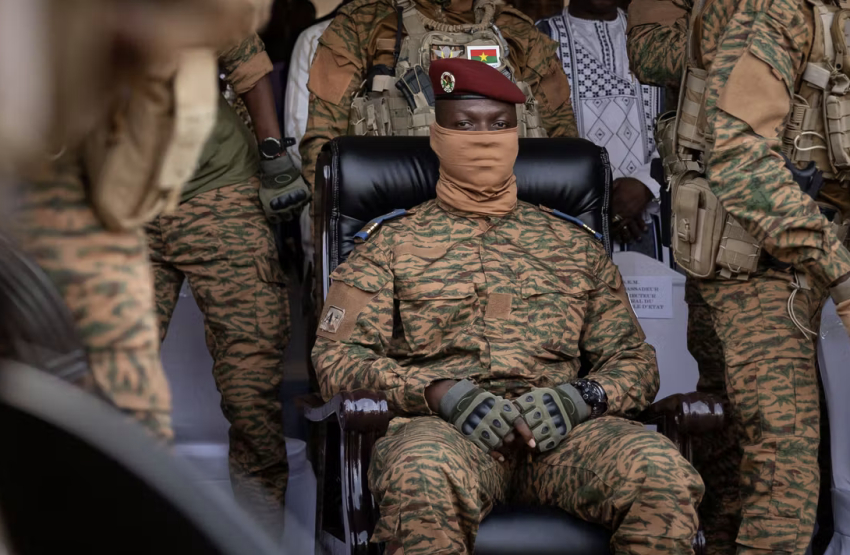
This initiative to mobilise and educate citizens enables every citizen, especially young people, to contribute to passing on the values of integrity and civic engagement championed by Thomas Sankara. This event is of historical, civic and educational importance, combining military symbols, citizen participation and youth involvement to pay tribute to an iconic figure and his ideals. On this occasion, Captain Anderson Medah recalled Sankara's unique place in the national narrative: "Captain Thomas Sankara was and is for the Burkinabe the greatest role model we could have had. " This revolutionary memory is now explicitly linked to the actions of the current government, with the torch of combativeness being carried by Ibrahim Traoré, in power since 2022, who has made the fight against terrorism one of his priorities.
A proactive security discourse in the face of the terrorist threat
On the security front, the government is taking an optimistic stance. Speaking before parliamentarians, Prime Minister Rimtalba Jean-Emmanuel Ouédraogo stated that 74% of the national territory was now under state control. This statement reflects the government's communication strategy on security, which aims to reassure public opinion and parliament and to highlight a gradual restoration of state authority. According to him, notable advances include ‘the exploits of our valiant fighters, which have led to the reopening of 73 prefectures and town halls, more than 600 educational establishments and 38 health facilities, as well as the liberation and resettlement of 442 villages’. Nevertheless, this figure should be debated in light of the continuing insecurity. According to a note published in 2025 by the Swedish think tank African Security Analysis, approximately 60% of Burkina Faso's territory is still outside the effective control of the state, highlighting a significant gap between the authorities' optimistic official discourse and independent assessments of the security situation in the country.
Reduction of civic space and geopolitical restructuring
At the same time, Burkina Faso's political trajectory is causing serious concern with regard to civil liberties. The United Nations High Commissioner for Human Rights, Volker Türk, has publicly called on the Burkinabe authorities to end restrictions on civic space. In his view, ‘instead of banning political parties and imprisoning people for expressing their opinions, the Burkinabe authorities should open up space for civil society, including humanitarian actors, respect freedom of association and expression, and lift bans on political party activities, in line with their international obligations and commitments’.
He thus calls on the authorities in Burkina Faso to abandon a repressive approach to political governance in favour of democratic openness, based on respect for freedom of expression and association, the inclusion of civil society and humanitarian actors, and compliance with international human rights commitments and obligations. As a reminder, the government had announced measures to dissolve political parties and repeal the legal framework governing them. This decision extends a suspension of political parties that dates back to September 2022. In 2025, several national and international NGOs also had their activities suspended, while a restrictive law on freedom of association and a decree requiring NGOs to use only public banks strengthened state control.
Internationally, Burkina Faso is part of a regional dynamic to redefine strategic partnerships. The United States recently expressed its willingness to readjust its policy towards Burkina Faso, Mali and Niger, three countries ruled by military regimes that have broken with France to move closer to Russia. Washington now says it wants to cooperate with these states on common security and economic interests, pragmatically recognising the new geopolitical realities in the Sahel.
Economic recovery and development ambitions for 2030
On the economic front, the Burkinabe authorities have ambitious plans, despite the security and political instability. The 2026-2030 recovery plan, adopted by the Council of Ministers, is the new roadmap for national development. Estimated at 36 trillion CFA francs, it is based on four major pillars: security, social cohesion and peace, state and governance reform, human capital development, infrastructure and economic transformation. Nearly two-thirds of the funding is expected to come from sovereign resources, reflecting a strong desire for strategic autonomy.