Burkina Faso : Between asserting sovereignty and the challenges of stabilisation
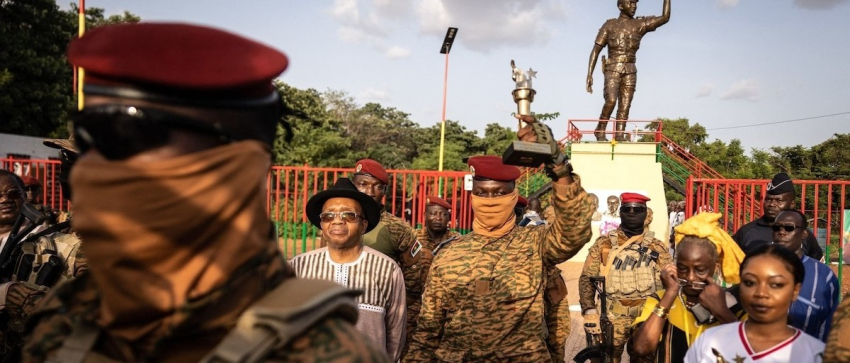 ©️ Agence France Presse
Timbuktu Institute - Week 3 - February 2026
Download the full Sahel weather report
This week, Burkina Faso is facing a complex equation combining persistent insurrection, a major humanitarian crisis and political and judicial tensions. Between Captain Ibrahim Traoré's assertions of sovereignty, the resurgence of attacks in the north of the country and tensions surrounding sensitive legal cases, the country is facing a systemic crisis in which security, governance and social resilience are closely linked. The central issue is the authorities' ability to transform their rhetoric of reconquest and sovereignty into tangible and lasting stabilisation of the territory.
A systemic and multidimensional humanitarian crisis?
Since 2015, the country has been facing a terrorist insurgency that has profoundly transformed its political, security and diplomatic architecture. Under the leadership of Captain Ibrahim Traoré, the country has taken a strong sovereignist stance, focused on territorial reconquest and the reorientation of its international partnerships. However, the humanitarian situation remains alarming. The National Humanitarian Response Plan (PNRH) for 2026 targets 4,474,321 vulnerable people, at a total cost of 769,841,825,700 CFA francs. This plan specifically targets 1,294,232 internally displaced persons and 902,042 returnees, reflecting a profound demographic and social crisis marked by massive population displacement, forced territorial restructuring and the lasting fragility of community structures. The Minister of Family and Solidarity, who is also President of the National Council for Emergency Relief and Rehabilitation (CONASUR), emphasises that sectoral priorities cover ‘food security and nutrition, health, protection, water, hygiene and sanitation, education in emergencies, and shelter’. She emphasises the interdependence of sectors, which implies greater overall effectiveness of humanitarian action. Burkina Faso is thus facing a systemic crisis in which security, governance and social resilience are closely intertwined.
Attack on Titao: persistent insecurity with regional repercussions
Meanwhile, on Saturday 14 February, armed individuals carried out a large-scale attack on the town of Titao, located in the north of the country, about fifty kilometres from Ouahigouya. The military camp, telephone facilities and shops were destroyed and looted. To date, the government has not released an official assessment of the attack, leaving citizens waiting for accurate information. According to statements by Ghana's Minister of the Interior, seven of the traders killed were Ghanaian nationals. This situation highlights the cross-border dimension of the security crisis. The presence of Ghanaian nationals among the victims testifies to the intensity of regional trade dynamics and serves as a reminder that local instability can have diplomatic and economic repercussions. It also highlights the need for enhanced security cooperation between neighbouring states to protect civilians and secure trade corridors in West Africa. This attack also demonstrates the intact operational capacity of armed groups, capable of attacking a strategic urban centre, and the continuing vulnerability of the north of the country, despite efforts to regain control of the territory.
Ouagadougou Court of Appeal: a judicial decision at the heart of political and security tensions
On the legal front, on Tuesday 17 February 2026, the Ouagadougou Court of Appeal handed down its decision on the appeal lodged by lawyer Ina Benjamine Esther Doli in her dispute with the public prosecutor's office. This proceeding follows posts published at the end of August 2025 on her Facebook profile, which the public prosecutor's office of the Ouaga I High Court considers to be criminally liable. In her message, the lawyer criticised the practices of ‘three Sahelian states’ which, according to her, claim to be close to Russia, while adopting behaviours that she considered ‘in total contradiction with the respectability’ of the Russian president. In particular, she referred to certain abuses observed in Burkina Faso.
Ultimately, the lawyer was given a twelve-month suspended prison sentence and a fine of one million CFA francs. She was prosecuted for ‘treason’, ‘insulting the head of state’ and ‘undermining the morale of the armed forces’. The country is plagued by constant tension between asserting its sovereignty and persistent structural weaknesses. The central challenge now is to translate the stated political direction into concrete and lasting stabilisation of the territory.