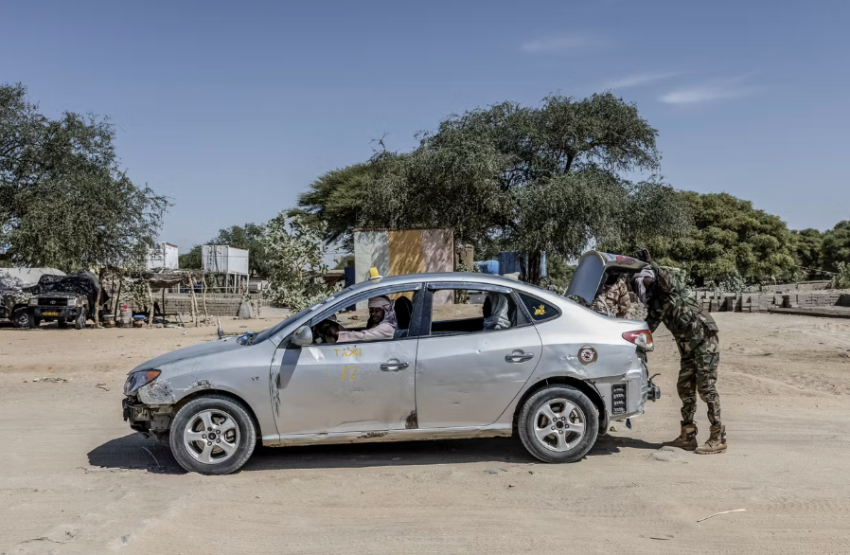
 © JORIS BOLOWEY/AFP
Timbuktu Institute - Week 4 - February 2026
From the outset, Chad has kept a close eye on the Sudanese conflict. Faced with a humanitarian crisis due to the influx of refugees at its eastern border, N'Djamena has strived to contain the repercussions. However, the situation now appears to be deteriorating. On 23 February, Chad announced the closure of its border with Sudan until further notice. According to a statement from the Minister of Communication, this decision was justified by ‘repeated incursions and violations committed by the forces in conflict in Sudan on Chadian territory’. N'Djamena insists that it wants to prevent ‘any risk of the conflict spreading’ and ‘reserves the right to respond to any aggression or violation of the inviolability of its territory and borders.’
A few days earlier, on 21 February, the Sudanese Rapid Support Forces (RSF) announced the capture of Al-Tina, a strategic area in North Darfur on the Chadian border, following the fall of El-Fasher at the end of October 2025, which was followed by massacres, rapes and mass abductions, according to the UN. In addition, last month, seven Chadian soldiers lost their lives in an altercation with RSF paramilitaries. The border closure therefore seems to reflect N'Djamena's exasperation and the exhaustion of a policy of restraint in the face of a conflict whose escalation is worrying the Chadian authorities. This is all the more so given that, on the one hand, there seems to be no solution in sight to this civil war and, on the other hand, its potential centrifugal effects cannot be completely ruled out, considering Chad's role in regional stability.
Border unrest
Clearly, securing Chad's borders appears to be one of the most pressing structural challenges facing Chad today. After its border with Sudan, N'Djamena is now on alert at its border with Libya. During a joint operation carried out on the night of 20 February in a desert area in the far north of the country, the Libyan-Chadian joint force conducted a major security operation. At the end of the operation, a large stockpile of heavy weapons, including surface-to-air missiles and large quantities of ammunition, was seized. In the wake of this, the Chadian and Libyan parties formalised their security cooperation by setting up a joint operations room to coordinate patrols, controls and demining in southern Libya, an area marked by porous borders and the circulation of weapons.
Furthermore, the first fruits of reconciliation between N'Djamena and Paris already seem to be bearing fruit. On 25 February, the French Development Agency (AFD) and the Chadian government signed a €15 million financing agreement to support two key areas: the modernisation of transport infrastructure and the strengthening of the cotton industry. While this financial support is undoubtedly welcome in terms of N'Djamena's goal of developing its macroeconomic growth, it would not be unreasonable to suggest that France's renewed financial commitment is part of a broader strategy that goes beyond development alone, given that France is taking measured steps in its plan for a hypothetical return to the Sahel.