Senegal: Social cohesion tested by a split at the top of the executive branch? Spécial
 © Patrick Meinhardt/AFP
Timbuktu Institute Week 1 - March 2026
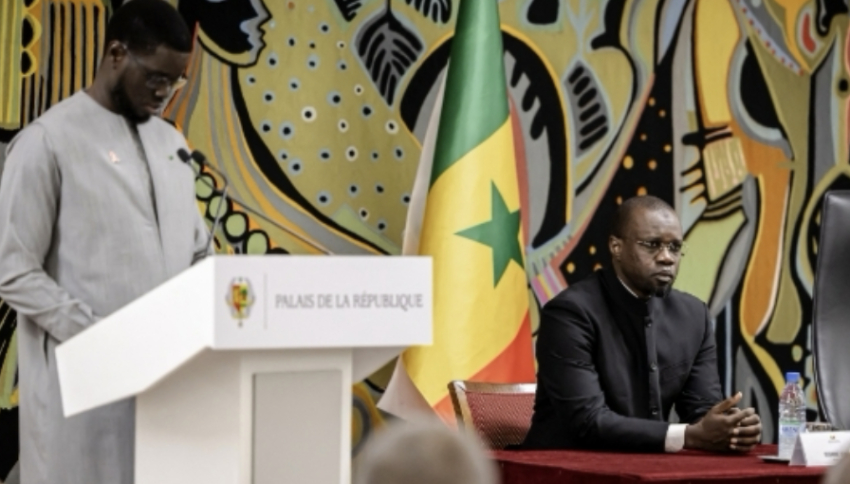
In Senegal, recent developments at the head of the executive branch mark a deep and now open rift between President Bassirou Diomaye Faye and his Prime Minister Ousmane Sonko, once united under the emblematic slogan ‘Diomaye moy Sonko, Sonko moy Diomaye’ that had carried them to victory in 2024. Latent tensions surrounding controversial appointments (such as the replacement of Aïssatou Mbodj by Aminata Touré at the head of the presidential coalition) intensified in early March 2026: on 2 March, Ousmane Sonko publicly considered a possible return to the opposition if Faye deviated from the party's radical line, evoking a ‘more difficult cohabitation’ or a political divorce. The climax came on 7 March, when Faye chaired the founding general assembly of his personal coalition ‘Diomaye Président’, formalising his autonomy from Pastef and calling for a more moderate discourse on issues such as justice, which was perceived as a betrayal by Sonko's supporters. This structuring as an alternative force to Pastef, with calls for a stronger local presence in view of future elections (notably in 2029), marks a complete break in discourse and structures, weakening the ruling majority and exposing the country to increased political instability at the top of the state, while observers already describe this fratricidal duel as inevitable and potentially destructive for post-transition stability. Meanwhile, the direct dialogue initiative, symbolised by the sessions of exchanges with citizens, marks a desire to strengthen the proximity between the top of the state and the population. This interactive communication format aims to explain the reforms underway, gather social concerns, and legitimise government action through grassroots education. This approach is part of a strategy to consolidate public confidence, where transparency in exchanges serves as a bulwark against misinformation and strengthens support for the national transformation project.
Diplomatic influence under debate?
The official candidacy of former President Macky Sall for a high-level position within the UN, supported by regional figures such as Évariste Ndayishimiye, illustrates the vitality of Senegalese diplomacy. This candidacy is a testament to the recognition of the country's expertise in mediation and global governance. Beyond the individual figure, it highlights Senegal's ability to project its leaders into the global multilateral architecture, thereby strengthening the influence of West African diplomacy within the United Nations.
Social cohesion and republican symbolism: the importance of inclusive dialogue
Moments of republican communion, such as gatherings at the Palace around cultural or religious symbols, serve as a framework for the pluralistic expression of Senegalese society. These meetings allow figures from civil and religious society to express their views on the social climate and advocate for better mutual understanding. By offering a platform to those who support the institution, the state seeks to ease discursive tensions and remind people that national stability is based on mutual respect, far from the invective that sometimes saturates the digital public space.
Senegal in the face of global crises: an African voice on the Middle East
In a context of global geopolitical tensions, notably the recent strikes in the Middle East, Senegal and its African peers (Morocco, Chad) are called upon to define clear positions. This situation highlights the country's responsibility in promoting peace and international stability. The reactions observed underscore a common desire to prioritise de-escalation and respect for international law. This position reflects Senegal's ambition to act as a balancing force, seeking to protect the interests of the continent while contributing to global security.