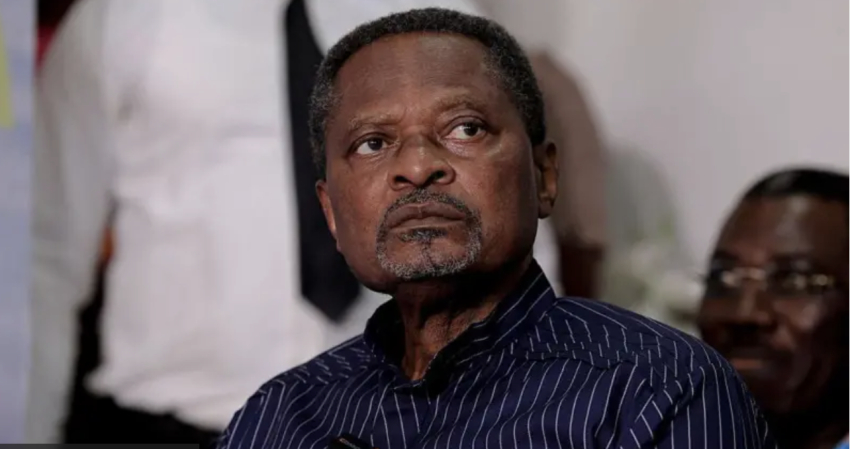
 © AFP VIA GETTY IMAGES
Timbuktu Institute – Week 1 – May 2026
Download the full Sahel weather report
The death of opposition figure Anicet Ekane, who died in the custody of the Cameroonian gendarmerie, caused a great stir in the country. Having died on 1 December 2025 after 38 days in police custody at the height of the protests against Paul Biya’s re-election, he was buried on Saturday 9 May in Bomono, his home village. But beyond the passing of this historic figure of the political opposition, it was the tensions surrounding his funeral – in which his own party, Manidem, refused to participate – that highlighted the divisions within the opposition. Firstly, given the dispute surrounding the organisation of Anicet Ekané’s funeral, his sister Mariane Simone Ekané had released audio recordings, purportedly reflecting the deceased’s wish that the organisation of his funeral should fall to his party, Manidem (African Movement for New Independence and Democracy), alongside his family. Ultimately, the courts ruled in favour of the deceased’s son, Muna Ekane, to the detriment of part of the family, to conduct the funeral.
In the wake of this, Maurice Kamto’s Movement for the Renaissance of Cameroon (MRC) announced that it would not attend the funeral. Despite the controversy, opposition figure Issa Tchiroma Bakary called for participation in the funeral. In response, MANIDEM announced its decision to break the agreement reached with Issa Tchiroma Bakary regarding the October 2025 presidential election. Underlying this imbroglio are suspicions regarding the role of the government, accused by some of doing everything in its power to prevent popular mobilisation around this event, at a time when the authorities had halted tribute ceremonies for the deceased last March. Furthermore, this episode, in which Issa T. Bakary’s move is viewed as a defection by part of the opposition, is indicative of the tensions within the opposition itself. Meanwhile, the institutional restructuring in Cameroon – of which the reinstatement of the post of Vice-President is the most telling sign – appears to be reinforcing the marginalisation of the political opposition.
Death of political figures
In the space of a few months, Paul Biya’s regime has lost several of its iconic pillars. Following the deaths of Marcel Niat Njifenji, President of the Senate, and Ayang Luc, President of the Economic and Social Council, the former President of the National Assembly, Cavaye Yeguié Djibril, passed away on 6 May at the age of 86. A pillar of the Biya system and a loyal representative in the north, his passing comes against a backdrop of quiet realignment at the very top of Cameroonian power. This, moreover, confirms the gradual fading of a generation of political figures who emerged in the 1980s and 1990s.
On the other side of the political spectrum, Yaya Saïdou Maidadi, a leading opposition figure, died on 7 May. Born into a family close to the ruling establishment (his father served as a minister under Ahidjo and Biya), he had chosen the path of opposition activism. After joining the SDF (Social Democratic Front) in 1992 and becoming its first national vice-president, he left the party in 2002 following differences with John Fru Ndi, before founding the Alliance of Progressive Forces and subsequently joining the UNDP, where he served as National Secretary for Communications and as a member of the Political Bureau at the time of his death.