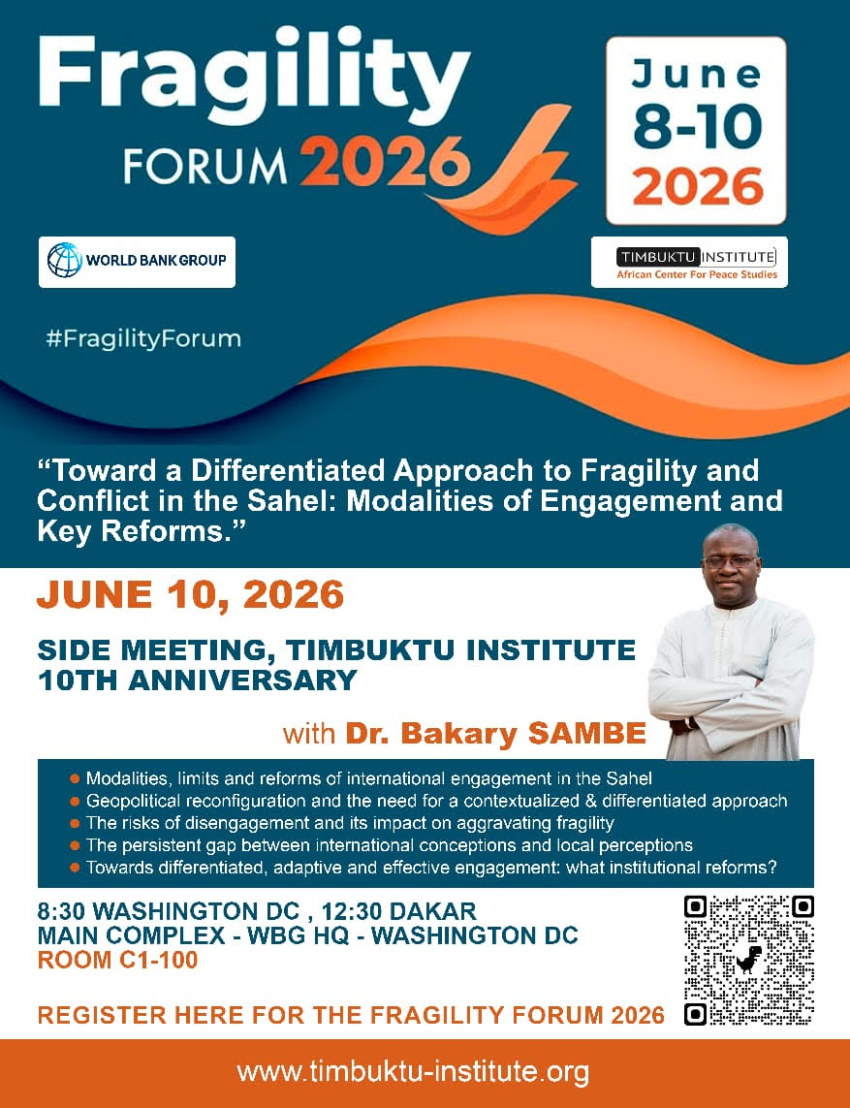
Toward a Differentiated Approach to Fragility and Conflict in the Sahel – West Africa : Modalities of Engagement and Key Reforms Spécial
Timbuktu Institute – June 2026
On the occasion of its 10th anniversary, the Timbuktu Institute is organizing a Side Meeting as part of the Fragility Forum 2026, to be held at the World Bank headquarters in Washington DC. This side meeting interrogates the modalities, limits, and necessary reforms of international engagement in the Sahel and the Gulf of Guinea. As the Sahel undergoes an unprecedented geopolitical reconfiguration, this session challenges the persistent tendency to apply undifferentiated tools and conditionalities to deeply dissimilar political and security contexts. It makes a resolute case for sustained engagement by international partners despite the deterioration of certain politico-security environments, arguing that any eventual disengagement would risk worsening the political and security situation, accelerating fragility, and ceding ground to destabilizing actors and transnational threats. Central to the discussions is the debate over the gap between international conceptions of fragility and local perceptions — a disconnect that continues to undermine the impact of even the best-resourced interventions. The session concludes with a forward-looking examination of the key institutional reforms required to make international engagement genuinely differentiated, adaptive, and impactful.
Main session themes
- Modalities, limits, and reforms of international engagement in the Sahel
- Geopolitical reconfiguration and the need for a contextualised and differentiated approach
- Risks associated with international disengagement and its impact on aggravating fragility
- The persistent gap between international strategic conceptions and local perceptions
- Institutional reforms for differentiated, adaptive, and effective engagement
Central positioning
The session seeks to document the inadequacy of standardised approaches that apply uniform tools and conditionalities to deeply different political and security realities across the Sahel. It argues that governments in the region face a wide array of challenges, legitimacy questions, and highly diverse local dynamics, and that only a genuinely contextualised and differentiated approach — one that grants strategies and initiatives the dignity of tailored solutions — will enable regional and international partners to rise to the challenges of the current moment.