Mali : chronic insecurity, between internal failings and power rivalries Spécial
 © FLORENT VERGNES / AFP
Timbuktu Institute Week 1 – June 2026
Download the full Sahel weather report
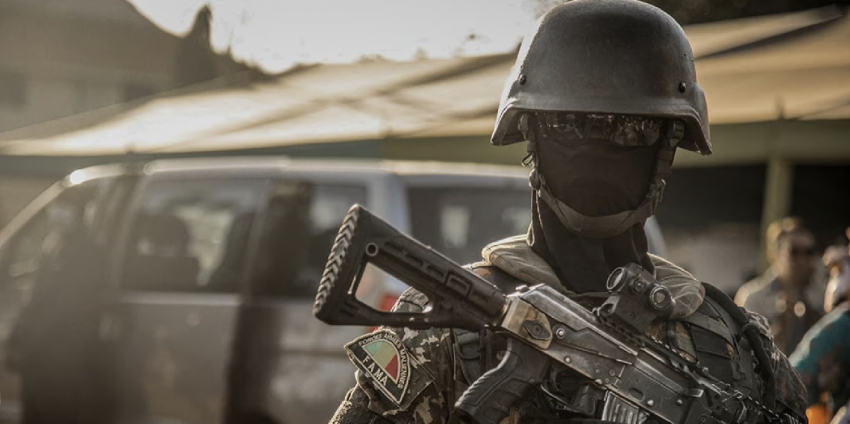
Since the coordinated attacks last April in several towns across the country, one thing has become clear: the persistence of assaults by armed groups. For many years now, the country has been embroiled in an increasingly intensifying war on terrorism . Since the 2012 coup, clashes were mainly concentrated in the north, but in recent years the conflict has become increasingly felt across the country, despite the support of foreign armed forces. Following the withdrawal of French troops, instability has worsened as the number of attackers has grown. To address this situation, collaboration with Russia has intensified with the arrival of the Africa Corps to replace Wagner. It established itself in the region following the successive coups d’état in Burkina Faso and Niger, carving out a place for itself within this already highly unstable region. With the arrival of these new forces, expectations were higher due to their reputation, but the reality on the ground quickly revealed the limitations of this military strategy. In truth, the Africa Corps’ intervention appears to serve more to consolidate the ruling power than to secure the territory. Research shows that the brutal methods employed by these forces, frequently targeting civilian populations, fuel a vicious circle by facilitating the recruitment of armed groups that exploit the distress of local residents. Rather than a solution, the presence of these external forces is turning the Sahel into a theatre of geopolitical rivalries, keeping the region in a state of militarisation and chronic instability, with civilians remaining the primary victims.
Security cooperation: Mali and Burkina Faso join forces
Mali and Burkina Faso have chosen to join forces to combat armed groups that move from one country to the other. By sharing intelligence and conducting joint operations along the borders, the two armies hope to be more effective. This alliance also allows the governments to demonstrate that they can manage security on their own, without the help of Western countries. It is a way of showcasing their independence and reassuring the population. On the ground, however, the situation remains difficult. Both countries lack equipment, particularly aircraft to monitor the vast desert areas. Furthermore, getting two armies to work together requires flawless coordination, which appears difficult to achieve. For this partnership to succeed, it will not be enough to simply sign agreements; the soldiers will need to achieve concrete results to secure the tri-border area in the long term. The population has high hopes for this cooperation, as the closure of borders and insecurity are stifling the economy and trade. If the two governments succeed in restoring calm to the affected areas, they will prove that their alliance is a sustainable solution for the Sahel. If not, public disappointment could undermine the support they currently enjoy.
The port of Conakry, a new strategic corridor for Malian military equipment
The port of Conakry, in Guinea, has become a key transit point for the transport of military equipment destined for Mali. Due to sanctions and diplomatic deadlocks with other neighbouring countries, Bamako has had to find new routes to allow the entry of new equipment purchased from its partners, notably Russia. Guinea, which shares a long border with Mali and maintains good relations with the authorities, emerged as the simplest and safest solution. These shipments of heavy equipment are unloaded at the port before being transported by lorry to the Malian- . For Bamako, securing this corridor is vital to continue equipping its army and maintaining its operations on the ground. It also shows that despite the country’s isolation on the international stage, solutions exist thanks to the solidarity of neighbours such as Guinea. However, this situation is attracting the attention of foreign intelligence services and international observers, who are closely monitoring the nature of the deliveries and movements in the region. For Guinea, accepting this role as a “bridge” carries diplomatic risks, but it strengthens its position as a key partner for the landlocked states of the Sahel. The long-term viability of this route will depend on political stability in Conakry and the ability of both countries to secure the road link to Bamako against attacks.
Between military operations in Koulikoro, a road tragedy on the Kita-Bamako route and supply operations under strain
In the Koulikoro region, the Malian armed forces have carried out operations that have resulted in the neutralisation of more than 60 terrorists. This offensive signals a clear determination to destroy the strongholds of armed groups near towns. By striking these bases, the army aims to reduce the armed groups’ capacity to cause harm and to restore confidence among local populations. These actions demonstrate that military pressure remains constant in the strategic areas surrounding the capital, even though the complete eradication of the threat requires long-term stabilisation efforts. Despite these efforts, the vulnerability of transport routes remains a daily challenge for civilians, as evidenced by the tragic explosion of a passenger coach on the road between Kita and Bamako, which killed five people and left dozens injured. This fatal incident serves as a reminder of the constant danger facing the movement of people and goods across the country. For the authorities, securing the national roads is proving just as crucial as frontline fighting, as the sense of insecurity on major roads is paralysing the economy and directly undermining public support for the transition. Meanwhile, economic pressure continues to mount due to the blockade of the capital. To break this isolation and alleviate the energy crisis, a strategic convoy of 765 fuel tankers has successfully reached Bamako under heavy military escort.
Anti-terrorist strategy: ban on motorbikes
In an attempt to curb the mobility of armed groups, the Malian authorities have taken a radical step by banning motorbikes from roads outside major cities. In many parts of the country, motorbikes have become the preferred means of transport for armed groups to carry out surprise attacks and retreat quickly to areas that are difficult to access. By restricting their use on secondary and rural roads, the government aims to deprive terrorist networks of their main means of transport and to facilitate the armed forces’ control of the territory. However, this strict ban is having a severe impact on the daily lives and economy of rural communities. In local communities, the motorbike is often the only way to transport crops to markets, access health centres or maintain links between isolated villages. Residents thus find themselves penalised by a measure that complicates their daily lives and limits their income-generating activities. The challenge for the state will be to successfully maintain this necessary security restriction without alienating local populations, who are already suffering the economic consequences of the conflict.
The government’s military strategy in the face of criticism
The debate over the situation in Mali is intensifying. Some observers and stakeholders in the region believe that the current government’s exclusively military approach is showing its limitations. In their view, the authorities’ responsibility for the current difficulties can no longer be concealed, particularly due to the lack of dialogue and the country’s international isolation. Critics argue that a solution based solely on force, without a return to civilian rule, will not be able to bring lasting peace to the country. For their part, government supporters reject these accusations. For the current government, the current insecurity stems mainly from the mistakes of former leaders and the failure of international armed forces. The authorities refuse to negotiate with armed groups in order to protect the country’s sovereignty. For the government, the main objective remains to keep the population united behind its army. This is a significant challenge, as this war is taking an ever-greater toll on the daily lives and economy of Malians.
The hunt for JNIM leaders at the heart of a propaganda war
The fight against jihadist leaders in Mali has sparked an intense information war between the army and the armed groups. Reports recently claimed that JNIM’s second-in-command had been killed in a targeted airstrike in the centre of the country. However, the organisation quickly issued an official denial, asserting that its leader was still alive. This situation highlights the difficulty of verifying actual casualties on the ground in conflict zones. For JNIM, denying the loss of its senior figures is essential to prevent its fighters from becoming demoralised. For the government, these announcements of successful strikes serve to highlight the army’s effectiveness and reassure a population severely affected by insecurity. At the same time, the authorities have decided to step up the manhunt by offering a bounty for the capture of Iyad Ag Ghalyand other terrorist leaders. The main leader of JNIM, considered the most wanted man in the Sahel, is now directly targeted by a statement promising a substantial financial reward for information leading to his arrest. This raises the question of whether, through this measure, the Malian government hopes to provoke internal divisions within the group or encourage the public to share any information they possess. In any case, this strategy appears aimed at disrupting the command structure of a terrorist group that continues to harass the Malian Armed Forces (FAMa) and block major roads. By targeting so visibly the historic figurehead of the rebellion and jihadism in the Sahel, the government is demonstrating its determination to reject any dialogue and resolve the crisis solely by force.