Sahel and Gulf of Guinea : The Timbuktu Institute Calls for a Differentiated and Adaptive International Commitment at the 2026 Fragility Forum Spécial
 © Timbuktu Institute
Washington, D.C., June 2026
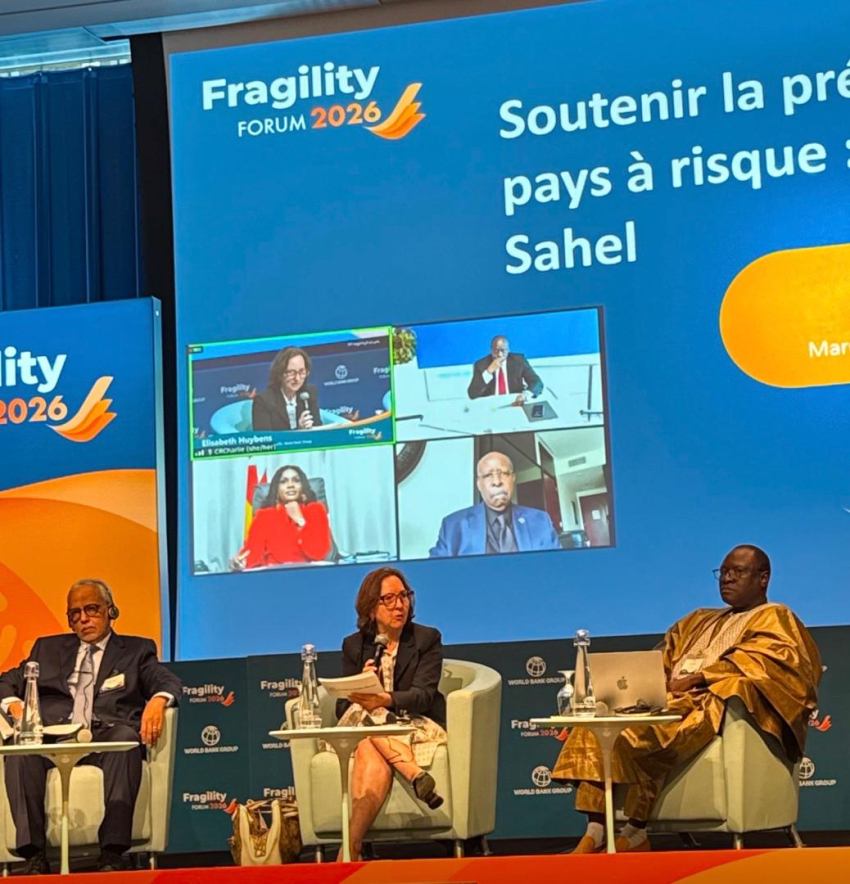
To mark its tenth anniversary, the Timbuktu Institute organized a side event as part of the Fragility Forum 2026 at the World Bank headquarters in Washington, D.C. The session, which is part of the most current international debates on fragility and conflict prevention, brought together policymakers, researchers, and practitioners to address a central question: to what extent do the tools and conditions of international engagement remain suited to the complexity of fragility and the realities of the Sahel and West Africa?
A decade of crises, a generation of lessons learned
The Timbuktu Institute’s intellectual contribution to the Fragility Forum centered on a fundamental observation: the fragilities now erupting in the Sahel and beginning to manifest in the coastal countries of the Gulf of Guinea are not sudden phenomena. They are the product of a structural lag spanning several decades. There is the legacy of economic policies from the 1970s and 1980s that systematically reduced states’ capacity to provide public services, uphold the social contract, and invest in human development. Persistent rural poverty, mass exoduses, uncontrolled urbanization, the collapse of educational and health services, and insufficient economic integration of border areas: these are all conditions that armed groups and jihadist networks have learned to exploit with formidable efficiency, filling the void left by weakened states.
This long-term historical analysis leads the Timbuktu Institute to issue a warning to international partners: treating the symptoms without addressing the structural issues that generate them dooms any intervention to failure, regardless of the resources mobilized. For the countries of the Gulf of Guinea, which now find themselves on the brink of this turmoil, the lesson from the Sahel is of the utmost urgency: the window of opportunity for prevention always closes very quickly.
The trap of militarization and the sidelining of development in favor of security
One of the most decisive positions taken during the session concerned the assessment of the security paradigm that has dominated international responses in the Sahel since 2012. Despite considerable funding allocated to military operations and national security forces, security indicators have deteriorated as military budgets have increased. Meanwhile, spending on education, health, agriculture, and justice stagnated or was drastically reduced. In several Sahelian countries, defense absorbed more than 20% of the national budget, while basic education received less than 5%.
During these discussions, the Timbuktu Institute highlighted a paradox that too few international actors dare to address: an armed soldier deployed to a village in northern Benin or northern Togo—without a school, without a health clinic, without access to justice—does not produce lasting security; he may even undermine its legitimacy. For security to be sustainable, it must be based on a benevolent state presence, not merely an armed one. Alongside the state—often perceived as too “repressive” to be approachable—the “protective” state must deliver the services needed by the people. This means defending, in the face of pressure from security donors and geopolitical agendas, the balance between the security response and continued investment in human development.
A gap in perceptions that undermines the best intentions
At the heart of the analyses presented by the Timbuktu Institute lies a diagnosis the Institute has long formulated: the real problem in the Sahel is not just the conflict itself, but a conflict of perceptions regarding that conflict. Imported conceptual frameworks act as analytical lenses that obscure profoundly different local dynamics: land disputes, marginalization, targeted ostracism, a sense of injustice, governance failures, and the exploitation of community grievances. This disconnect between donors’ assessments and the realities experienced by communities has, at times, led to poorly targeted interventions, perceived locally as foreign or even hostile, and has fueled rejection of international actors in certain countries.
This disconnect is precisely the breeding ground on which recruitment into armed groups thrives: where the state is absent and international aid is perceived as illegitimate, armed groups know how to present themselves as “credible” alternatives. For coastal countries still in the prevention phase, the urgent need is to build and support endogenous systems for understanding conflicts through local research, community observatories, and traditional mediators before this window closes for good.
The strategic error of zoning: denying sociocultural continuums
The session also challenged one of the most entrenched conventions of the international framework: the analytical construction of the “Central Sahel” (Mali, Burkina Faso, Niger) as a priority intervention zone, artificially delineated and ignoring the region’s anthropological and sociocultural realities. The pastoral networks of Liptako-Gourma do not stop at the borders inherited from colonization. Trade routes, the recruitment dynamics of armed groups, and clan- and religious-based solidarity transcend these administrative boundaries.
By isolating the Central Sahel from the rest of West Africa, the international community has contented itself with addressing the problem where it was most visible, while allowing the conditions for its expansion toward the Gulf of Guinea to take root.
The insecurity now evident in northern Ghana, Benin, Togo, and Côte d’Ivoire is not a “contagion” from the Sahel: it is the same dynamic that has always existed across these regions, and which simply had not yet been fully recognized. An integrated regional approach, taking into account pastoral, ethnic, religious, and commercial continuums, is a prerequisite for any truly effective strategy with impactful results.
Above all, do not disengage: a political imperative in the face of geopolitical reconfigurations
In a context of unprecedented geopolitical reconfiguration—marked by the withdrawal of international forces, strategic repositioning, and the rise of new actors—the temptation to disengage is real for many international partners.
The Timbuktu Institute took a fairly clear-cut stance on this issue at the Fragility Forum: withdrawing, reducing funding, or rigidly conditioning engagement on governance criteria disconnected from local dynamics risks exacerbating precisely the fragilities that these partners should be seeking to further reduce. International disengagement creates vacuums that other actors—whose agendas are often less aligned with the interests of local populations—will rush to fill.
For Dr. Bakary Sambe, “this does not mean blind or unconditional engagement. It means sustained, differentiated, and adaptive engagement capable of maintaining a presence and influence without being held hostage to uniform conditions that do not correspond to any reality on the ground.” ”
Three Priorities for a Renewed International Engagement
In light of this assessment, the Timbuktu Institute formulated three operational priorities for international development organizations during the session.
The first is the establishment of decentralized early warning and anticipation systems capable of detecting weak signals even before crises erupt. This involves shifting from a reactive to a proactive stance, supporting permanent monitoring capacities that integrate both structural causes and triggering factors, and establishing a differentiated classification of contexts to better guide engagement decisions and improve anticipation.
The second priority is the adoption of differentiated and localized approaches, rejecting simplistic zoning in favor of interventions tailored to the actual profile of each context. In areas of severe security deterioration, humanitarian programs must be coupled with measures promoting, for example, employment and support for the local entrepreneurial sector, even if it is predominantly informal. In areas of moderate risk, targeted territorial interventions that include conditions of transparency and inclusion are more appropriate. For areas of intense conflict, the specific management of refugees and internally displaced persons requires dedicated tools.
The third priority is strengthening local ownership and regional synergies. The structural gap between international strategic perceptions and those of local communities is one of the primary causes of the failure of top-down interventions. Organizations must systematically promote inclusion and local ownership in program design and monitoring, while developing regional and transnational synergies because the dynamics of insecurity in the Sahel transcend state borders.
Toward a “light rain” paradigm in the face of emergency “storms”
To conclude the discussions, the Timbuktu Institute proposed an image that summarizes its position: the contrast between thunder that strikes and commands all attention, and the light rain that nourishes. The international trend over the past decade has been to respond to crises with the thunder of massive, visible, militarized interventions, often disconnected from local realities. What researchers and practitioners at the Timbuktu Institute advocate is patient and sustained investment in the “light rain” of community building, a benevolent state presence, inter-community dialogue, structural prevention, and the daily strengthening of resilience
This paradigm requires profound institutional reforms within international organizations themselves: more agile procedures, more flexible funding mechanisms, and success indicators rooted in local perceptions rather than in reporting requirements to headquarters. The Timbuktu Institute, drawing on ten years of observation, analysis, and advocacy from the field in the Sahel and West Africa, intends to continue bringing this imperative to the forefront of international debate.
Building on the discussions shared at the Fragility Forum, the Institute will publish a series of policy briefs that will facilitate organized debates with experts and practitioners to support national and international strategies while ensuring they are connected to local actors and endogenous realities—factors whose consideration is essential to ensuring acceptability, effectiveness, and success.