Disengaging from the Sahel would be a major strategic mistake on the part of the international partners. (Dr. Bakary Sambe) Spécial
 © Timbuktu Institute
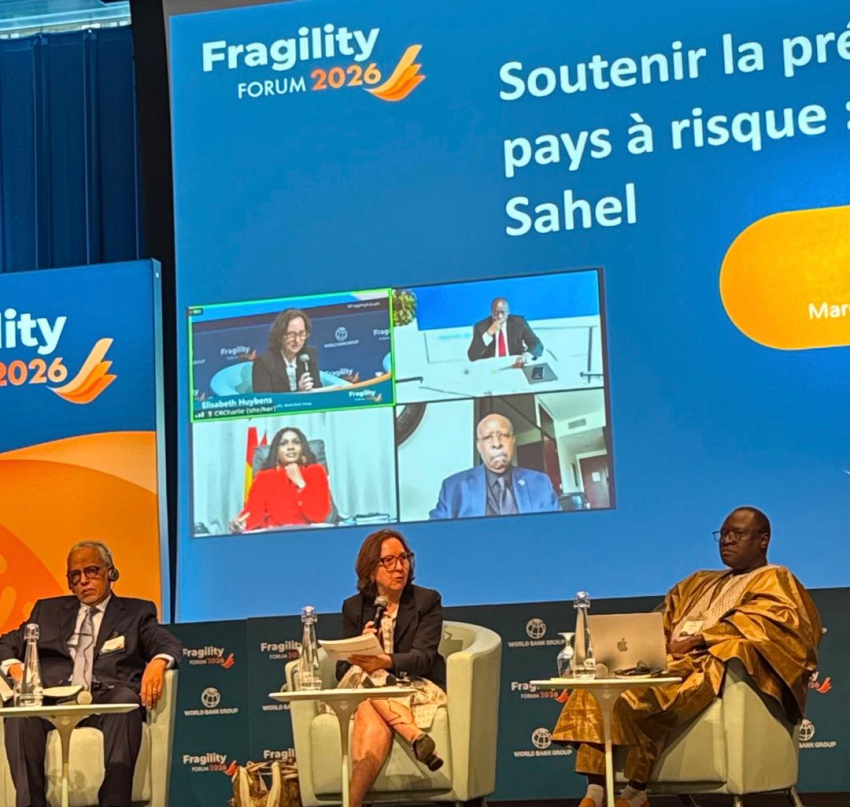
At the 2026 Fragility Forum held at the World Bank headquarters in Washington, D.C., the Timbuktu Institute, by organizing a side event, celebrated its tenth anniversary by posing a question: what if the international community’s actions reflect a lack of understanding of the Sahelian problem? Its president, Dr. Bakary Sambe, a renowned researcher and analyst on the dynamics of fragility, conflict, and violence in West Africa, participated in a High-Level Panel alongside the World Bank Vice President for West and Central Africa, the Mauritanian Minister of Economy, the Secretary General of the Presidency of the Council of Togo, and the Special Representative of the United Nations Secretary-General for the Sahel and West Africa, presented the Institute’s theses and positions, informed by a decade of fieldwork and engagement with Sahelian communities.
In this interview with Dakaractu on the sidelines of the forum, he speaks candidly about the lessons of successive crises, the strategic errors of governments and their international partners, the trap of an all-security approach, and the only way out he sees: an international engagement that is finally differentiated, adaptive, co-constructed, and attuned to local realities.
Dakaractu: Dr. Sambe, your think tank is celebrating its tenth anniversary this year, and you have chosen to mark the occasion by organizing a Side Meeting at the World Bank’s Fragility Forum. Why this moment, why this venue?
Dr. Bakary Sambe: Ten years of observing the Sahelian terrain, of interventions and advocacy, give us a long-term perspective to speak frankly but with great humility. The Fragility Forum is where decision-makers, donors, and researchers come together—those who fund and support policies and those who analyze them, among others. We felt that now was the time to raise a few questions in this forum that may seem uncomfortable. The first is that the fragilities we observe in the Sahel—and which are beginning to spread to the Gulf of Guinea—are not sudden crises. They are the result of a structural imbalance spanning several decades—the legacy of economic policies that have systematically stripped states of their ability to provide public services, uphold the social contract, and invest in their populations. One cannot understand Sahelian jihadism without understanding the 1980s.
Dakaractu: You speak of a “legacy of the 1980s.” That is a very different interpretation from the one prevailing in Western capitals…
Dr. Bakary Sambe: Exactly, and that is precisely the problem. The dominant trend since 2012 has been to treat the Sahel as merely a security issue. Military interventions have been prioritized with operations that have cost billions, and at the same time, budgets for education, health, and justice have been allowed to melt away like snow in the sun despite efforts around the Security-Development nexus. There are figures that should give us pause: in several Sahelian countries, defense and security have absorbed more than 20% of the national budget, while basic education received less than 5%. And the result? Security indicators have deteriorated as military spending has increased. Few actors acknowledge this paradox. We highlighted this in Washington, where the Fragility Forum provided a space for free, open, and constructive debate following the launch of the new FCV strategy—Fragility, Conflict, and Violence—which, it must be acknowledged, was the result of an inclusive process and to which I was invited as part of the Sahel Advisory Panel, of which I was a member alongside experts and figures from the region or those committed to its development for years.
Dakaractu: But during the Forum, you’ll say that a soldier deployed to a border area with no school or health clinic can erode the state’s legitimacy. That’s a statement likely to provoke a reaction…
Dr. Bakary Sambe: It’s a reality on the ground expressed frankly, not a provocation. Imagine a border village where young people have no accessible school, no clinic, no justice system. And then a well-armed soldier arrives. What does he represent to these people? He represents the state as a coercive power, without the counterpart of the protective state. Sustainable security is not a matter of an armed presence; it is a matter of legitimacy. And legitimacy is built through services, through justice, through listening. Alongside the repressive state, there must be a benevolent state that delivers. This is a message we have emphasized repeatedly during this session. The Sahel is not burning because of a lack of soldiers; but because of a lack of states that provide services.
Dakaractu: In your analyses, you mention a “conflict of perceptions regarding the conflict.” What do you mean by that?
Dr. Bakary Sambe: This is, perhaps, one of the most important insights we have developed over the past ten years. When a donor or international partner speaks of “terrorism” or “violent extremism” from their home country, they use categories that may be useful for their government agencies, their parliaments, and their public opinion. But on the ground, these words do not always correspond to what communities are experiencing and, above all, perceiving. They are grappling with land disputes that have remained unresolved for generations, ethnic marginalization, ostracism toward certain communities, and a deep sense of injustice exacerbated by chronic governance failures. This disconnect between partners’ assessments and the reality on the ground risks leading to misdirected interventions, which are sometimes perceived as foreign or even hostile. And when people reject international cooperation, this vacuum is exactly what armed groups know how to fill. They present themselves as credible alternatives where the state is absent and international intervention is perceived as illegitimate.
Dakaractu: The issue of “contagion” from the Sahel to coastal countries is very much present in the debate. Do you reject this term?
Dr. Bakary Sambe: Yes, and this is a fundamental analytical distinction. To speak of “spillover” is to suggest that insecurity originates from a focal point—the Central Sahel—and spreads like an epidemic, creeping into new territories. This image is misleading. The pastoral networks of Liptako-Gourma, the history of latent conflicts, the cross-border trade routes between Niger and Benin, and the community and religious bonds along the borders of Burkina Faso and Togo: none of these have ever respected the borders inherited from colonialism. What we are observing in northern Ghana, Benin, Togo, and Côte d’Ivoire is the same dynamic that has always traversed these regions and that simply had not yet been fully appreciated. The international community and its governmental partners in the region made the mistake of framing the concept of a “Central Sahel” as a priority intervention zone, thereby artificially isolating Burkina, Mali, and Niger from the rest of West Africa. We addressed the problem where it was visible, while allowing the conditions for its worsening to take root in the Gulf of Guinea countries.
Dakaractu: Some Western donors or governments are tempted, in the current context, to scale back their engagement in the region. What is your position?
Dr. Bakary Sambe: Our position is clear, and we have defended it unequivocally in Washington: disengaging would be a major strategic mistake. Withdrawal is not an option. When international partners withdraw or excessively condition their engagement on governance criteria disconnected from local realities, they do not reduce fragility; they transfer it to other actors, whose agendas are often less aligned with the interests of the people. This withdrawal creates vacuums, and vacuums get filled. That said—and this is essential—I am not advocating for blind or unconditional engagement. I am advocating for sustained, differentiated, and adaptive engagement capable of maintaining a real presence and influence without being held hostage to uniform conditions that do not work on the ground. However, this will necessarily require both a more agile approach from partners and a minimum of guarantees provided by our governments. It is true that in Europe, the effects of the war in Ukraine risk diverting attention from the Sahel, just as the resurgence of conflicts in the Middle East pushes the Sahel far from international priorities.
Dakaractu: In concrete terms, what does this mean? What are, for example, your three priorities for a renewed international engagement?
Dr. Bakary Sambe: First, we need to build real early warning systems for better anticipation. Not just dashboards produced in Brussels or Washington, but decentralized capabilities, rooted in the local areas, capable of picking up on early warning signs before crises erupt and escalate. The shift from a reactive to a proactive stance seems crucial to me. Second, approaches would benefit from being differentiated and tailored to specific regions. What works in Bamako doesn’t necessarily work in Cotonou, and even what works in Cotonou doesn’t automatically work in northern Benin. We need to move away from simplistic zoning and tailor interventions to the actual profile of each context. Third, and this is perhaps the most difficult to implement, in my view, we really need to strengthen local ownership for greater sustainable impact. The gap between international strategic perceptions and those of local communities is one of the primary causes of failure, rejection, and inefficiency. Programs must be designed with local partners and communities, not for them or in their place.
Dakaractu: You used an image during the forum: “thunder and drizzle.” Can you explain it to our readers?
Dr. Bakary Sambe: It’s an image that sums up our position well. For the past ten years, the international trend has been to respond to crises by following the sound of thunder: massive, visible, militarized, spectacular interventions. Thunder makes noise during storms; it attracts attention and reassures public opinion in donor countries. But it neither nourishes nor fosters growth. What nourishes, fosters growth, and allows the future to flourish is the light rain—the patient and continuous investment in strengthening community cohesion, in the benevolent presence of the state, in inter-community dialogue, and in structural prevention. Light rain is not spectacular. It does not make the headlines. But it is what sows the seeds for lasting peace. We have also advocated for international organizations to reform their procedures, their funding mechanisms, and their success indicators, so that they can finally invest in this gentle rain and pay equal attention—as the saying goes—to the crack of a falling tree and to the silent forest that grows: it is there that sustainable resilience in the face of multidimensional fragilities is consolidated daily and patiently.
Dakaractu: A final word on the future: what are your plans following this advocacy at the Fragility Forum?
Dr. Bakary Sambe: The reflection will continue, as will the advocacy and support for efforts to address fragilities and mitigate the risks of conflict. In the coming weeks, the Timbuktu Institute will publish a series of policy briefs delving into each of the dimensions discussed in Washington and at recent forums such as the one in Brussels and, coming up at the end of July, the Emerging Markets Forum in Abuja. These publications will provide an opportunity to organize discussions with experts and practitioners, to support national and international strategies while connecting them to local actors and endogenous realities. This is precisely where the difference lies between a strategy that remains on paper and one that aims to bring about change: taking local realities into account is not merely a methodological choice; it is a guarantee of effectiveness and legitimacy. After ten years of advocacy and generating knowledge to inform decision-making, we continue to carry this message forward with, I hope, a little more perseverance. If, by the end of this process, we succeed in convincing as many people as possible that we must give greater weight to endogenous strategies as viable solutions, we will have succeeded in sowing the seed. Others, even without us, will be able to help it sprout and grow. That is the minimum role of a think tank: to use ideas to move those who are, perhaps, stronger or more legitimate than we are.
Interview conducted by Cheikh Sadibou Fall
Source: Dakaractu