Senegal : Between the Balance of Power and the Tangled Web of Debt Spécial
 © AFP - SEYLLOU
Timbuktu Institute Week 3 - June 2026
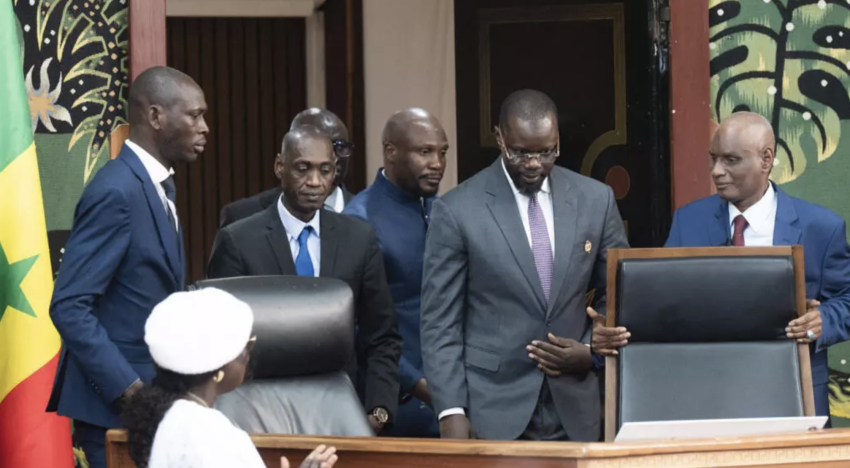
Although the specter of former Prime Minister Ousmane Sonko’s dismissal had become increasingly apparent over time, his ouster nonetheless caused quite a stir on the Senegalese political scene. In what was a moment of political uncertainty if ever there was one, various parties felt compelled to reaffirm their loyalty or allegiance to either Ousmane Sonko or President Diomaye Faye, depending on their political stance. It was undoubtedly for this reason that, upon assuming the presidency of the National Assembly, O. Sonko opted for a conciliatory approach, insisting that “there is no institutional crisis” in Senegal. Thus, in an interview with France 24 and Radio France International (RFI), the new head of the legislature, in the same vein, presented himself as a man of moderation. While acknowledging the existence of “political and programmatic differences,” Ousmane Sonjo assured that “there will be no rift,” maintaining that “Senegal is greater than political differences.” At the helm of an Assembly largely dominated by Pastef, Sonko affirms his intention to work in a spirit of cooperation with the executive branch and promises not to resort to censorship for political reasons.
Regarding the electoral calendar, he opposed any postponement of the local elections scheduled for 2027, stating that “there is no valid reason for them to be postponed” and that “the elections must be held on schedule.” On the economic front, he advocated for solutions in line with “Senegal’s best interests” and raised the need to discuss a possible partial debt cancellation. Finally, on the issue of homosexuality, he defended the tightening of Senegalese legislation, asserting that “there is no witch hunt against homosexuals” and reaffirming that Senegal is “a sovereign country” that enacts laws in accordance with its values and societal choices.
Thus, it is clear that Ousmane Sonko intends to demonstrate both restraint and pragmatism. Indeed, despite his promise not to use the National Assembly as a tool for institutional obstruction, it remains unlikely that he will entirely forgo such a significant lever of influence in the power struggle that now pits Pastef against the presidential coalition. This is all the more true given that on June 18, the Senegalese Constitutional Council declared itself without jurisdiction to review the appeal filed by the opposition against Ousmane Sonko’s reinstatement to the National Assembly, citing a violation of the rules of procedure and an “institutional coup.” Even though there was little chance, in reality, that this proceeding would succeed, this episode reinforced the former prime minister’s status as the country’s second-in-command.
Debt: Heading Toward an Upcoming Restructuring?
After more than two years in office, the debt issue remains one of the deadlocks in governance under President Diomaye Faye, who is more in favor of debt restructuring than Ousmane Sonko. On the operational front, negotiations are ongoing between the IMF and Senegal regarding the future of this debt, which brought the country’s debt-to-GDP ratio to approximately 132% at the end of last year. In its statement released following its mission to Dakar from June 15 to 19, the IMF warns of “high risks” weighing on the country’s short-term economic outlook and calls for continued efforts to reduce debt-related vulnerabilities. The institution emphasizes that, despite an improvement in the budget deficit—which fell from 13.4% of GDP in 2024 to 6.4% in 2025— “fiscal and debt vulnerabilities remain high,” against a backdrop marked by the revelation of an underestimated debt and the suspension of the $1.8 billion aid program. The Fund nevertheless acknowledges that “the Senegalese economy has shown resilience,” with growth of 6.7% in 2025, driven by hydrocarbons. But it warns that the outlook remains fragile due to rising oil prices and their impact on public finances.
While commending “the authorities’ ongoing commitment,” the IMF reaffirms its readiness to support Senegal in reforms aimed at strengthening governance and debt management. For Dakar, the challenge remains—beyond any potential direct financial support—to reach an agreement with the IMF that would restore investor confidence, reduce the cost of debt, and secure access to other sources of international financing. The sensitive issue of debt restructuring remains. Faced with a debt burden deemed difficult to sustain, several observers believe that rescheduling or reprofiling could gradually emerge as a compromise to break the deadlock without formally resorting to restructuring. In this context, the recent appointment of Babacar Touré, former CEO of Afrika Banque Sénégal, to head the new General Directorate of Finance and Debt shows that Dakar is willing to pull out all the stops to get back on track by strengthening the transparency and credibility of its financial governance.
Nearly a metric ton of cocaine seized in the east
Eastern Senegal, long viewed as a secondary transit zone, continues to emerge as a key corridor for drug trafficking, thanks to its border location and the porous nature of the road networks connecting the country to Mali and Guinea. On June 15, the Koumpentoum Mobile Customs Brigade seized 970.6 kg of cocaine on the Koumpentoum-Koungheul route, near Ida Mouride. The drugs, divided into 844 packets and estimated to be worth more than 58.2 billion CFA francs, were hidden in a secret compartment inside a truck coming from a neighboring country and camouflaged under a shipment of a fruit called “madd.” Analyses by the National Laboratory of the Technical and Scientific Police confirmed the nature of the substance. This operation, which is part of efforts to strengthen the fight against transnational trafficking, represents one of the largest cocaine seizures recorded recently in Senegal. An investigation has been launched to identify those responsible and uncover the ramifications of the network involved.