Washington’s “quiet” Return to the Sahel: Between Religious Lobbies, Minerals and Realpolitik Spécial
 © Jeune Afrique
Timbuktu Institute – July 2026
After a decade of progressive disengagement, the United States is beginning a tentative return to the Sahel. This return no longer follows Washington’s strategy of the Obama-Biden years, which provided humanitarian aid and still promoted “democratic values.” Under the Trump presidency, this is a more transactional diplomatic actor, driven by unprecedented domestic pressures, now negotiating directly with Sahelian stakeholders it seemed to snub just two years ago. Apart from the lightning intervention in Nigeria and visits that have become more frequent in the region in recent months, the latest signal came from a Washington Postreport on July 22, 2026, according to which the Trump administration is already considering direct military action in Mali among the possible options. The two contexts are quite different, given that the Nigeria intervention was, at least in its stated justification, driven by a religious dimension. For Mali, other reasons would necessarily have to be invoked, despite the pragmatic approach that is fueling debate both within the US Administration and among regional experts.
A Withdrawal Followed by a Strategic Vacuum
Since 9/11, American engagement in the Sahel has taken two forms: a counterterrorism presence that always remained minor compared to its scale in the Middle East, and humanitarian soft power carried out by various structures such as the Peace Corps, USAID, and NGO funding in health, education and food security, as well as the prevention of violent extremism. But this dual engagement collapsed almost simultaneously following the latest decisive developments in the region. There was a military withdrawal from strategic bases, including drone bases in Niger, closed in 2024 after the coup, and the closure of USAID programs, the US Agency for International Development. This dynamic, compounded by the effects of France’s withdrawal and signs of Europe’s waning interest – preoccupied with Ukraine – de facto precipitated a vacuum that Russia lost no time filling, through the Wagner Group, rebranded Africa Corps, now present in Mali, Burkina Faso and Niger.
The result of this combination of facts, according to General Dagvin Anderson, head of AFRICOM, in a Senate hearing, was that a reduction in the Command’s regional posture turned the Sahel into what he himself called an “intelligence black hole.” Meanwhile, Jama’at Nusrat al-Islam wal Muslimin (JNIM), Al-Qaeda’s Sahelian branch, has reached its highest operational capacity since its creation, to the point of claiming, alongside Tuareg separatists, the assassination of Malian Defense Minister Sadio Camara in late April 2026 as part of an alliance that is redrawing the lines of the conflict in Mali.
Diplomatic Doctrine or Religious Lobbying: What Is Driving Washington’s “Return”?
Since 2020, legislative texts and Congressional hearings devoted to the Sahel point to the same conclusion: the American return could not be driven by a single, coordinated doctrine, but rather by the convergence of several lobbies with distinct interests — security, economic, and even ideological.
The case of Nigeria perfectly illustrates this new mindset in American diplomacy under Trump. After a hearing before the House of Representatives in the first quarter of 2025, where Nina Shea of the Hudson Institute and Tony Perkins of the Family Research Council testified, President Trump insisted on putting Nigeria back, in October 2025, on the list of “Countries of Particular Concern” for religious freedom, denouncing a persecution of Christians that he called an “existential threat.” The United States Commission on International Religious Freedom welcomed the decision at the time, and a resolution calling for sanctions soon followed in the House.
The affair then took a dramatic turn: Trump threatened to intervene militarily “guns-a-blazing,” before finally ordering, on Christmas Day 2025, drone strikesagainst Islamic State positions in Sokoto State.
As already analyzed at the time, researchers from the Timbuktu Institute noted in an article titled Religion, Rockets and Troops: The Trump Administration’s Push Against Jihadists in Nigeria: “In early December, a delegation of members of the US Congress traveled to Abuja as part of a fact-finding mission, during which it gathered testimony from government officials, victims of violence, as well as leaders and religious organizations (…) in the Middle Belt region. The military strikes were carried out a few weeks after this visit. Despite this new military cooperation between the United States and Nigeria, a bill was introduced in the US Congress in February 2026, threatening visa bans and asset freezes for Nigerians specifically accused of violations of religious freedom.”
Recall that these strikes had been coordinated with Abuja, as confirmed by Nigerian Foreign Minister Yusuf Tuggar after two calls with Marco Rubio. The Washington Post, in a December 27 editorial, even praised these “justified strikes,” judging that the president was “wise to stay engaged” in the region. Such praise was so rare from a newspaper whose editorial line is often critical of the Trump Administration that it drew the attention of many observers of the American political-diplomatic scene. But this religious reading of the Nigerian conflict by certain pressure groups remains contested: several analysts point out and document that jihadist groups strike both Muslims and Christians.
A Realpolitik of “Intelligence for Minerals”?
Taking into account the complexity of this shift in American diplomacy, it would appear that the religious lobby is, in the end, only one of many drivers of this policy. On the security front, the Trump administration had, since 2025, renewed ties with the military powers of the Alliance of Sahel States (Mali, Burkina Faso, Niger), which it had nonetheless watched gradually shift toward Moscow. Such an approach is described by certain specialized media outlets such as Geopolitical Futures as a pragmatic trade-off: exchanging counterterrorism intelligence for access to the region’s strategic minerals. Washington has even gone so far as to soften, in its official talking points, its opposition to the sovereigntist rhetoric of the military regimes ; which points to a clear break with yesterday’s normative stance emphasizing democratic governance criteria. On the economic front, finally, Congress is exploring infrastructure projects with a security dimension, such as the transatlantic submarine cable linking the United States, the Virgin Islands, Ghana and Nigeria (H.R.1737), passed in the House with rare bipartisan supportespecially when it comes to African issues.
Mali: From Intelligence Realpolitik to the Military Option?
This pragmatic trade-off logic — offering intelligence-sharing in exchange for strategic access — already appears to be shifting toward a more direct positioning on the Sahelian chessboard. The Washington Post revealed on July 22, 2026, based on several current and former official sources, that the Trump administration is actively assessing military action in Mali against JNIM.
If such an operation were to be approved, it would make Mali the eighth country where Trump has ordered strikes since the start of his second term. The whole question will be how the American Administration would justify such a choice, which would run counter to its initial promises to disengage from foreign conflicts.
The case above all reveals an Administration divided on such a crucial issue. Sebastian Gorka, senior director of the National Security Council for counterterrorism, is reportedly openly pushing for the military option, while other officials are said to be arguing for more caution. Experts consulted by the Postare skeptical about the effectiveness of a new armed intervention. Wassim Nasr, a Sahel specialist at the Soufan Center, believes that “opting once again for the military solution will solve nothing — the French tried it for ten years, the Russians for five, and the situation has only gotten worse.” Peter Pham, Trump’s former special envoy for the Sahel during his first term, argued for his part that trust with Bamako and Niamey would first need to be rebuilt before any security cooperation.
The immediate context fueling these debates remains quite sensitive: in early July 2026, JNIM set an ambush for a Malian military convoy between Gao and Anefis, killing or capturing at least 50 soldiers, including Russian fighters from Africa Corps, which replaced Wagner alongside the Bamako regime following Moscow’s official acknowledgment of its military engagement in Mali. Bamako claims, however, to have retaliated with airstrikes that killed 20 fighters. And according to data from the Armed Conflict Location & Event Data Project (ACLED) cited by the Post, the Malian army and its Russian partners killed nearly four times as many civilians last year (925) as Islamist groups combined (232). Such a confusing balance of power will significantly complicate the idea of an American security partnership with a military power already accused of abuses by human rights organizations.
A senior Administration official, speaking anonymously, summed up the emerging American doctrine: terrorism in the Sahel is a “multinational problem,” and Washington is now calling on “regional partners and NATO allies to support the Alliance of Sahel States in its war against JNIM and the Islamic State.” Such a stance, just months after American troops were expelled from Niger, marks, diplomatically, a certain decisive reversal. It remains to be seen how NATO partners will receive such a proposal, and to what extent Europe and its member states will respond to this “call,” which raises a number of diplomatic and strategic questions.
American Re-engagement: What Room for Maneuver Do Countries in the Region Have?
For Sahelian governments, this reshuffling opens a narrow but real window. Washington, which appears to be motivated by religious lobbies, critical mineral needs, and competition with Russia and, above all, China, would thus become a partner with real leverage, but one with whom every form of engagement will need to be negotiated down to the smallest detail. But warnings abound from various quarters, calling instead for a degree of caution. Where the National Interest judges Washington’s current actions toward re-engagement to be “welcome but insufficient” in the face of a JNIM in full regional expansion, several experts point out that a partnership built on accumulated mistrust since the post-coup sanctions would remain fragile, and that Washington cannot settle for a simple “quiet return” if it wants to carry weight now and over time against a Russia that is already firmly established.
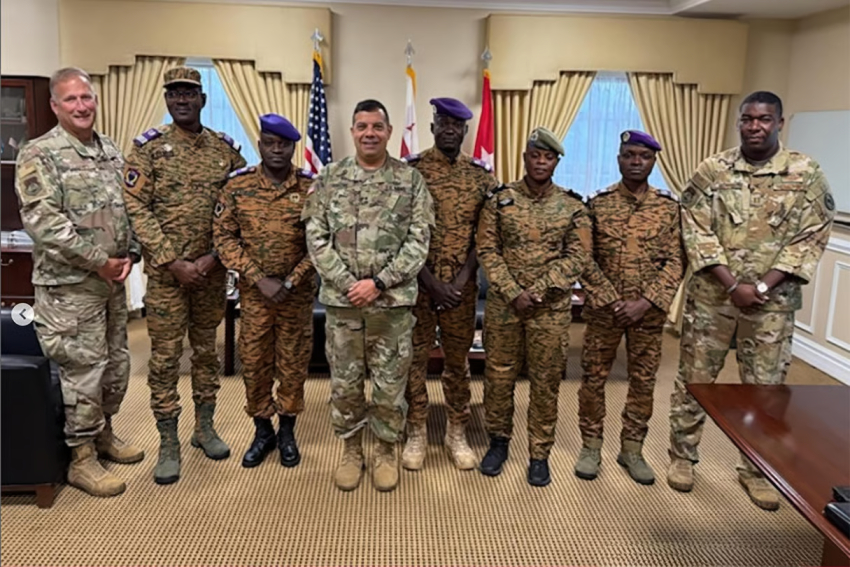
But in reality, even without a visible presence, the Americans never fully severed ties with the region’s military high commands, which are constantly invited to the United States for various exchange programs and also take part in various exercises, training seminars and exchanges of best practices on counterterrorism strategies, among other things. Washington has remained in constant contact with the military leadership of the region’s various countries, despite diplomatic posturing and AES-ECOWAS tensions.
For governments in the region — and first and foremost the most directly concerned countries of the central Sahel — it would be strategically necessary to understand the ecosystem of pressure groups, defense industries, ad hoc bipartisan coalitions and other think tanks in Washington, in order to no longer be subject, without leverage, to this new reality of American diplomacy. Anticipating this potential dynamic of American re-engagement in the Sahel would be the best guarantee of putting it to work for their own development and security priorities, in the face of populations that have grown, over time, skeptical of security cooperation and increasingly hostile to foreign interventions.