Benin : at the crossroads of diplomatic, security and judicial challenges Spécial
 © Présidence du Bénin
Timbuktu Institute, Week 3, July 2026
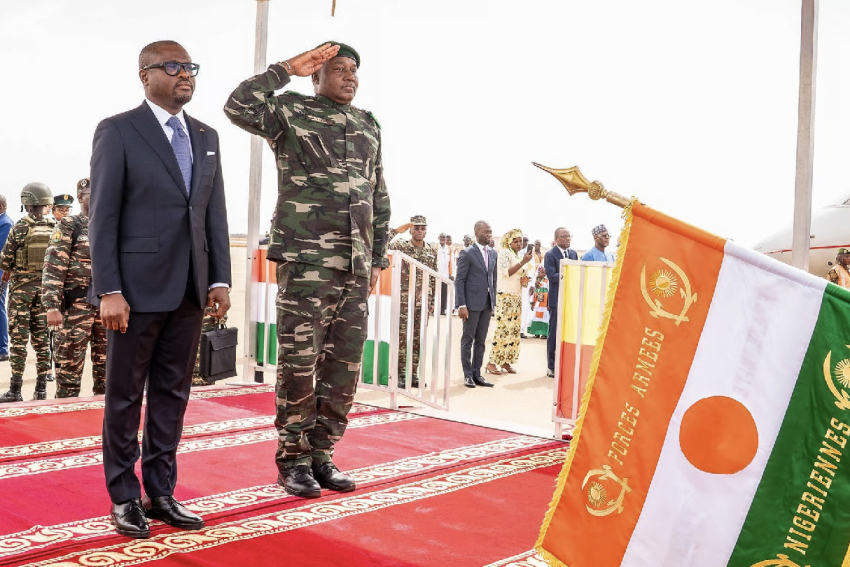
In Benin, the challenges of the moment remain at the crossroads of diplomatic, security and institutional issues. As the country tries to consolidate its balances in a regional environment undergoing full-scale realignment, its domestic scene continues to be marked by sensitive, at times politically charged, cases. Thus, between asserting a regional role, managing security vulnerabilities and pursuing ongoing judicial proceedings, Beninese authorities are seeking to preserve the country's stability while adapting their strategies to the current regional balance of power. The question of relations with Niger is one of the main markers of this diplomatic realignment. Closed since August 2023 following the tensions triggered by the change of regime in Niamey and the regional sanctions that followed, the land border between the two countries has heavily affected bilateral trade. The Cotonou–Malanville–Niamey corridor has historically been an essential axis for supplying Niger and a major source of activity for the Autonomous Port of Cotonou. The severing of this link had led to a temporary drop in Beninese port traffic and a sharp rise in logistics costs for Niamey, which was forced to rely on alternative routes via Togo or Nigeria. Benin, however, has gradually managed to absorb part of the economic impact of this closure thanks to the diversification of its trade flows and the dynamism of the Glo-Djigbé Industrial Zone. Niger, by contrast, has borne the brunt of the situation, notably through lost customs revenue and a growing reliance on costlier corridors. Against this backdrop, the prospect of reopening the border, agreed following a visit by Beninese President Romuald Wadagni to Niamey in June 2026, appears to be an important step towards a gradual normalisation of relations between the two countries.
This development nonetheless comes against a regional backdrop where security issues continue to weigh heavily. Recent rumours of a joint military operation between Benin and Burkina Faso along their shared border are a case in point. Images circulated on social media had suggested a coordinated intervention by the two armies in the Koualou-Kourou area, but Beninese authorities denied this interpretation, clarifying that the Burkinabè troops present in the area were engaged in a territorial repositioning operation. The Koualou-Kourou region remains particularly sensitive due to a long-standing border dispute between Cotonou and Ouagadougou, provisionally settled by a 2009 agreement providing for a special status pending a ruling by the International Court of Justice. To this territorial dimension is now added the threat posed by the expansion of armed groups in the Sahel's border areas, notably with the presence of groups affiliated with JNIM. While relations between Benin and Burkina Faso appear to have improved recently, this development has not yet led to structured military cooperation.
At the same time, Benin is seeking to strengthen its monitoring capabilities through enhanced cooperation with Nigeria. The two countries have deployed a system based on geospatial technologies to improve surveillance of their shared border and the management of cross-border flows. Piloted at the Sèmè-Kraké border post, this initiative is designed to help customs services identify vulnerable areas more effectively, combat smuggling and improve intelligence gathering. It reflects a determination to reconcile border security with the smooth flow of trade. In a similar vein, meeting in Cotonou on 12 and 13 July, the 23 Atlantic African states adopted the Cotonou Declaration to structure cooperation around maritime security, green logistics corridors, energy and economic integration. This initiative, driven by the Atlantic African States Process launched in 2022 in Rabat, aims to turn Africa's Atlantic seaboard into a new strategic space aligned with the African Union's Agenda 2063. Its scope will, however, depend on the concrete implementation of the projects announced and on states' ability to coordinate their actions.
Judicial developments
Alongside these regional issues, Benin's domestic scene remains marked by no less significant judicial developments. First, more than seven months after the attempted coup of 7 December 2025, proceedings brought by the Court for the Repression of Economic Offences and Terrorism (CRIET) are continuing. This is illustrated by remand warrants issued against political figures such as Candide Azannaï, while some defendants have already been convicted, as in the cases of former opposition MP Soumaïla Sounon Boké and journalist Angela Kpeidja. More recently, and in a different register, the judicial news continued with the conviction of Maître Magloire Yansunu, a leading figure of the Beninese bar, by CRIET. The lawyer was sentenced to seven years in prison for “breach of trust and money laundering”, along with a fine of around 29 million CFA francs, in a case involving a financial dispute with one of his former clients over a severance payment. The defence, which considers the sentence disproportionate, has announced its intention to appeal, recalling that Maître Yansunu remains presumed innocent pending the outcome of the appeal process.
In another particularly sensitive case, the trial linked to the disappearance of trade unionist and opposition figure Pierre Urbain Dangnivo also continues to attract attention, more than fifteen years after the events. The public prosecutor's office has sought a 30-year prison sentence against Codjo Alofa, considered one of the main defendants, after the charges were requalified as “complicity in murder committed with acts of barbarity”. The prosecution believes the accused contributed to the preparation of the crime without being its direct perpetrator. Since Dangnivo's disappearance in 2010 under the Boni Yayi regime, the case has remained mired in controversy. The family of the missing man continues in particular to challenge the identification of the body presented as that of their relative, as well as certain findings of the investigation, denouncing several grey areas. As a reminder, the Dangnivo affair refers to the disappearance, in August 2010, of trade unionist P. Dangnivo, as he was on his way home. His presumed body was found several years later, but the circumstances of his death and the responsibilities in the case remain shrouded in controversy, making this case a symbol of concerns over press freedom and justice in Benin.
All in all, Benin today is navigating between two imperatives. On the one hand, preserving its reputation for stability in a fragile regional environment and managing the aftermath of an institutional and political realignment exemplified by the recent constitutional revision and the new Senate. On the other hand, coping with a considerable weakening of the political opposition, which appears to have been reduced to its simplest expression.