Burkina Faso : Amid a diplomatic standoff, the consolidation of power Spécial
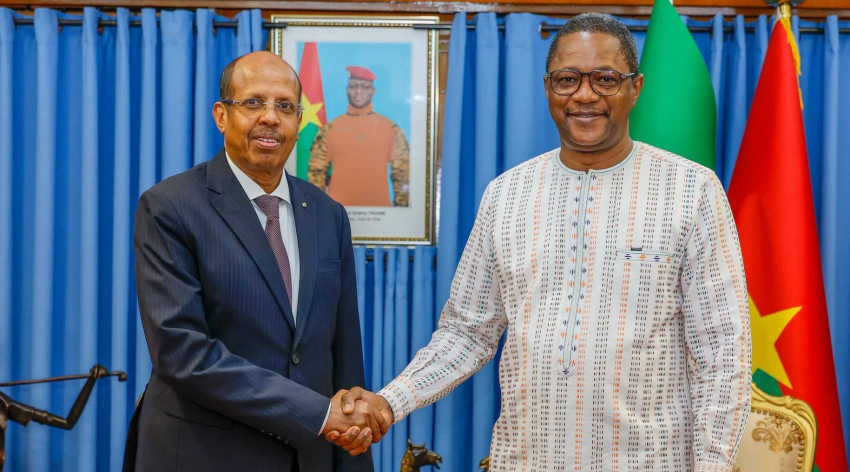 © Burkina 24
Timbuktu Institute, Week 3, July 2026
In the midst of a diplomatic pullback from Europe, Ouagadougou appears unwilling to back down or soften its approach. A new step was taken in its confrontation with the European Union: the declaration persona non grata, on 14 July, of two officials from the European delegation in Ouagadougou (the deputy head of delegation and a programme officer), who were ordered to leave Burkinabè territory within 72 hours, without the authorities officially specifying the reasons. This decision follows on from a resolution adopted in June by the European Parliament denouncing the “repression of civic space and fundamental freedoms” and calling for independent investigations into possible human rights violations. That text had subsequently been labelled “neo-colonial” by Ouagadougou, which viewed it as a breach of the principle of non-interference. For its part, Brussels stated that it saw “no basis” for this expulsion and that it was assessing its response, in a context where the crisis compounds the already consummated break with France and the broader deterioration of relations with Western partners.
It was against this rather tense backdrop that the chairperson of the African Union Commission, Mahamoud Ali Youssouf, paid a working visit to Ouagadougou on 16 July, following a stop in Bamako, to reaffirm the continental organisation's “re-engagement” with the countries of the Alliance of Sahel States (AES). Suspended from the AU's political bodies since the January 2022 coup, Burkina Faso was urged to maintain dialogue rather than sink further into rupture. Indeed, the head of pan-African diplomacy called for a transition exit involving the reopening of political space, the resumption of party activities and the holding of elections, while also advocating for closer ties between the AES and ECOWAS, which Ouagadougou, Bamako and Niamey withdrew from in January 2024. On the security front, he proposed revitalising the Nouakchott Process, launched in 2013, in response to a blunt appeal from Burkinabè Prime Minister Rimtalba Jean Emmanuel Ouédraogo, who denounced the “silence and inadequacy” of African solidarity in the face of Sahelian crises.
However, Ouagadougou's recent hardening towards Europe has not translated into total, uniform diplomatic isolation. On 13 July, Burkinabè Foreign Minister Karamoko Jean Marie Traoré received British ambassador Angus McKee to affirm a shared determination to strengthen strategic cooperation on security and development, including the establishment of a dedicated framework for counterterrorism consultation. The British diplomat proposed creating a regional forum for Sahelian countries, while the Burkinabè side called for cooperation geared more towards structuring projects than humanitarian aid. A sign that Ouagadougou, while breaking with some Western partners, is seeking to diversify others, provided they are willing to value its security efforts rather than scrutinise them.
Religious realignment and tightening of power
This variable-geometry diplomacy also has a domestic echo, namely in the way Captain Ibrahim Traoré is seeking to reaffirm his authority over both religious and political matters. On 16 July, before community leaders in the Yaadga region, he called for a “moderate” Islam, denounced a “minority of extremists” and defended the law governing religious practices, weeks after the controversial arrest of imam Ishaq Kindo. Arguing that “imperialism” was seeking to instrumentalise Islam to destabilise the country, he announced financial support for imams deemed to be spreading a “positive message”, the possibility of suspending dissenting preachers, as well as tighter oversight of religious training abroad, with the announced repatriation of young Burkinabè studying sharia outside the country. These measures, added to restrictions on prayers in public spaces, have been perceived by some Muslim leaders (who were nonetheless among Captain Traoré's earliest supporters in 2022) as calling into question their place in society, even though the authorities deny this, invoking the fight against the religious instrumentalisation of terrorism.
Yet this drive to tighten control extends beyond the religious sphere alone. Faced with persistent rumours of internal rivalries, Ibrahim Traoré responded with unmistakable firmness. The speculation in question concerns in particular the prolonged absence of several figures within the regime, such as Commander Oumarou Yabré, the intelligence chief who has been off the public radar since late May, Captain Kiswendsida Azaria Farouk Sorgho, a former junta spokesman, and the affair of imam Kindo. While visiting the Yaadga region, the President of Faso, Captain Ibrahim Traoré, met on 16 July with community leaders from the region. During his address, Ibrahim Traoré repeatedly set the record straight, declaring in Ouahigouya that “there aren't two captains on a boat” and vowing to punish any “anti-revolutionary” behaviour. Bluntly, he stated: “If someone screws up, I'll bring them to heel without hesitation.” A terse formula which, in seeking to quash the speculation, perhaps reveals less the solidity of a unified chain of command than the regime's need to publicly reaffirm it.