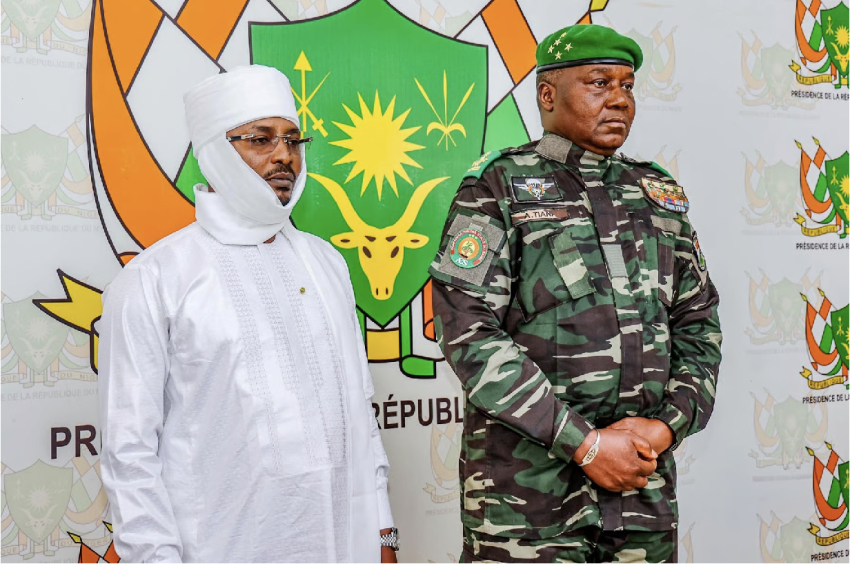
 © Présidence du Tchad
Timbuktu Institute Week 1, September 2026
In Chad, the moment still seems to be about seeking room for maneuver, both in its regional environment and domestically. In this respect, N'Djamena is working to preserve a pragmatic relationship with its neighbors despite persistent suspicion and tension. At the same time, the government intends to take firmer control of the humanitarian response, while difficulties in absorbing national expertise in sectors as essential as health are a reminder of the limits the state still faces. Behind this drive for assertiveness lies a more complex equation: consolidating the country's sovereignty and autonomy without losing sight of the vulnerabilities that continue to weigh on its stability. First, Chad already appears to be struggling to shake off the specter of persistent distrust from neighboring Niger. Following the mutiny that took place on 28 and 29 August in Niamey, statements by a Nigerien officer placed N'Djamena in a particularly uncomfortable position. In testimony broadcast on state television, Captain Roger Gabriel claimed that Chadian officials had taken part in preparing an intervention meant to support the mutineers holed up at Base Aérienne 101, with the alleged support of French special forces. These accusations, which also target Benin, Côte d'Ivoire and France, have not, at this stage, been backed by any material evidence confirming their veracity.
As might be expected, Chad's reaction was firm, though without tipping into escalation. N'Djamena described the accusations as “ridiculous” and favored the hypothesis of a manipulation designed to create a “climate of distrust” between the two capitals. Chad's leadership pointed in this regard to the hitherto “brotherly and pragmatic” nature of relations between Mahamat Idriss Déby Itno and Abdourahamane Tiani. In response to the accusations, the Chadian president posted a cryptic and allusive message on his Facebook account, quoting verse 42 of Surah Al-Baqarah of the Quran: “And do not mix truth with falsehood or conceal the truth while you know it.” This caution is no accident. The two countries share a border confronted with significant security threats, while rumors of clashes between their forces had already circulated. This episode thus shows how fragile the relationship between N'Djamena and Niamey remains. Mutual suspicions surrounding the movement of armed groups and the potential support they might receive on either side of the border sustain a distrust that official statements do not always manage to dispel. For N'Djamena, preventing this episode from turning into an open crisis is thus as much a diplomatic imperative as a security necessity.
N'Djamena plays the Russian card
In this uncertain regional context, closer ties with Russia appear to be the other side of Chad's opening strategy. The swearing-in, on 3 September, of the new Russian ambassador to N'Djamena, Maksim Dulian, gives fresh visibility to a relationship whose intensification has accelerated in recent years. Mahamat Idriss Déby's visit to Russia in 2024, Chad's participation in the Russia-Africa Partnership Forum and, more recently, Foreign Minister Abdoulaye Sabre Fadoul's trip to Moscow in July, all attest to a now well-established dialogue. The signing, on that occasion, of an agreement facilitating travel for holders of diplomatic and service passports illustrates this drive to deepen relations. But for Moscow as for N'Djamena, the challenge now is to turn diplomatic closeness into more substantial cooperation, particularly on commercial, economic and strategic fronts. The upcoming Russia-Africa Summit, scheduled for October, could provide a fresh opportunity to give more concrete substance to this rapprochement. This diversification of partnerships does not mean, however, that N'Djamena is turning away from its traditional partners. It rather reflects a search for greater latitude in a shifting regional environment. Chad thus appears to want to multiply its points of support, as the Sahel's security and diplomatic balances undergo constant change.
The test of state capacity
This drive for national ownership is also evident in the management of the humanitarian crisis. On 2 September, the Chadian government and the UN's humanitarian country team signed a memorandum aimed at strengthening the coordination of aid under state leadership. The arrangement calls for greater involvement of national institutions in steering the response, while maintaining support from the United Nations and non-governmental organizations. The reform comes against a particularly heavy backdrop. The influx of refugees fleeing the war in Sudan, internal displacement, and multiplying crises that vary by territory have pushed the number of people in need of humanitarian assistance in Chad to 4.5 million. For 2026, the response targets 3.4 million people, with financial needs estimated at $986.1 million. Yet this drive for ownership runs up against the state's actual capacities. The situation in the health sector offers a particularly telling example. As the country faces major health needs, 926 doctors trained in Chad and abroad are demanding their integration into the civil service. Meeting on 1 September in N'Djamena, members of the Collective of Non-Integrated Doctors of Chad called on the authorities to follow through on commitments made during their dealings with various levels of the administration. Thus, between persistent tensions with Niamey, deepening partnership with Moscow, and the drive to strengthen national ownership of the humanitarian response, Chad is seeking to consolidate the attributes of its autonomy. But the difficulties encountered in the health sector are a reminder that this diplomatic and political ambition cannot durably be separated from the state's capacity to deliver concrete responses on institutional, public and diplomatic fronts.