Nigeria : The Electoral Battle on the Ground, in the Media and in Washington Spécial
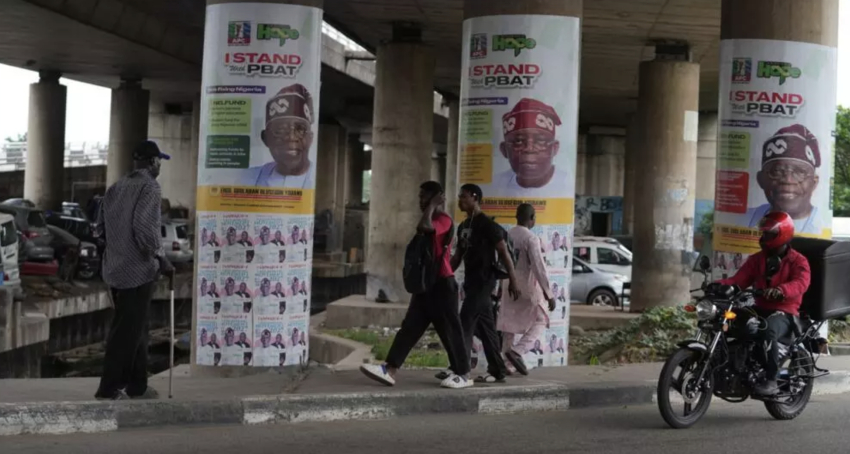 © AP Photo/Sunday Alamba - Sunday Alamba
Timbuktu Institute September 2026, Week 2
As the presidential election — scheduled for January 2027 — draws closer, political competition in Nigeria appears to be taking on a particularly bitter turn. In the meantime, it is campaign season, and therefore a time for maneuvering and jostling. As the leading candidates begin sharpening their strategies, the campaign is playing out as much on the domestic front as in the international media and diplomatic arena. The entry into the race of opposition figure Atiku Abubakar, now the African Democratic Congress (ADC) candidate, illustrates this internationalization of electoral competition. The former vice-presidentreportedly hired, for nearly €1.5 million, the American-Nigerian firm Von Batten-Montague-York to work on his image among American policymakers and to bring back into the spotlight certain controversial elements of President Bola Tinubu's past in the United States, notably a 1993 judicial seizure of accounts belonging to him. The move mirrors a strategy already employed by the ruling power. In January, Tinubu himself had turned to a lobbying firm to defend his policies before the US Congress, after Donald Trump had notably criticized his handling of violence which, in Trump's telling, targeted Christians in Nigeria.
The affair took on a more sensitive dimension, however, when the firm hired by Atiku claimed it had been approached by someone close to the president, who allegedly offered $3 million to have it drop its lobbying campaign. A claim that remains to be established, but one that adds another dimension to the standoff between the two camps. In presidential circles, Atiku's initiative is portrayed as an attempt to obtain “foreign validation,” while the opposition is clearly seeking to exploit, before American decision-makers, the vulnerable points in Tinubu's record and past.
A Campaign Under Tension
On the ground, the first incidents offer another gauge of electoral tension. On September 8, Peter Obi, who came third in the 2023 presidential election and is now an opposition candidate, was prevented from visiting a camp for displaced persons in Yelwata, in Benue State. Dozens of young people had blocked the road and threatened his convoy, forcing police to intervene to ensure the candidate's safety. Obi had wanted to meet with victims of the recurring violence between farmers and herders in the region, notably following the June 2025 attack that killed more than 200 people in Yelwata and displaced around 6,500 people. His party, the Nigeria Democratic Congress (NDC), denounced a “shameful obstruction” and pointed the finger at Benue State Governor Hyacinth Alia, a member of the ruling APC. Alia rejected the accusations, arguing that the candidate should have notified the authorities of his visit so that security arrangements could be made. The affair nonetheless reveals a looming difficulty for the campaign: in certain regions already destabilized by communal violence, candidates' visits are bound to turn into episodes of political confrontation. The opposition has called for an investigation and urged diplomatic missions to take note of the incident.
This tension found an even more troubling echo in Kano, where Ibrahim Khalil Dan Shagamu, a political influencer followed by several hundred thousand people,was found dead at his home. A former journalist and regular critic of the authorities in Hausa-language videos, he reportedly fell victim to a particularly violent murder, while two of his phones went missing. Death threats reportedly preceded his death. The motive, however, remains unknown, and no political involvement has been established at this stage. Amnesty International has called for a full investigation. In a country where election campaigns have regularly been accompanied by intimidation and violence, this affair nonetheless serves as a reminder of the vulnerability of political and media voices as the election approaches.
The Security Front Remains Open
The prevailing political tension comes against a security backdrop that is bleak, to say the least, with the country still facing a persistent jihadist threat. In Borno State, the army recentlyfoiled an ambush attributed to suspected Boko Haram elements on the Buni Gari-Buratai axis, during an Operation Hadin Kai patrol. Nigerian forces forced the attackers to retreat before discovering and dismantling several makeshift camps. Ammunition, rocket-propelled grenades and various means of transport were notably recovered. No soldiers were injured, although several vehicles were damaged. An episode that serves as a reminder that, alongside the electoral contest, security remains a thorn in the side of the Nigerian authorities. The operations conducted in the northeast attest to the continued nuisance capacity of jihadist groups and to Abuja's need to maintain constant military pressure on their networks and areas of operation.
It is presumably also with this in mind that military cooperation with the United States is being strengthened. The US Air Force announced on September 10 thedelivery of new equipment to the Nigerian Air Force as part of a military sales agreement expected to lead to several further deliveries. According to AFRICOM, this equipment is meant to strengthen Nigerian operational capabilities and support the fight against terrorist groups active in the region. Washington insists that its support comes at Abuja's request and in accordance with its sovereignty. US-Nigerian security cooperation thus appears set to deepen at the very moment when the two countries are already engaged in a battle of influence over the Nigerian political narrative.
All things considered, Nigeria is entering 2027 with a political life that will be increasingly difficult to separate from the security tensions running through the country. Moreover, the campaign is likely to provide an additional sounding board for existing fault lines. In Abuja as in the states, at the ballot box as in the media and even in relations with Washington, the battle for power is now being fought on several fronts at once. It remains to be seen whether this multiplicity of confrontations can still be contained by the electoral process, or whether, as the vote draws closer, it will end up shifting its boundaries.