Senegal : restoring partner confidence to prepare for the post-debt era? Spécial
 © TDR
© TDR
Timbuktu Institute - Week 3, September 2026
Armed with its agreement with the IMF, Dakar now seems to be redoubling its efforts to restore its financial balance. Indeed, the new programme negotiated with the IMF, being an agreement in principle, is for now less an achievement than a starting point. Senegal must now secure guarantees from its creditors and have the programme approved by the Fund’s Executive Board. In addition, Dakar must undertake a debt restructuring, notably of its Eurobonds, while getting potentially unpopular budgetary measures adopted by the National Assembly amid a rising cost of living. It is in this light that President Diomaye Faye’s recent economic offensive should be read.
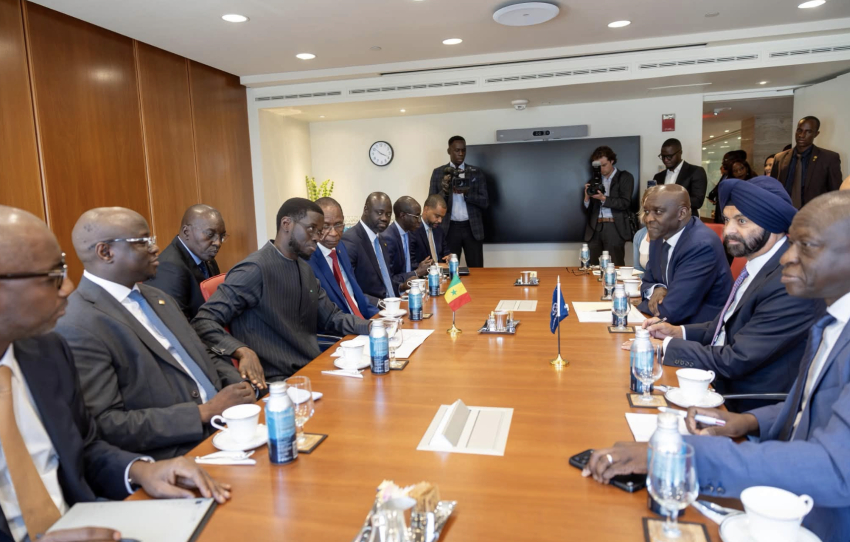
First, in Washington, the Senegalese president sought above all to consolidate the institutional support likely to accompany the country’s economic recovery. On 14 September, he held talks with Ajay Banga, President of the World Bank Group, who confirmed the institution’s readiness to support Dakar in consolidating its macroeconomic framework and financing its public policies over the coming years. The discussions covered several of the most sensitive issues of economic transformation: reducing the cost of energy, social protection, improving the business environment, entrepreneurship and youth employment. In doing so, President Faye also met Kristalina Georgieva, Managing Director of the IMF, and Scott Bessent, US Secretary of the Treasury. The World Bank said it was in favour of handling Senegal’s case “with the utmost speed”, while the IMF Managing Director spoke of a willingness to move “expeditiously” towards a new economic and financial programme.
Moreover, President Faye’s trip was not limited to financial institutions. On 14 September, the Head of State received a delegation from the American cybersecurity company Cybastion. At the end of the meeting, the company announced the mobilisation of around 300 million dollars to support Senegal’s digitalisation. The investments are expected to cover cybersecurity, data centres, technology transfer and national capacity building, with the participation of Senegalese start-ups. Straight afterwards, the Senegalese Head of State met a delegation from the US Chamber of Commerce, in the presence of executives from American companies already active in Senegal in energy, health and digital technology. To investors, the president presented the country’s strengths: its institutional framework, its open economy and its geographical position. He invited them to invest in priority sectors, highlighting “transparency” and rigour in the management of public finances. The aim of this economic diplomacy offensive thus appears quite clear: to prepare for the “post-debt” era by trying to make the restoration of financial confidence a springboard for attracting private investment.
From hydrocarbons to the energy transition
This search for capital and partnerships continued in Thailand, where Senegal took part, from 14 to 17 September, in Gastech 2026, held at the Bangkok International Trade & Exhibition Centre (BITEC). The event is one of the leading international gatherings devoted to gas, oil, LNG, hydrogen and energy transition technologies. Led by the Minister of Energy and Petroleum, El Hadji Abdourahmane Diouf, the Senegalese delegation held numerous meetings with investors, operators and international partners in order to present the opportunities of the Senegalese market and explore new avenues for cooperation.
The Bangkok event comes as Senegal enters a new phase of its oil and gas production. Dakar is seeking to make its hydrocarbons not a mere source of rent, but a lever for economic transformation, through investment, technology transfer, the training of national skills and the development of a local industrial base. Dakar’s presence at Gastech is also part of a broader energy transition perspective, with an interest in renewable energy, energy efficiency, hydrogen, decarbonisation and new technologies. Looking ahead, the same economic diplomacy aims to raise the country’s profile among major investors and diversify its partnerships.
In Abu Dhabi, widening the circle
After Washington, Bassirou Diomaye Faye continued his offensive in Abu Dhabi. The objective is clear: to widen the circle of partners able to support the country’s major projects. On 16 September, a few hours after arriving in the United Arab Emirates, he was received at the Presidential Palace by his Emirati counterpart, Sheikh Mohammed bin Zayed Al Nahyan. The two leaders discussed strengthening bilateral relations and finalising a new economic partnership between Dakar and Abu Dhabi. The future cooperation framework is expected to cover finance, infrastructure, energy, agriculture, logistics and digital technology. These sectors directly overlap with the priorities set out by the Senegalese government and give this visit a significance that goes beyond the mere search for financing. It is well known that Dakar’s approach also follows a logic of diversification. Indeed, in Abu Dhabi, several investors had been waiting for the IMF agreement to be secured before making new commitments.
The private sector to the rescue?
Yet economic diplomacy can only produce results if it finds a relay within the country. On 17 September, in Dakar, Prime Minister Ahmadou Al Aminou Lo thus called on the private sector to play a central role in economic transformation. “The structural transformation of the Senegalese economy will not come about through the will of the State alone,” he said. The government notably intends to complete the settlement of domestic debt in order to restore business confidence. It also plans to finalise, before the end of the year, the implementing texts of the 2025 Investment Code as well as the new framework for public-private partnerships. Strengthening local content, supporting industrialisation and increasing the participation of Senegalese companies in regional markets are also among the stated priorities. The ambition is considerable: to create 1.5 million jobs by 2029 and make the private sector more of a driver of growth. In addition, the government plans to settle over three years the more than 1,400 billion CFA francs in arrears owed to companies, with a first repayment of 300 billion announced by the end of 2026. But the private sector considers this timetable too long, after several years of difficulties linked to unpaid bills, the halting of many construction projects and declining investment. Furthermore, proposals are set out in a “white paper” handed to President Faye on 17 September to support the recovery of economic activity. For it is at this level that the effectiveness of capital diplomacy will be judged.
The investments announced in Washington, the partnerships sought in Bangkok and Abu Dhabi and the financing mobilised from international institutions will only truly make sense if they manage to irrigate the national economy, strengthen local businesses and generate jobs. Clearly, then, Dakar is working harder than ever to rebuild an economic credibility that has been severely tested over the past two years. The growing number of interlocutors, financial centres and targeted sectors clearly reflects a determination no longer to depend on a single window or a single partner. In this sense, Senegalese economic diplomacy appears as the external extension of one and the same domestic imperative: regaining room for manoeuvre in an economy weakened by debt.