Benin : Wadagni’s Territorial Reform, Between Development and Security Vigilance Spécial
 © TDR
© TDR
Timbuktu Institute - Week 4 September 2026
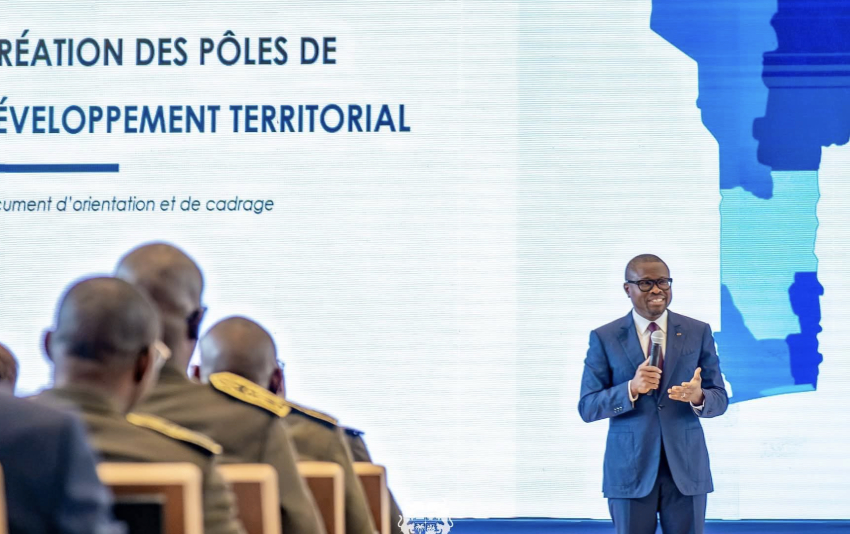
Benin now wants to change scale. When he took office as head of state, President Romuald Wadagni declared that he wanted to make “continuity” the watchword of his term. It must at least be acknowledged that the head of state has since shown remarkable energy, both in foreign policy and in economic diplomacy. “Benin will remain open to the world, without ever straying from itself,” he had promised; along the same lines, at home, a number of projects are emerging. On 23 September, President Romuald Wadagni presented a reform aimed at bringing public action closer to the population through the creation of six territorial hubs covering the country’s 77 municipalities. Placed under the responsibility of general delegates required to reside in their territories, these new steering units will monitor the implementation of programmes, report bottlenecks to the central authorities and measure results using precise indicators. Reducing extreme poverty, developing human capital and creating local wealth are among the stated priorities, with particular attention paid to farmers, livestock breeders and fish farmers. For the country, it is also a matter of better identifying the potential specific to each territory and fostering promising sectors there, from agriculture to industry, by way of tourism and innovation.
While this reform does not call into question the powers of prefects and mayors, nor the decentralisation framework established in 1999, it does introduce a new steering level between the central administration and local authorities, with general delegates due to be installed from the fourth quarter of 2026. The North-East will bring together the departments of Borgou and Alibori, the North-West Atacora and Donga, the Centre Zou and Collines, while Ouémé and Plateau will form the South-East hub. The South-West will group Mono, Couffo and part of Atlantique, while Greater Nokoué will make up the sixth unit. Each will thus have its own potential, but also its own constraints and performance indicators. Results will be assessed in particular in terms of jobs created, wealth produced and improvements in living conditions. A first review is expected at the end of the first year.
Development as a Matter of Proximity
Moreover, President Wadagni intends to give greater responsibility to local officials and leaders. The Beninese president called on them to get directly involved in the development of their territories, while displaying “zero tolerance” for unsanitary conditions, waste and disregard for collective rules. A requirement that he nevertheless wants to enforce through “exemplary conduct, education and individual responsibility”. The message therefore goes beyond the question of investment alone: it is also about changing everyday practices and making local action a space where the effectiveness of the state is more directly visible. This desired proximity takes on particular significance in areas exposed to security vulnerabilities. The development of territories is indeed presented as one of the means of reducing the fragilities likely to fuel social tensions and dynamics of marginalisation. The territorial hubs reform thus places the effective presence of the state on the same level as the capacity to generate activity, jobs and services. In doing so, attention will now need to be paid to the capacity of this new level to better coordinate public policies, that is, to give the territorial development hubs a full and complete place in state action.
Watch on the Security Front
However, this institutional overhaul should not overshadow the other fronts on which state action is still being played out. Among them, security remains central, and in this regard Benin is showing dynamism in its various bilateral cooperation arrangements. It is within this framework that on 24 September, the United States strengthened the capacities of the Counter-Terrorism Investigation Unit of Benin’s Republican Police. In Cotonou, its premises were renovated and equipped with computers, investigative equipment, crime scene analysis tools and equipment for processing digital data. These resources are intended to strengthen the joint work of counter-terrorism investigators, intelligence analysts and forensic police. The facilities were commissioned by the Minister of the Interior, Djibril Mama Cissé, and the US chargé d’affaires.
This support is part of the ICITAP (International Criminal Investigative Training Assistance Program) of the US Department of Justice and complements cooperation already under way with France and the European Union, particularly in explosive device detection, demining and decontamination. For Cotonou, strengthening investigative capacity thus becomes another facet of the state’s presence on the ground. The territorial reform seeks to better identify needs and speed up public responses; security cooperation, for its part, aims to better detect and address threats. In both cases, the challenge lies in the gap between the institutional architecture and what it actually delivers on the ground. For, quite clearly, a reform only truly takes shape once it brings decision-making closer to the territories and gives them a hold over the choices that concern them.