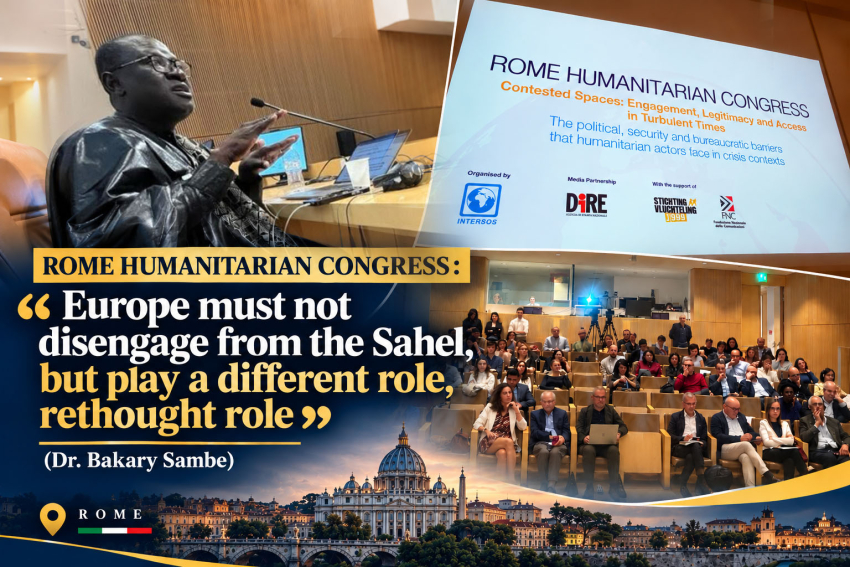
Rome Humanitarian Congress : “ Europe must not disengage from the Sahel, but play a different role, rethought role” (Dr. Bakary Sambe) Spécial
17 October 2026 · Dakaractu
The Timbuktu Institute – African Center for Peace Studies carried the voice of the Sahel to the Rome Humanitarian Congress, held on 15 October 2026 at the Ara Pacis Museum in Rome. Organised by the Italian NGO INTERSOS on the theme “Contested Spaces: Engagement, Legitimacy and Access in Turbulent Times”, the event brought together humanitarian, diplomatic, academic and media actors to discuss the political, security and bureaucratic obstacles that hinder humanitarian action in crisis zones.
Director and Founder of the Timbuktu Institute, Dr Bakary Sambe spoke on the panel dedicated to “Humanitarian access and strategic engagement in the Sahel”. He was joined by Alda Cappelletti, Deputy Director General of INTERSOS, and Andrea Palamidessi, Head of the West and Central Africa Office at the Italian Ministry of Foreign Affairs and International Cooperation. The discussions of this high-level panel were moderated by Vincenzo Giardina, head of the international desk of the DIRE news agency.
Back from Rome, he speaks to Dakaractu about the role of humanitarians, who in his view have become “the last thread” between Europe and the Sahel, and about the need for a new vision of European engagement in the region.
Humanitarians: the last thread between Europe and the Sahel?
Dakaractu: You opened your remarks in Rome with the striking image of a humanitarian convoy. Why that choice?
Dr Bakary Sambe: Because that image says everything about the current situation. Take a humanitarian convoy between Gao and Ménaka, or on a dirt track in the Liptako-Gourma. There is no longer a European military operation, no longer a United Nations mission, and hardly any European ambassador left to talk to. In entire parts of the Sahel, that convoy is all that remains of Europe. It is the last thread. The question I asked in Rome is simple: are we going to let this last thread of solidarity break?
Dakaractu: In concrete terms, what do humanitarians represent for Sahelian populations today?
B. S : When embassies cut their staff, when cooperation agencies hesitate, when military missions pack up and cooperation programmes are suspended, who stays? Humanitarians. They are the ones still negotiating access, often with great courage and not without risk. They know the village chiefs, the women’s committees, the youth associations. For millions of Sahelians, they are, very concretely, the last human face of Europe. In the Sahel zone alone, there are more than 3 million internally displaced people, and behind that figure are their teams, working hard despite shrinking resources and the ostracism of regimes that are hostile to them.
Dakaractu: Should they, then, be entrusted with the relationship between Europe and the Sahel?
B. S : Absolutely not. That was not what I meant. I always tell European decision-makers: you cannot ask humanitarians to carry the weight of the political relationship between Europe and the Sahel on their own. They must not become diplomatic instruments. Their neutrality is one of the few guarantees of their protection in a political and security context marked above all by suspicion. If you use them as tools, you expose them, and then you lose them.
What is needed is to support them more: fund them over the long term, not according to the rhythm of media attention, which often determines the priorities of donors; protect them politically; and preserve humanitarian space. At a time when aid budgets are shrinking across much of the Western world, cutting this last link would be a historic mistake. It would be telling Sahelians: you no longer exist for us.
Dakaractu: You also directly addressed humanitarian organisations such as INTERSOS. What role do you expect NGOs to play beyond emergency response?
B. S : In my remarks in Rome, I did not ask humanitarians to become negotiators or political actors. Their neutrality must remain intact. But because they are present where no one else goes, and because they have the trust of communities, they can help create the conditions for dialogue. First, by carrying the voices of communities to where decisions are made, in Rome, Brussels or Geneva. Second, by documenting what works: local mediation, community agreements, the reintegration of young people who have left armed groups. Third, by supporting the social fabric that makes dialogue possible: education, livelihoods, psychosocial support, reconciliation between herders and farmers and between cross-border communities. And finally, by telling European decision-makers clearly that the all-military strategy has reached its limits. The Sahel does not need more weapons. It needs more trust. And trust is precisely what humanitarians have built, patiently, over the years, despite the current difficulties in the central Sahel.
Towards a new vision of European engagement
Dakaractu: Europe has been a major topic of discussion. How is Europe perceived today in the Sahel and in West Africa?
B. S : I will not use diplomatic language that would somewhat obscure the reality shown by hard evidence: Europe, and I am not talking about humanitarians, still needs to improve its image. At the Timbuktu Institute, we conducted a pilot perception survey of more than 1,100 representative respondents in Côte d’Ivoire, Niger, Senegal and Togo. The figures are harsh. 70% believe that Western partners, including the European Union, act first and foremost to protect their own security interests. 58% say the same about development aid. 61% believe that security cooperation with foreign partners does more harm than good. And these are not only AES countries: they also include coastal countries that are considered stable and, at times, friendly.
Dakaractu: Is this, then, a total rejection of Europe as such?
B. S : Not necessarily, and that is the key point. This rejection is rarely a rejection in principle. It is often a lack of knowledge. Most of the people surveyed simply do not know what Europe does. The Sahel Alliance, with its 1,200 projects, has remained invisible to ordinary citizens. At the same time, 73% get their information mainly from social media, where very effective disinformation campaigns are being waged, certainly against Europe. Europe is not only losing ground in this space. It is also losing the battle of narratives, sometimes simply by not being there or by not communicating enough about what it does.
There is also a gap in perspective. From Brussels, Paris or Rome, the Sahel is read through three words: coups, terrorism, migration. These words certainly reflect a reality. But in Kaya, Tillabéri or Mopti, the situation they describe is lived through other words: dignity, sovereignty, survival. People do not reject cooperation. They reject condescension, opacity and domination, whatever the nationality of the partner.
Dakaractu: Faced with this distrust, some in Europe are tempted to leave. What is your answer to them?
B. S : That no partner has solved the security crisis: not France, over ten years, with a regular army working in cooperation with the states of the region, and not Russia today, with Wagner mercenaries turned Africa Corps who have never changed their methods. The “Russian myth” itself is crumbling in the face of the security reality in the region, as we have seen with military setbacks in many areas of the AES countries. The Sahel has not found a saviour, and in any case it should not have expected one from outside. Instead, it has found competitors who have turned this space into an information battlefield, with a fierce war of narratives. That is precisely why Europe must not disengage: not to take back or restore yesterday’s role, but to play a different, rethought one.
Europe may at times seem to have reasons to disengage: frustration, diplomatic humiliation, fatigue, as can be perceived in the rhetoric. But it must be aware of the price of leaving. Others would immediately fill the vacuum, the crisis would spread to the coastal countries, migration flows would increase, and radicalisation explicitly targeting Europe would intensify. Staying will be costly, it is true. Leaving will cost much more, especially in terms of image.
Dakaractu: How can one stay engaged with regimes that have sometimes driven Europeans out with rhetoric that was anything but diplomatic?
B. S : I am often asked that question. My answer is simple: Europe does not engage with regimes that are hostile to it; it engages with peoples and with a shared future. The military regimes of the AES will not last forever. The history of our continent shows that transitions end, one way or another; they are parentheses in the long history of relations between our peoples. The real question is: on that day, when the regimes have passed, will Europe still have friends in the Sahel? Or will it have let an entire generation grow up convinced that it was abandoned? Total isolation only increases these countries’ dependence on other powers that do not share the same values. All studies show people’s strong attachment to democracy and freedom, despite populist rhetoric. For Europe, as for other partners, real but conditional and respectful engagement is better than a complete break, which would make no sense in light of collective security imperatives.
Dakaractu: What would this new vision, this new approach towards what you call a “Europe brand”, look like in practice?
B. S : First, moving away from the all-military approach. For more than ten years, the dominant response has been military, despite efforts on development, and violence has not receded: it has spread and changed in nature. Terrorism in the Sahel is largely endogenous. Terrorists are no longer hordes of invaders coming from abroad. Those who take up arms are often, for example, young herders who have lost their cattle, young people humiliated at checkpoints, communities that feel abandoned or stigmatised and that have become enemies of their own states, where they no longer have a place. Jihadist groups did not create these grievances; they exploited them. You do not bomb a grievance; you address it at its root.
So room must be made for dialogue, alongside security. This dialogue already exists on the ground, with local negotiations on truces and the lifting of blockades: it is carried by religious leaders, traditional chiefs, women’s networks and local peace committees. These endogenous solutions are still treated as second-class or merely alternative solutions. They must be given the dignity of a solution.
Dakaractu: But Dr. Sambe, the region has changed profoundly, and relations between states have become complex with the AES–ECOWAS rifts. Where would Europe fit in all this?
B. S : Indeed, the region has become very complex. But channels must be kept open, even indirect ones, by relying on credible intermediary countries such as Senegal, Togo, Mauritania or Algeria. No AES or ECOWAS country can move out of West Africa. They will be secure or insecure together. Humanitarians, the last faces of a Europe in retreat in some areas, must have the means to keep investing where others do not go: justice, local governance, food and pastoral security, and the border areas of Liptako-Gourma and Lake Chad, where armed groups recruit. Talking about human rights, yes: it means defending values shared with the peoples of the region; but through dialogue and discreet mechanisms, not through public statements that feed anti-Western narratives. As we say back home, you don’t mop the floor while it is still raining. Without renouncing anything, each moment has its own tempo. And finally, giving real substance to the “Europe brand”: a more collective Europe, carrying less historical baggage than bilateral engagements.
Dakaractu: The congress was held in Rome. Does Italy have a particular role to play, and what about European partners more generally?
B. S : Italy is not a spectator of the Sahel crisis: it is one of its borders. Every fragility in the Sahel eventually shows up in Lampedusa, Sicily or Calabria. The central Mediterranean route runs through Niger and then through Libya, where the Fezzan is becoming the link between Sahelian instability and the Mediterranean. But Italy also has assets: it is hardly perceived in the Sahel as a former colonial power, despite its history in the east of the continent. Like Belgium, Germany and Switzerland, it did not close the door to dialogue at critical moments, and with the Mattei Plan it has set out the ambition of a partnership between equals with Africa. It could take its full place within a European engagement based on solidarity, including all Member States, but necessarily rethought. It could embrace its de facto status as a bridge between the stability of the Sahel and that of the Mediterranean. Spain should also play this bridging role, as should France, which still has a Special Envoy for the Sahel and continues to host a large Sahelian diaspora in its universities and businesses. Its relationship with the Sahel cannot be reduced to these passing tensions, which are temporary in light of the long history it shares, and is still writing, with the countries and peoples of this region.
Dakaractu: What is the main message to take away from your time in Rome, and especially from your participation in this humanitarian congress?
B. S : Stay engaged in the Sahel, but differently: with humility, attentive listening, consistency and patience. Let us dare dialogue, which in any case will be the ultimate solution. Let us trust the solutions that Sahelians are building themselves, and support those who never left the ground, namely humanitarian organisations. Today, humanitarians are holding the last thread of the essential solidarity between Europe and the Sahel. The Sahel of tomorrow is being built today. And on that day, when the guns fall silent and the passing tensions and resentments fade away, Sahelians will remember who stood by them when all seemed lost.
Interview by Cheikh Sadibou Fall, Dakaractu.