Foreign Information Manipulation and Interference (FIMI) : Timbuktu Institute Raises the Alarm over Risks of Instability in the Sahel Spécial
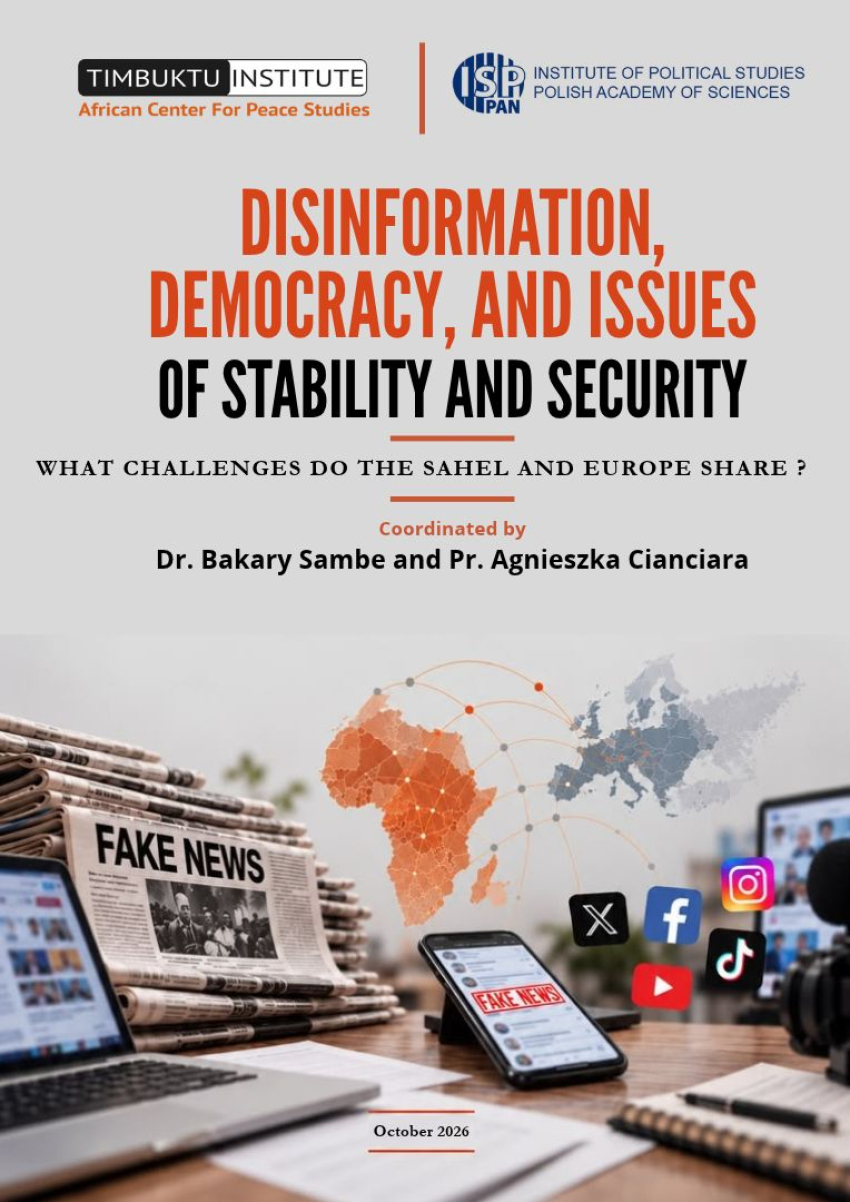
Disinformation represents a growing threat to democracy, stability and security in both Africa and Europe. This was the main conclusion reached at a seminar held on Friday, 23 October 2026, in Dakar, organised by the Timbuktu Institute in partnership with the Embassy of Poland, as part of the scientific activities marking the Institute’s 10th anniversary.
Chairing the meeting, Bakary Sambe, Director and President of the Timbuktu Institute, emphasised the urgency of a collective response to the growing spread of information manipulation.
The seminar also provided an opportunity to present a report, produced in collaboration with the Institute of Political Studies of the Polish Academy of Sciences. This cross-cutting study examines the manifestations of disinformation in European societies and its implications for peace and security in the Sahel.
Beyond false information circulating on social media, the phenomenon is now taking on an increasingly concerning technological dimension. “Disinformation is no longer the preserve of a handful of militants, activists or organised groups; it has become widespread,” stated Bakary Sambe.
In this regard, he highlighted the use of generative artificial intelligence by jihadist groups, particularly in their propaganda and recruitment strategies.
According to him, these technologies facilitate the production of manipulated videos, the dubbing of messages into several African languages, and the targeted recruitment of new members. This development further complicates States’ efforts to anticipate security threats.
In response to this situation, the President of the Timbuktu Institute advocates an approach based on media literacy, raising awareness among young people and combating digital illiteracy. He also recommends technological cooperation between Africa and Europe, particularly through mechanisms such as Viginum, while stressing the need to adapt these tools to the linguistic and socio-political realities of the Sahel.
Restoring the Credibility of Democratic Discourse
Furthermore, Bakary Sambe sought to challenge the notion that African populations are rejecting democracy. He recalled that studies indicate that 60 to 70% of West Africans consider democracy to be the ideal form of governance.
“The problem does not lie with democracy itself, but with the credibility of those who advocate for it,” he argued. In his view, inconsistencies among international partners and perceived injustices in the functioning of the international system contribute to undermining citizens’ trust in democratic values.
He also believes that the young Africans who currently support new leaders are the same people who previously mobilised to defend democracy. The challenge, therefore, lies in restoring trust and ensuring greater consistency between the democratic principles being promoted and the actual practices of the actors advocating for them.
Ultimately, the meeting highlighted the need for a joint mobilisation of States, the media, researchers and civil society. In an ever-evolving digital environment, the fight against disinformation has become an essential condition for safeguarding democracy, peace and stability in both the Sahel and Europe.
Source: SunuGox Info