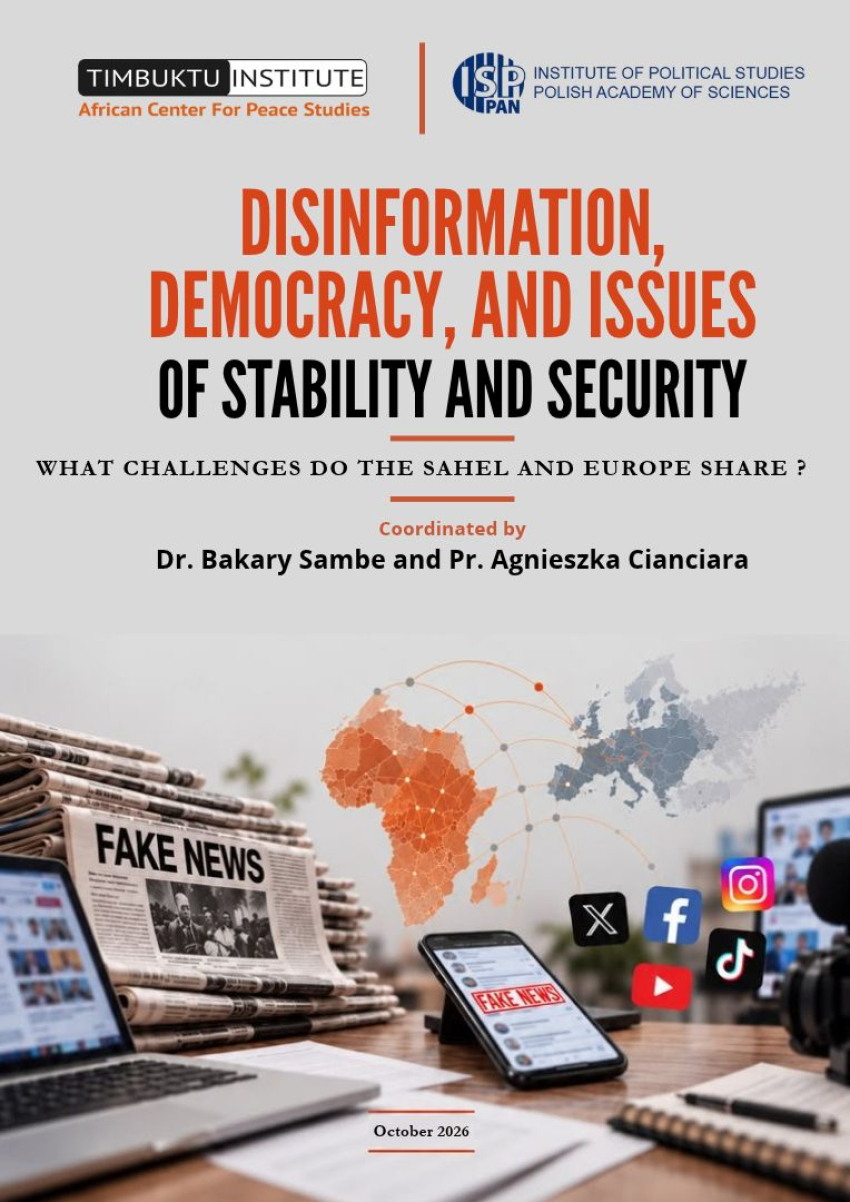
DISINFORMATION, DEMOCRACY, AND ISSUES OF STABILITY AND SECURITY : WHAT CHALLENGES DO THE SAHEL AND EUROPE SHARE ? Spécial
 © Timbuktu Institute
Across the globe, disinformation has today become a major test for democracies: it weakens their institutions, strains social cohesion and distorts the conditions of public debate. This report by the Timbuktu Institute and the Institute of Political Studies of the Polish Academy of Sciences sheds light on the mechanisms of a threat that feeds on social divides, political distrust and geopolitical rivalries. What is at stake, in this sense, goes beyond the mere circulation of false information. It touches on citizens’ trust and on their ability to distinguish facts from narratives designed to shape their perceptions and representations.
In the Sahel, deteriorating security, political transitions, sovereigntist discourse and power strategies all provide fertile ground for manipulation operations. In Europe, such operations exploit social anxieties, tensions over immigration and distrust of national and European institutions. While their manifestations differ, these dynamics follow a common logic: information operations draw their strength from pre-existing grievances and discourses, which they amplify and redirect to serve political or geopolitical interests.
This convergence calls for moving beyond a strictly technical reading of disinformation. The circulation of misleading content alone cannot explain its influence. That influence also depends on the local relays that spread such content, on the vulnerabilities they exploit and on the credibility they gain among populations. Consequently, exclusively repressive responses risk missing their target, and may even weaken the very freedoms they claim to defend. Countering information manipulation therefore requires strengthening prevention capacities without unduly restricting the pluralism of public debate.
With this in mind, this report advocates closer cooperation between Europe and Africa, based on information sharing, stronger monitoring and early-warning mechanisms, coordination with digital platforms and support for independent media. Media literacy, fact-checking and the protection of fundamental freedoms are also essential levers. It is indispensable to consolidate the institutions and civil society without which no fight against disinformation can prosper in the long run. This necessity must be matched by a more fundamental requirement: making information resilience one of the pillars of democratic resilience.