ECOWAS Chiefs of Defence Staff in Dakar – Dr Bakary Sambe: “Terrorists are not only fighting our armies, they are exploiting our disagreements: it is this grey zone that must be closed” Spécial
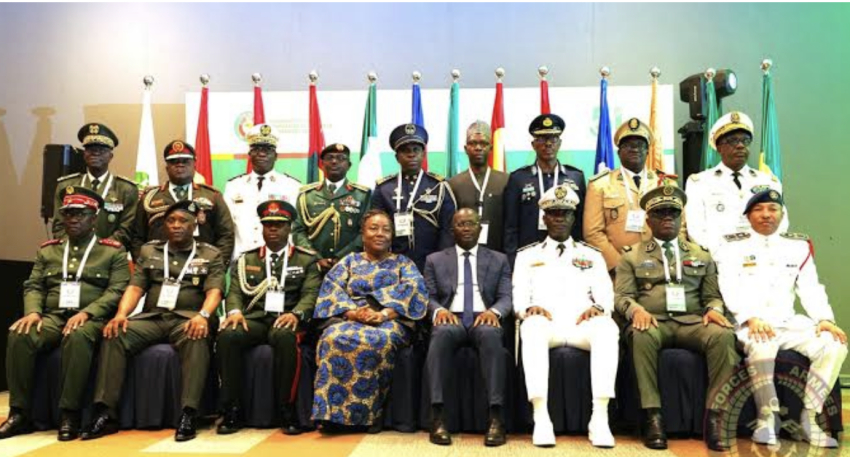 © Ministère des forces armées
Source: Dakaractu.com
Dr Bakary Sambe, Director of the Timbuktu Institute, unpacks the stakes of the 45th meeting of the ECOWAS Committee of Chiefs of Defence Staff
From 16 to 18 November 2026, Dakar is hosting the 45th meeting of the ECOWAS Committee of Chiefs of Defence Staff. The proceedings open today under the auspices of the Minister of the Armed Forces, Yankhoba Diémé, and under the direction of Vice Admiral Oumar Wade, Chief of the General Staff of the Armed Forces; they will close at Camp Dial Diop, before the delegates take part, on 19 November, in Senegalese Armed Forces Day. On the agenda: interoperability of the armed forces, follow-up of the counter-terrorism brigade approved in July 2026, collective security and the prevention of local crises. A few hours before the opening, and a few days after a briefing to the trainees of the Senegal Defence Institute’s Higher War College and Staff College, Dr Bakary Sambe, Director of the Timbuktu Institute – African Center for Peace Studies and coordinator of the FOWARD Observatory (Fragility Observatory), shares with Dakaractu his reading of the stakes of a meeting he considers “more decisive than it looks”. Interview.
Dakaractu: Dr Sambe, a meeting of chiefs of defence staff is usually a technical, almost routine affair. Why does the Dakar meeting deserve particular attention?
Dr Bakary Sambe: Because the context is anything but routine. Look at the map: since 29 January 2025, two security architectures have coexisted in the same space. On one side, ECOWAS, now down to twelve members. On the other, the Confederation of the AES (Alliance of Sahel States), with its Unified Force based in Niamey. Two chains of command, one area of operations, and… the same armed groups. JNIM and the Islamic State Sahel Province have only one map. They focus neither on Abuja nor on Niamey; they know the gaps between the two. So when the chiefs of defence staff meet in Dakar, the real question before them will not be a matter of protocol. It is simple, almost brutal: will we fight together, or lose separately?
Dakaractu: You talk about gaps. In concrete terms, where does the threat stand today?
Dr Bakary Sambe: We are facing a continuous front, from the Sahel to the coastal states. Bamako has been living under a fuel blockade since September 2025. Kidal was lost in April before being retaken on 6 October. In Ménaka, on 18 October, dozens of civilians were killed. Niamey has been struck, right up to its airport. And in the south, what many refused to see is now here: in northern Benin, attacks rose from 22 in 2021 to 176 in 2024, according to ACLED. Eight times more in three years! To the west, JNIM’s presence in the Kayes region brings the threat closer to our own borders. I often tell officer cadets at the region’s military academies: in West Africa and the Sahel, the border is no longer a line of defence. It is a seam, and a seam has to be held from both sides.
Dakaractu: The committee does not take decisions; it issues technical recommendations to the leaders. So what real weight can it carry?
Dr Bakary Sambe: Considerable weight, precisely because it is technical. Heads of State set the political course, but it is the general staffs who say what is feasible, with what resources and within what timeframe. A political decision without a military translation remains a mere communiqué. And we are at a turning point: the AES–ECOWAS ministerial meeting held on 17 October, here in Dakar, set an explicit goal, a framework agreement between two entities that recognise each other. The political process exists, or at least has been set in motion. It is now up to the military to prepare the security component of this future agreement. If the general staffs do not come with concrete proposals, others will fill the vacuum, and not necessarily the ones we would want.
Dakaractu: Interoperability: the term has been coming up repeatedly in every statement lately. What does it really mean?
Dr Bakary Sambe: Very down-to-earth things, and so much the better. To interoperate is to be able to talk to each other on the same frequencies. It is having common procedures so that a unit pursuing an armed group does not stop dead at a border while the enemy calmly crosses it. It is posting liaison officers in each other’s border command posts, conducting at least one joint staff exercise a year, and pooling what no state can fund alone: surveillance drones, tactical transport, medical evacuation, maintenance. But be careful: interoperating does not mean merging. The formula I recently used before officer trainees at the War College is this: command separately, coordinate together. Each keeps its own chain of command, but we close the grey zone between them. Because it is in this grey zone that the adversary thrives.
Dakaractu: The follow-up of the counter-terrorism brigade approved in July 2026 is reportedly at the heart of the agenda. What do you expect from the Dakar meeting on this?
Dr Bakary Sambe: I expect it to move from paper to the field. West Africa has a long history of forces announced, applauded, then forgotten for lack of funding or political will. The ECOWAS Standby Force is estimated to cost 2.6 billion dollars a year: that shows what is at stake budget-wise. The follow-up must therefore answer three very concrete questions: who funds it, who commands it, and where and against whom is it deployed? And there is one trap that must be avoided at all costs: duplication. On the AES side, the Unified Force, launched in December 2025 with 5,000 troops, is now aiming for 15,000. If the ECOWAS brigade and the AES Force operate back to back without coordinating, we will have two forces, one enemy, and a grey zone in between. JNIM needs nothing more to expand further and destabilise the region. Finally, I argue that our collective security should be funded first and foremost from our own resources. It is well known that whoever pays always ends up steering the manoeuvre.
Dakaractu: Can one seriously talk about collective security without Mali, Burkina Faso and Niger at the table?
Dr Bakary Sambe: No, and that is the whole paradox. More than 70 million Sahelians have left ECOWAS, but the threat has not left the region. I advocate neither a forced reintegration of the AES, which is politically blocked, nor the status quo, which leaves the grey zones to the adversary. I advocate differentiated, functional cooperation. In practical terms: a joint AES–ECOWAS committee of general staffs, facilitated by the African Union as a neutral mediator, with cells dedicated to intelligence, borders, resources and doctrine. We have moved from rupture to coexistence. Dakar, on 17 October, took us into coordination. The military can move faster than the diplomats on this front, because security cannot wait for an overall political settlement of the various differences.
Dakaractu: Intelligence remains the lifeblood of war. How can sensitive security information be shared when trust between the countries of the region is so fragile?
Dr Bakary Sambe: It is the most difficult question, and it cannot be sidestepped. You do not share sensitive intelligence with a partner you distrust. That is why political dialogue is the precondition for any military cooperation. But we can start with what does not expose sources: a common early-warning format, intelligence requirements defined together, a fusion cell built up gradually. And above all, we must not forget local human intelligence: traditional chiefs, religious leaders and transhumant herders see what is coming before anyone else. No cross-border operation is effective without sharing. Without common intelligence, we fight blindfolded, each on our own side of the border.
Dakaractu: The prevention of local crises is also on the agenda. Isn’t that more of a political issue than a military one?
Dr Bakary Sambe: It is the most military issue there is, if one properly understands the adversary. Sahelian jihadism has become home-grown. JNIM now recruits beyond the Fulani, among Bambara, Malinké and Dogon alike. It promotes a national narrative, negotiates local agreements, levies taxes, arbitrates disputes and governs. Its centre of gravity is local legitimacy. Faced with this, a purely military response, especially when accompanied by militia abuses or indiscriminate strikes, strengthens the enemy. In Ménaka, the Islamic State precisely invoked the abuses of a militia. Every abuse committed by the security forces is a recruitment campaign handed to the adversary. The population has become decisive terrain: we need exemplary conduct by the troops, public investigations, constructive civil-military action and a genuine response to disinformation. A single blunder can wipe out months of effort and change how people see us.
Dakaractu: Russia, Turkey, the United States, and now Algeria deploying troops to Niger. Does this interplay of partners ultimately help or hinder collective security?
Dr Bakary Sambe: It hinders it, if we do not master it. The redefinition of partnerships is real: Russia on the ground, Turkey in the air with its drones, a conditional American return focused on intelligence, the Gulf providing funding or offering mediation, Morocco offering access to the Atlantic. And Algeria is crossing a historic threshold: at the end of October, its Parliament approved a deployment to Niger, its first abroad since 1973, with the protection of energy interests at stake. The Sahel is also becoming a front in the rivalry between Algiers and Rabat. The problem is that each partner ranks threats in its own way. Diversifying is not coordinating. Without a general staff that brings it all together, the state becomes the arena in which its own allies compete. Hence a simple rule: every foreign asset must fit into a national and regional manoeuvre, never the other way round. The cancelled delivery of Mi-35M helicopters to the AES countries proved it: a single supplier is always an operational vulnerability.
Dakaractu: And where does Senegal stand in all this? Simply the host country, or a fully-fledged actor?
Dr Bakary Sambe: Senegal is a bridge nation, and it must embrace that role. By hosting the ministerial meeting on 17 October, President Bassirou Diomaye Faye restored Dakar’s place as a country of dialogue and mediation, recognised as a credible interlocutor by both sides. Hosting the ECOWAS chiefs of defence staff this week extends that role to the military sphere. But Senegal is not an observer: it shares a border and a vital corridor with Mali. The Kayes–Tambacounda sector directly concerns us, and the Dakar–Bamako corridor has already been disrupted by insecurity. I see four concrete steps for our country: fostering regular meetings between the chiefs of defence staff of both blocs, building a joint arrangement with Mali for the Kayes–Tambacounda sector, securing the Dakar–Bamako corridor, and opening our war colleges further to AES trainees. Training is the most immediate lever: officers who have learned and manoeuvred together find it easier to talk to each other tomorrow. And the fact that the delegates will attend Senegalese Armed Forces Day on 19 November will be more than a symbol: it will be a showcase of what Senegal can offer, a republican, professional army at the service of dialogue.
Dakaractu: The proceedings will close on 18 November at Camp Dial Diop. What, on that day, would make you say the meeting has been a success?
Dr Bakary Sambe: Three things, which I hope to see in the technical recommendations submitted to the leaders. First, a costed and time-bound roadmap for the counter-terrorism brigade, not a mere declaration of intent. Second, explicit proposals for coordination with the AES: direct lines between general staffs, liaison officers, joint early warning and, in time, a right of cross-border pursuit limited in depth and duration. For example, I propose a 36-month horizon: connect, then coordinate, then integrate certain functions, decoupling each stage from the political timetable. Finally, indicators to steer all of this. A posture is steered with warning lights: a rise in attacks in the north of the coastal states, corridor disruptions, abuses still uninvestigated after thirty days… What is not measured cannot be corrected.
Dakaractu : A final word ?
Dr Bakary Sambe: A geographical truth, which I repeat to everyone I speak with: none of our countries will move out of West Africa. We share the same borders, the same populations, the same corridors and, unfortunately, the same threats and the same vulnerabilities. Between ECOWAS and the AES, dialogue is no longer a diplomatic option; it is a collective security imperative, as I often say. The only question is whether we will face our challenges together, or lose separately, to the benefit of the armed and terrorist groups seeking to thrive on our divisions.
Interview by Cheikh Sadibou Fall