Guinea: Conakry bets on Simandou 2040 and the diversification of its partners Spécial
 © TDR
© TDR
Foreign Minister Morissanda Kouyaté defended in Moscow an “Africa that speaks with its own voice”, “attached to its independence and determined to work with all those who accept a relationship of equals”, at the third Russia-Africa summit. Recalling the ties forged with the Soviet Union since independence, he invited Moscow to support the country's transformation through “productive investment and technology transfers” and the development of Guinean skills, notably in education, energy, health and agriculture. Far from aligning with Moscow, Conakry is asserting its desire to diversify its international partnerships, following agreements with the United Kingdom and Algeria and a record contract with an American company.
Conakry exceeds its bond issue target
Launched on 25 September and closed on 23 October, the Guinean State's bond issue raised more than 4,500 billion Guinean francs (more than 300 billion CFA francs), against an initial target of 2,500 billion, a subscription rate of 183%. With a five-year maturity and a yield of 11%, the funds will be allocated to the priorities of the Simandou 2040 programme. While the 11% rate may seem high, it should be weighed against inflation, which reached nearly 6% in September, reducing the real cost of borrowing for the State.
Air Algérie relaunches the Algiers-Conakry route
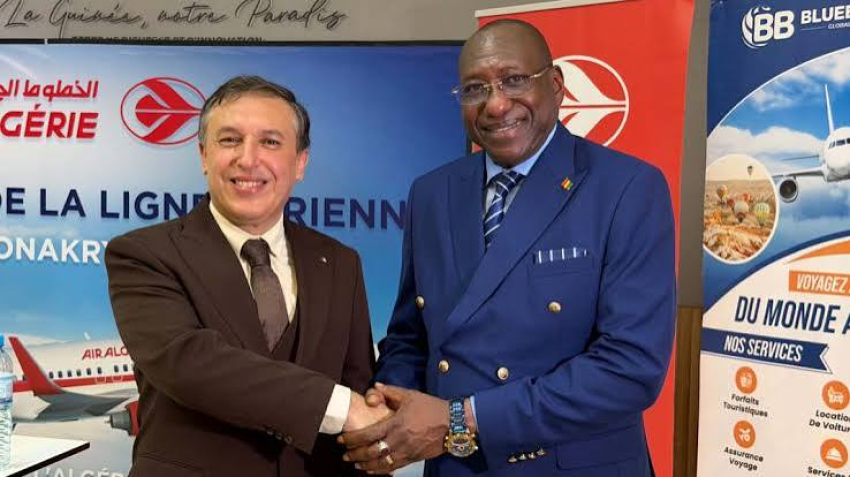
After a 45-year interruption, Air Algérie has confirmed the resumption of direct flights between the two capitals, with three flights a week. For Guinea, this new air link represents the realisation of the third pillar of the Simandou 2040 programme, which provides for strengthening transport infrastructure. Algiers, for its part, continues to develop its air connections in the region. The same week, Air Algérie announced the opening of routes to Brazzaville, Abuja and Lagos. Following the conclusion on 21 October of a military cooperation protocol with Niger, this new route confirms that Algiers' strategic repositioning in the region relies on several levers, from security to connectivity.
Fisheries enter the era of digital traceability
On 26 October, Minister Djiba Diakaté officially launched the Integrated Fisheries and Maritime Economy Management System (SIGPEM). Presented as “an act of sovereignty” and “a break with opacity”, the platform is designed to track licences, landings and vessels, in order to better monitor territorial waters and secure State revenue. The introduction of this system is fully in line with the ambitions of Simandou 2040, with the digitalisation of public administration being one of the programme's priorities.
The crackdown on shisha intensifies
Officially banned since 2021, the sale and consumption of shisha have been subject to a stepped-up crackdown since 21 September, when the Prosecutor General's Office at the Conakry Court of Appeal ordered the internal security forces to carry out search and seizure operations targeting equipment linked to this activity. On 27 October, the special services for combating organised crime presented the results of a series of seizures carried out in Conakry: 442 boxes of devices, 142 boxes of tobacco and 178 boxes of charcoal, with an estimated value of 920 million Guinean francs (around 61 million CFA francs). For Chief Superintendent Foromo Soropogui, the campaign aims to protect public health, particularly that of young people.
Dernier de Timbuktu Institute
- Burkina Faso: Mass Returns, Persistent Insecurity, and Restrictions on Information
- Burkina Faso : rapatriements massifs, insécurité persistante et opacité de l'information
- The Gambia : a presidential election amid social tension and in Jammeh's shadow
- Gambie : une présidentielle sous tension sociale et dans l’ombre de Jammeh
- Guinée : Conakry mise sur Simandou 2040 et la diversification de ses partenaires