 French
 Arabic
 English
 Portuguese
 Spanish
 Swahili



Sacré-Coeur 3 – BP 15177 CP 10700 Dakar Fann – SENEGAL.
+221 33 827 34 91 / +221 77 637 73 15
contact@timbuktu-institute.org

 © TDR
© TDR
Timbuktu Institute - Week 1 - April 2026
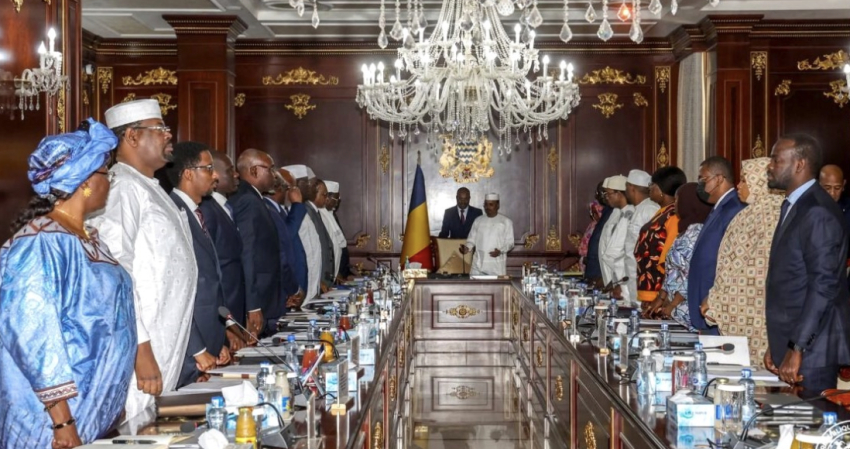
In Chad, the political climate appears to reflect the ongoing development of a political framework that combines institutional continuity with the inclusion of figures from the opposition. On April 1, 2026, Chadian President Mahamat Idriss Déby Itno appointed a new 37-member government, proposed by Prime Minister Allah-Maye Halina, combining reappointments with new appointments to strategic posts. Several ministers of state were reappointed, including Limane Mahamat (Territorial Administration), Abdoulaye Sabre Fadoul (Foreign Affairs), and Tahir Hamid Nguilin (Finance). Two women have been appointed as ministers of state: Kitoko Gata Ngoulou (Women and Children) and Mahamat Ahmad Alhabo (National Education). Among the new appointments are Sitack Yombatina, former vice president of the Transformateurs party, to the Ministry of Higher Education, and Nair Abakar, a former soccer executive, to the Ministry of Youth and Sports. Key ministries include Ndolenodji Alix Naimbaï at Justice, Ali Ahmat Akhabach at Security, and Issakha Malloua Djamous at the Armed Forces. Other key portfolios include Health, Infrastructure, Land Use Planning, Mines, Agriculture, Livestock, Environment, Transportation, Social Action, and Tourism. The team also includes three deputy ministers and several secretaries of state.
However, the appointment of Sitack Yombatina, former vice president of the opposition party, Les Transformateurs, is drawing attention. Indeed, Sitack Yombatina had left his party in August 2025 following the conviction of its president, Succès Masra—a departure perceived by some observers as a “strategic break.” In this sense, his appointment is viewed by some as a reward from the government for his resignation. As for Les Transformateurs, the party is taking a cautious stance, emphasizing that S. Yombatina remains free to make his own political choices. He succeeds Tom Erdimi, who resigned in early March following the cancellation of a reform project. In any case, this cabinet reshuffle could signal the Chadian government’s desire to consolidate its control while integrating figures from the opposition through the usual strategy of co-optation.
Persistent Security Challenges
On the security front, the Nigerian border remains a source of chronic instability. The latest major incident: the kidnapping of six Chadian nationals in the Lake Chad region by the terrorist group Boko Haram, which has released videos showing the execution of a hostage and is demanding a ransom of 500 million CFA francs for the captives’ release. In one of the videos, a hostage identifying himself as a doctor calls, under duress, on President Mahamat Idriss Déby Itno and the government to intervene quickly. The group threatens to take further action if the ransom is not paid. This kidnapping is part of Boko Haram’s standard strategy combining propaganda, psychological pressure, and violence, and comes at a time when the Lake Chad region remains fragile in terms of security.
A few days earlier, on April 2, Chadian President Déby was in Nigeria (Abuja) at the invitation of his counterpart Bola Tinubu for a working visit focused on security and economic co . Discussions centered on security in the Lake Chad basin in the face of threats from Boko Haram, with a possible strengthening of military coordination, intelligence sharing, and joint operations through the Multinational Joint Task Force (MJTF). On the economic front, discussions aimed to facilitate trade, improve transport and transit infrastructure, reduce customs barriers, and develop joint projects in energy, agriculture, and cross-border trade to stimulate the economy and regional integration. The situation around Lake Chad underscores how cross-border insecurity remains a structural challenge for Chad, where violence by terrorist groups such as Boko Haram weakens both the population and the state, which must work to provide sustainable prospects for stability.
Sacré-Coeur 3 – BP 15177 CP 10700 Dakar Fann – SENEGAL.
+221 33 827 34 91 / +221 77 637 73 15
contact@timbuktu-institute.org