 French
 Arabic
 English
 Portuguese
 Spanish
 Swahili


Sacré-Coeur 3 – BP 15177 CP 10700 Dakar Fann – SENEGAL.
+221 33 827 34 91 / +221 77 637 73 15
contact@timbuktu-institute.org

Timbuktu Institute – June 2026
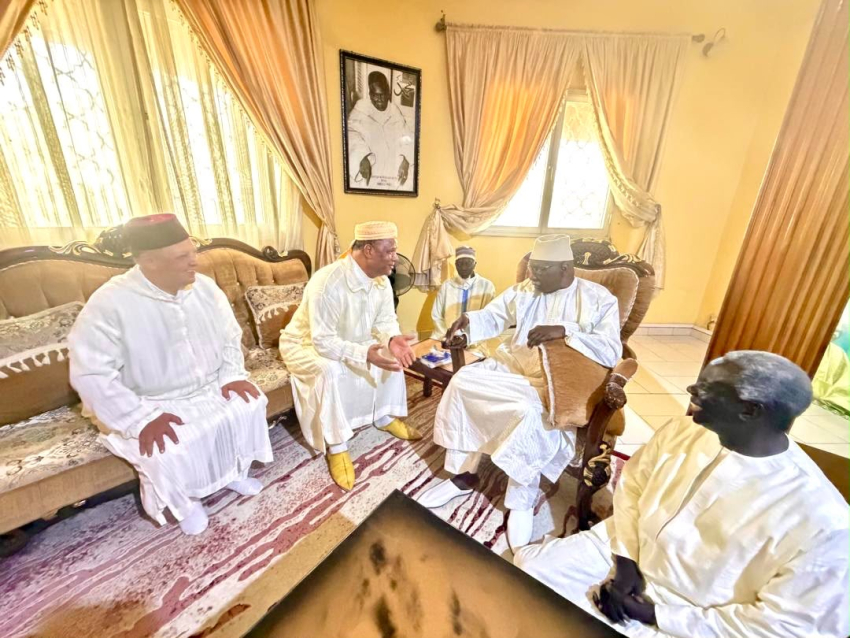
The visit by the Moroccan ambassador to the Khalife of the Tijaniya on June 26, 2026, reveals the depth of a bilateral relationship that goes far beyond conventional diplomatic interests.
Tivaouane, June 26, 2026—corresponding to the 10th of Muharram in the year 1448 of the Hijri calendar—Mr. Hassan Naciri, Morocco’s Ambassador to Senegal, visited the home of Sheikh Babacar Mansour Sy, General Khalife of the Tijaniyya Order. On the surface, it was a courtesy visit. In reality, however, it was a highly diplomatic act.
Some bilateral relations are measured in terms of treaties, trade balances, or joint communiqués. The Moroccan-Senegalese relationship cannot be understood in this way—or at least not solely in this way. It is rooted in a longer historical context: that of Sufi brotherhoods, the exchange of Islamic knowledge, and pilgrimages that, long before the advent of modern states, forged a shared destiny between the two sides of the Sahara. In his first book, published in 2011, Islam and Diplomacy: Morocco’s African Policy, Dr. Bakary Sambe extensively analyzed this unique characteristic that makes Morocco the most influential Maghreb country in sub-Saharan Africa due to the “spiritual dimension of the bond that unites it—beyond successive states and governments—to the very peoples of the region.”
The Tijaniyya Order is one of the most visible manifestations of this connection. Founded in the 18th century, it spread throughout the Maghreb and sub-Saharan Africa, eventually becoming one of the most socially, politically, and spiritually influential brotherhoods in Senegal. Sheikh El Hadj Malick Sy, founder of the Senegalese branch known as the “Malikiyya,” made Tivaouane a center of Islamic influence whose moral authority spans generations and geographies. Sheikh Boubacar Mansour Sy is today its Khalife, embodying this continuity.
For Rabat, maintaining and strengthening this bond is not merely a symbolic gesture: it is also a strategic priority. The Commander of the Faithful—a title held by King Mohammed VI, as by all the Kingdom’s sovereigns—is not merely a constitutional figure. He is a religious authority recognized by millions of Muslims in sub-Saharan Africa, which gives Morocco a capacity for spiritual influence unmatched in the region.
“This visit is part of the ongoing human and spiritual interaction between the August Alaouite Royal Family and the Senegalese Sufi brotherhoods. ” notes Ambassador Hassan Naciri
The visit took place on the 10th of Muharram, the first month of the Hijri year, a day of commemoration steeped in meaning in Islam. This was likely no coincidence. “Choosing this day for a diplomatic-spiritual visit is to deliberately frame the gesture within a religious context, signaling a shared belonging to a civilizational space and a shared memory.” The message is addressed as much to Khalife Cheikh Babacar Mansour Sy as it is to all the followers of the Senegalese Tijaniyya and beyond.
For decades, Moroccan diplomacy has cultivated this art of timing and symbolism. Royal visits to Senegal—such as King Mohammed VI’s memorable one—the construction of mosques, support for the zawiyas, training programs for Sahelian imams in Rabat, and the network of Mohammed VI Institutes for Imam Training all form part of a single, coherent strategy: to make the spiritual dimension a vehicle for a lasting presence on the continent, but also a sign of “brotherhood among peoples beyond institutional diplomatic conventions.”
The June 26 meeting in Tivaouane between the Moroccan Ambassador, Mr. Hassan Naciri, and the General Khalife of the Tijâniyya revived a memory that illustrates the depth of these relations. Sheikh Boubacar Mansour Sy spoke emotionally about his visit to Morocco in 2018, which took place following the death of his cousin, Sheikh Abdoul Aziz Sy Al Amine, who had been the Khalife. At that time, Morocco had welcomed the grieving Khalife, and the visit led to a concrete achievement among other constructive initiatives: the publication of the *Diwan*, the collected works of Sheikh El Hadj Malick Sy—a compilation of the foundational writings of the Malikite Tijaniya, the preservation and dissemination of which represent a major intellectual and spiritual challenge for the brotherhood.
This detail deserves attention. “For Morocco, editing and publishing such a seminal religious work means becoming part of the enduring memory of a spiritual community—far beyond mere publicity—and thus perpetuating the legacy of a great leader of the Tijâniyya order and adding it to the universal library,” explains Dr. Bakary Sambe, president of the Timbukru Institute. In his view, “this is a form of cultural and religious patronage that reinforces Tivaouane’s enduring loyalty to the Kingdom of Morocco;a capital of trust that, unlike traditional forms of cooperation, is not measured in euros or dollars, but carries significant weight in the long-term balance of influence”
Ambassador Naciri’s visit to the Khalife of Tivaouane illustrates a consistent doctrine: for Rabat, sub-Saharan Africa “is not a periphery to be exploited,” but “a space of shared civilization to be actively nurtured, where meaning is constructed jointly and common symbols are interpreted positively in the service of South-South cooperation,” emphasizes Sambe.
This stance, embodied in Mohammed VI’s African policy since the 2000s, rests on three pillars that this visit encapsulates: a spiritual presence; humanitarian solidarity, as demonstrated during the COVID-19 pandemic; and a firm commitment to the long-term historical perspective, while opening up prospects for South-South cooperation—a vision largely reflected in the recent Atlantic Initiative launched by the King of Morocco.
At a time when many powers are seeking to (re)define their relationship with Africa amid rapid geopolitical realignment, “Morocco offers a model that is both original and sustainable: that of a country which, century after century, has cultivated a capital of trust that the new powers on the continent struggle to build due to a lack of comparable historical roots,” notes Dr. Bakary Sambe, author of the book, “African Morocco: Trajectories of a Continental Ambition”
Sacré-Coeur 3 – BP 15177 CP 10700 Dakar Fann – SENEGAL.
+221 33 827 34 91 / +221 77 637 73 15
contact@timbuktu-institute.org