 French
 Arabic
 English
 Portuguese
 Spanish
 Swahili


Sacré-Coeur 3 – BP 15177 CP 10700 Dakar Fann – SENEGAL.
+221 33 827 34 91 / +221 77 637 73 15
contact@timbuktu-institute.org

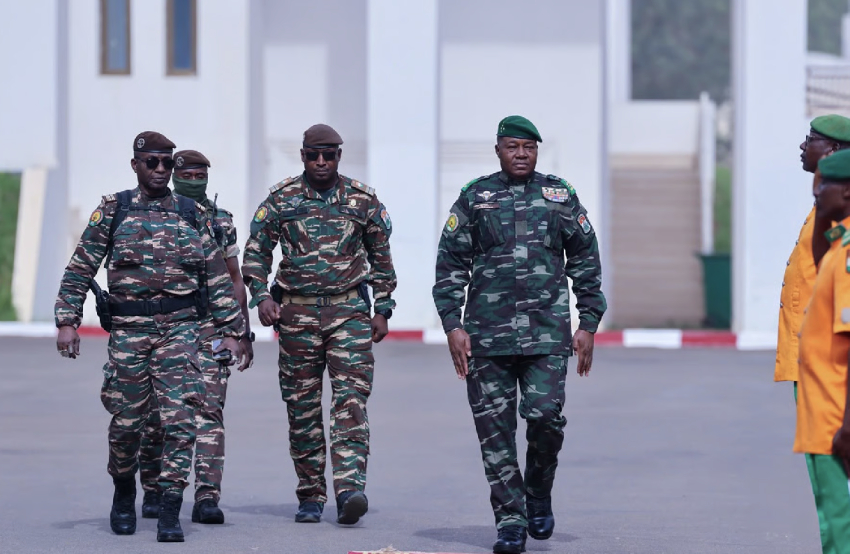 © CNSP
Timbuktu Institute - Week 3 September 2026
Niger faced one of its first internal challenges since General Abdourahamane Tiani came to power in 2023 with the attempted coup at the end of August 2026. With the support of Africa Corps, the Nigerien army very quickly regained control of strategic sites.
Crackdowns and reshuffles within the army
Two weeks after the mutiny, the Nigerien regime launched a wave of purges. Several senior army officers were thus removed from their posts. These included the dismissal and house arrest of the former Chief of Defence Staff, General Moussa Salaou Barmou, followed by the appointment of Brigadier General Mamane Sani Kiaou, former Chief of Staff of the Land Army, experienced in counter-terrorism in Tillabéry and Diffa, as head of the Nigerien army. A wave of arrests followed, notably of some forty officers and non-commissioned officers of the BSR-COS, including their alleged leader, Commander Maïhati, and of soldiers from the 1st Parachute Battalion in Niamey, as well as the arrest of civilians such as Kalla Moutari, former Minister of Defence and close associate of Mohamed Bazoum, and Kalla Ankouaro, former Minister of Foreign Affairs, and the disappearance since 31 August of journalist Moussa Kaka, with suspicions of enforced disappearance according to Amnesty International.
These measures come at a time when the State is accused of restricting freedoms, with political parties dissolved, Tiani’s term extended until at least 2030, the detention without trial of former President Bazoum and his wife, etc. Niger has reportedly also fallen in press freedom rankings, placed 120th by RSF, and is considered “not free” by Freedom House. Against this backdrop, the government published a programme for the “refoundation of the Republic” and stepped up awareness visits to the troops to restore cohesion.
A partnership with Russia reserved for protecting the military regime in power?
Despite the military’s promise to resolve insecurity by fighting JNIM and the Islamic State in the Sahel, three years after Tiani came to power, violence has increased, with nearly 2,000 civilian and military victims in 2025 and attacks reaching Niamey in 2026. Junior officers and front-line soldiers bear the brunt of the consequences, notably supply shortages and precarious living conditions, and have little influence over the conduct of the war. Some observers view the partnership with Russian paramilitaries as a means solely of protecting the regime from internal crises such as coup attempts, among others. These phenomena are also observed in the member countries of the Alliance of Sahel States.
Continued offensive and area control operations
The Defence and Security Forces are also continuing offensive and area control operations with Operation Damissa, which covers the Dosso region with the objective of destroying several dozen huts and hamlets used as hideouts by mercenaries and armed groups in the Kabéri area. Operation Naléwa Dolé in the Diffa Bosso region led to the arrest of two Boko Haram members, two lookouts and three improvised explosive device planters, including two women, as well as the seizure of military-patterned fabric intended for Boko Haram, with two of their former fighters captured. Medical consultations, distributions of food and medicine, and awareness-raising among the population are also being organised; these operations reflect the continued fight against armed groups such as Boko Haram in the south-east.
General Tiani’s deliberate silence and the use of appointments of “men of the field” are proof that the Nigerien government is taking the situation in hand despite allegations of ineffectiveness.
Sacré-Coeur 3 – BP 15177 CP 10700 Dakar Fann – SENEGAL.
+221 33 827 34 91 / +221 77 637 73 15
contact@timbuktu-institute.org