 French
 Arabic
 English
 Portuguese
 Spanish
 Swahili






Sacré-Coeur 3 – BP 15177 CP 10700 Dakar Fann – SENEGAL.
+221 33 827 34 91 / +221 77 637 73 15
contact@timbuktu-institute.org

Timbuktu Institute – January 2026
In a context where debates on migration in West Africa are often dominated by a reductive security-based approach, which equates migration flows with mere vectors of cross-border threats, it is imperative to deconstruct this unilateral view. This dominant interpretation of migration could obscure the positive and structuring contributions of migrants to local development and resilience.
Indeed, this security-focused perspective, often influenced by international agendas, masks the transformative impact of remittances from the diaspora in Europe, particularly in the departments of Bakel and Goudiry in eastern Senegal. These financial transfers play a significant role in reducing vulnerabilities by supporting community investments in education, health, agriculture and basic infrastructure, thereby strengthening local resilience to various threats, including violent extremism. By placing migration at the heart of a dynamic of inclusive development and social cohesion, this action research initiative invites us to rethink migration policies beyond repressive approaches, in order to harness their potential to prevent the risk of ideological infiltration in these fragile border areas.
The departments of Goudiry and Bakel, located in eastern Senegal in the Tambacounda region, represent a strategic and vulnerable crossroads in West Africa. Bordering directly on the Kayes region of Mali, these areas are exposed to growing security threats, illustrated by recent attacks such as those perpetrated in July 2025 in Diboli by Jama'at Nusrat al-Islam wal-Muslimin (JNIM), a group affiliated with Al-Qaeda in the Sahel. Located less than two kilometres from the Senegalese border, this incursion into the locality highlights the porosity of the borders, facilitating cross-border trafficking in arms, drugs and gold from illegal gold mining.
Areas exposed to the effects of cross-border activity with Mali
Although Senegal has remained relatively resilient to violent extremism – thanks to its historical social cohesion and prevailing religious moderation – these border regions are at risk of ideological infiltration if local vulnerabilities are not addressed and mitigated. Factors such as socio-religious tensions (linked to marginalisation due to castes and traditional community divisions, descent-based slavery and the influence of foreign preachers) weaken local religious models. They could also be exploited, as observed in other Sahelian contexts, by extremist groups that have exploited social grievances to extend their influence beyond the original epicentres of violence.
Environmentally and socio-economically, these departments face a hostile climate characterised by water and wind erosion of the soil, accelerated degradation of fauna and flora, and a glaring lack of communication routes between isolated localities, despite efforts to provide infrastructure through several programmes. High adult illiteracy rates, combined with a lack of basic community infrastructure—schools, health centres, water systems—and necessary equipment, exacerbate the precarious situation. In this context, the interventions of grassroots community organisations, projects and programmes remain limited, while means of communication remain limited, particularly in the south-eastern areas not fully covered by telephone networks.
Paradoxically, these regions are full of potential: fertile and abundant arable land, resources for firewood and timber, water for irrigation and fishing, gold mines and gatherable products, a rich and diverse livestock population, a dynamic network of associations, historical sites and a social fabric that is still relatively strong.
The history and impact of emigration in these regions
Emigration and the income it generates have played a crucial role in the socio-economic evolution and transformation of the departments of Goudiry and Bakel. This emigration, which is viewed in a positive and constructive light in these areas, has evolved in distinct phases since the 1970s. Initially seasonal, with an exodus to the peanut-growing regions of the interior or to fishing areas, it was aimed at securing income to help young men prepare for marriage. It then shifted towards Central Africa (Gabon, Central African Republic, Congo, DRC, etc.) and then West Africa, particularly the mining areas of various countries such as Côte d'Ivoire, Guinea, Senegal and Mali.
From 1974 onwards, a severe cycle of droughts led to mass immigration to Europe, motivated by the search for financial resources to support families who had remained in the country. Before that, veterans and ‘navigators’, workers employed by the merchant navy and international industrial fishing, had paved the way, followed later by more massive migratory flows to Europe, mainly to France.
‘Migrant builders’: a whole section of community resilience
In these departments in eastern Senegal, the achievements resulting from these migrations are tangible and multifaceted. From the earliest stages, migrants invested in social and community infrastructure: building mosques, schools and health posts, purchasing livestock to rebuild herds decimated during years of drought, and supporting agricultural production through improvements and equipment. This encouraged the emergence of village and inter-village associations, as well as investment in education and water systems.
In the 1980s, the network of associations, which had grown denser since the diasporas in Europe, was consolidated with the return of migrants with community and individual projects, who had increasingly benefited from training and a certain level of education, leading to greater awareness of development issues. Local housing was gradually modernised, houses were purchased in urban centres, and the living environment was improved through various facilities. Supply stores, grain banks and community financing of agricultural campaigns strengthened food security.
The 1990s saw a certain diversification in the investment of migrant income with the acquisition of household equipment (refrigerators, telephones, electrification), the development of local and interurban transport and trade, thus promoting the opening up of villages, and the creation of associations under the 1901 law from France. From 1994 onwards, the ‘Migration – Citizenship – Development’ cooperation axis developed with the GRDR became established, with, among other things, the political involvement of migrants in local elections, mayors and rural councillors. The development of North-South partnerships through twinning with French local authorities and decentralised cooperation has given rise to a clear dynamic of local development supported by returning migrants and diasporas from the eastern regions of Senegal.
A tangible impact, a need for sustainability
The overall impact can be seen in terms of increased food security through access to production factors, improved living conditions, easier access to education, rural water supply and health, as well as diversification of health services. Easier access to means of communication has had a positive impact on openness to partnerships with local authorities in the North. There has been a gradual strengthening of inter-village relations with countries and regions through migrant associations and networks. Testimonials attest to the impact of these local development initiatives on reducing women's workload, for example, but also on increasing access to decision-making bodies.
The Timbuktu Institute's Action Research Initiative
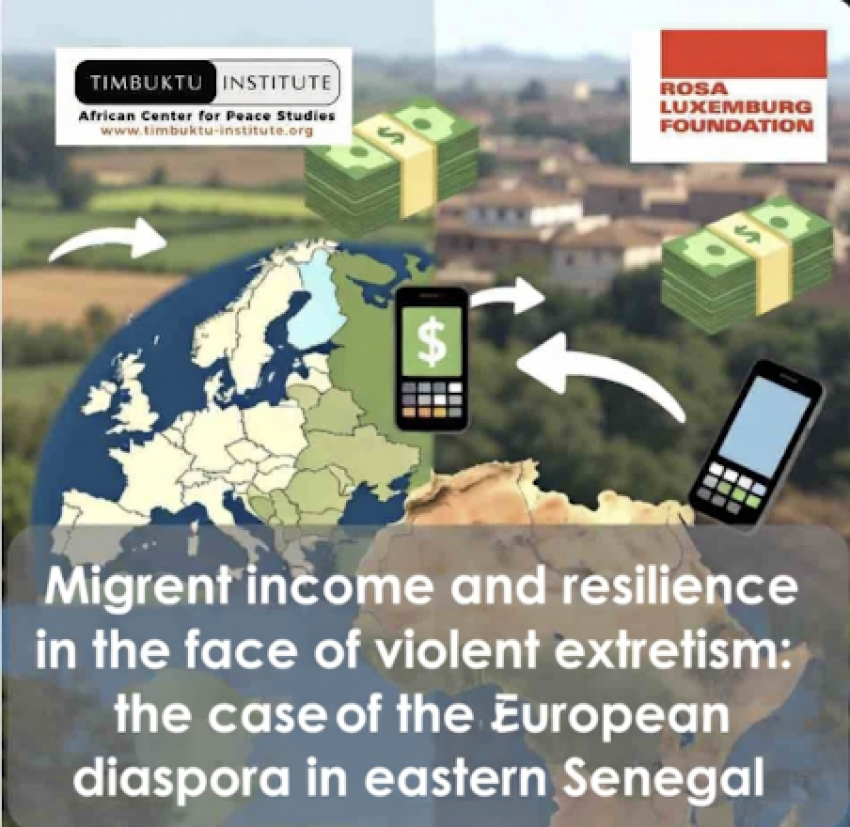
In response to these dynamics, the Timbuktu Institute, in partnership with the Rosa Luxemburg Foundation, is launching an action research initiative entitled "Strengthening resilience to crises in the Goudiry and Bakel areas: The role of remittances from the European diaspora and mitigation of vulnerabilities to counter violent extremism ." This initiative aims to analyse the important role of remittances from the region's diaspora in European countries – mainly France – in mitigating vulnerabilities and strengthening resilience.
Although these funds improve livelihoods, particularly by financing education, family farming and small businesses through community projects, poor channelling could involve them in illicit networks, exacerbating risks.
Key questions explored in this action research initiative include: How do migrant remittances (amount, frequency, use) contribute to the economic and social resilience of households? What socio-religious dynamics (caste tensions, foreign influence) increase vulnerabilities to extremism? How do populations perceive factors of resilience (social cohesion, religious moderation) in the face of threats exacerbated by the border with Mali? What community and institutional strategies – taking into account cross-border dynamics and the socio-historical continuum with Kayes – can prevent the spread of violent extremism in this area?
The project, developed as part of a partnership between the Foundation and the Institute, will be carried out in three phases:
Sacré-Coeur 3 – BP 15177 CP 10700 Dakar Fann – SENEGAL.
+221 33 827 34 91 / +221 77 637 73 15
contact@timbuktu-institute.org