 French
 Arabic
 English
 Portuguese
 Spanish
 Swahili


Sacré-Coeur 3 – BP 15177 CP 10700 Dakar Fann – SENEGAL.
+221 33 827 34 91 / +221 77 637 73 15
contact@timbuktu-institute.org

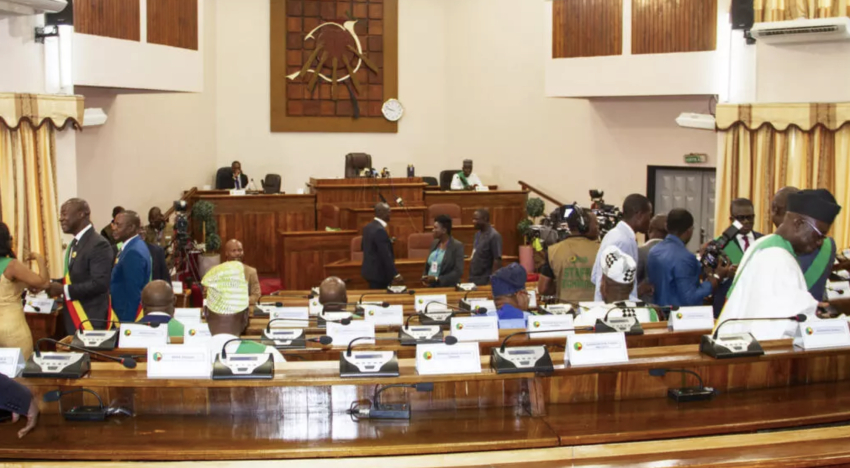 © PROSPER DAGNITCHE / AFP
Timbuktu Institute January 2026
No opposition MPs will sit in the tenth legislature. The parties of the presidential bloc, the Progressive Union for Renewal (UP-R) and the Republican Bloc (BR), came out on top in the legislative elections with 41.15% and 36.84% of the vote respectively, according to the Independent National Electoral Commission (CENA). The main opposition party, Les Démocrates (LD), with 16.16%, did not obtain at least 20% of the votes cast in all 24 constituencies, as required by the electoral code. The same was true for the two other parties in the running, FCBE (4.86%) and Moele-Bénin (1.21%). In the end, the UP-R (60 seats) and the BR (49 seats) won all 109 seats in the National Assembly. "It was an exclusive electoral code. I continue to say that this does not honor our country," lamented Guy Mitokpè, candidate in the election and national secretary of communications for the LD party. It should be noted that this is the second time—the first being in 2019—under the presidency of Patrice Talon that the parliament will be single-party. This seems to be yet another illustration of the concentration of power and the reduction of civic space that many observers have been quick to point out under Talon's governance.
Security efforts
In light of the ongoing security challenges in the north of the country, the authorities continue to implement measures to strengthen trust between local populations and the defense and security forces. A campaign to provide free medical carewas organized in Porga (Atacora department) from January 13 to 16 by the civil-military action unit of Operation Mirador. According to the organizers, more than 2,000 residents of Porga and the surrounding area benefited from medical consultations, treatment, and donations of medicines. In the same vein, on January 15, the German army provided the Beninese Armed Forces (FAB) with a batch of equipment as part of security cooperation between the two countries. This included 25 night vision devices, 60 respirators, and 500 sets of personal protective equipment. These initiatives reflect the dual strategy advocated by the Beninese authorities: strengthening the operational capacity of the defense forces while consolidating the resilience of local populations in the face of jihadist threats. International cooperation underscores the importance of bilateral support in securing the north of the country and stabilizing affected communities.
Sacré-Coeur 3 – BP 15177 CP 10700 Dakar Fann – SENEGAL.
+221 33 827 34 91 / +221 77 637 73 15
contact@timbuktu-institute.org