 French
 Arabic
 English
 Portuguese
 Spanish
 Swahili



Sacré-Coeur 3 – BP 15177 CP 10700 Dakar Fann – SENEGAL.
+221 33 827 34 91 / +221 77 637 73 15
contact@timbuktu-institute.org

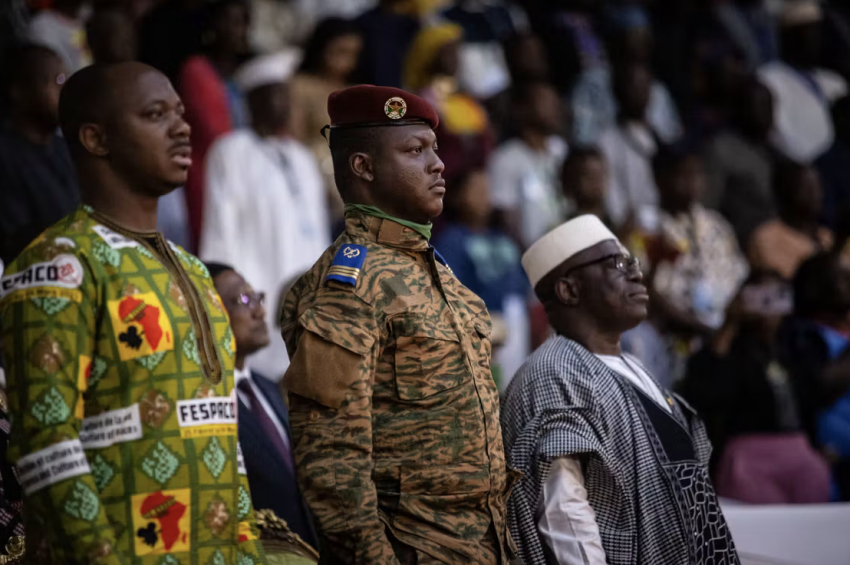 © OLYMPIA DE MAISMONT/AFP
Timbuktu Institute – Week 2 – February 2026
The week in Burkina Faso was marked by a major acceleration in the institutional restructuring that began in September 2022. Since coming to power, the military authorities had banned all political activities throughout the country. Three years later, this decision has been formalised by the country's institutions.
The dissolution of political parties: a major break in Burkina Faso's institutional trajectory ?
On 9 February 2026, the Transitional Legislative Assembly unanimously passed a law dissolving political parties, thereby repealing the 2001 charter and the 2009 law on their funding and the status of the opposition. The government justified this decision by citing the need to adapt the institutional framework to current security, political and social challenges, and stated its intention to lay the foundations for a new political system that is ‘more coherent and rooted in national realities.’ The regime led by Captain Ibrahim Traoré is now explicitly undertaking a political overhaul outside the traditional pluralist framework, justified by the need for national unity in the face of security challenges. This is no longer a transitional measure, but a complete legal dismantling of the party system. This development marks a further step in the consolidation of executive power. It considerably reduces the institutional space for dissent and raises the question of the political model that the authorities envisage for the future.
From ‘diplomatic lobbying’ to internal consolidation: analysis of a strategic repatriation
In the same spirit of consolidation, Damiba's transfer from Lomé to Ouagadougou, obtained from the Togolese authorities, would demonstrate a desire to neutralise any political alternatives. This move demonstrates the Burkinabe government's ability to mobilise diplomatic channels, despite a controversial political context. According to Africa Intelligence, this transfer is the result of sustained lobbying by Ouagadougou with the Togolese authorities. The transfer of the former Burkinabe leader to Ouagadougou is therefore part of a strategy to neutralise a potential political alternative in order to reduce the risks of internal restructuring.
Between political pressure and multilateral partnerships: Burkina Faso's balancing strategy
As part of its economic partnerships, Burkina Faso continues to seek funds to finance its development through a variety of collaborations. On 6 February 2026, Ouagadougou signed a financing agreement worth 850.2 billion CFA francs with the United Nations System for the period 2025-2030. This partnership targets three key areas: sustainable food systems, the humanitarian-development-peace nexus, and the stabilisation of fragile areas. These areas are part of the RELANCE 2026-2030 plan, mentioned in the previous issue of Météo Sahel. With this in mind, as the political arena closes, the socio-economic arena is opening up to an ambitious multilateral partnership aimed at food sovereignty and territorial resilience, while Burkina Faso faces international pressure on the issue of political freedoms.
Sacré-Coeur 3 – BP 15177 CP 10700 Dakar Fann – SENEGAL.
+221 33 827 34 91 / +221 77 637 73 15
contact@timbuktu-institute.org