 French
 Arabic
 English
 Portuguese
 Spanish
 Swahili


Sacré-Coeur 3 – BP 15177 CP 10700 Dakar Fann – SENEGAL.
+221 33 827 34 91 / +221 77 637 73 15
contact@timbuktu-institute.org

 © AFP
© AFP
Timbuktu Institute Week 1 - March 2026
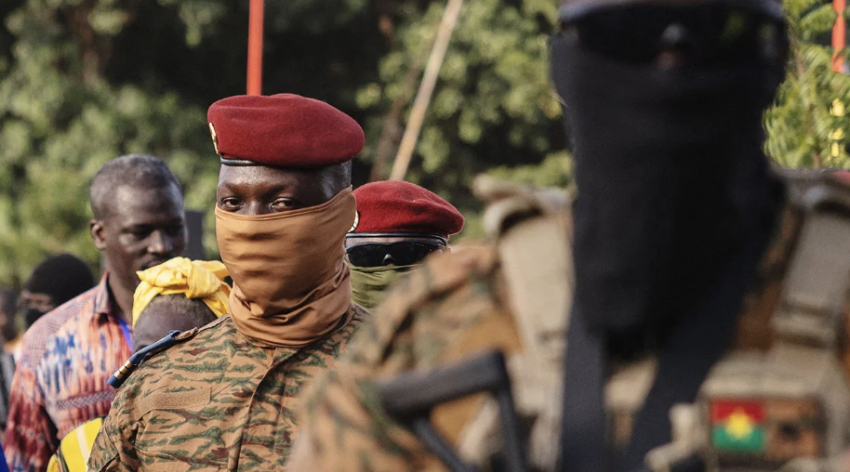
Explosions heard near the presidential palace in Ouagadougou on the night of 28 February to 1 March 2026 have reignited questions about the internal cohesion of the military regime led by Captain Ibrahim Traoré. Between suspicions of dissent within the army, security communications surrounding anti-terrorist operations, the political reorientation of 8 March and the circulation of false information about the Alliance of Sahel States, these events testify to the many military, political and informational challenges facing the Burkinabe transition.
Night-time incident at the presidential palace: divisions within the junta?
During the night of 28 February to 1 March 2026, explosions were heard near the presidential palace in Ouagadougou. This situation triggered a wave of alerts among supporters of Captain Ibrahim Traoré's military regime. However, the government ruled out the possibility of a coup attempt. According to one source, ‘it all started with a shot fired at a vehicle in which flammable products were stored.’ Other corroborating sources suggest that this reflects internal tensions among the military regarding the management of the security situation, as officers summoned to Ouagadougou did not respond to the call. This defiance of hierarchical authority is a sign of dissent within the army, against a backdrop of growing jihadist pressure. The lack of communication from the presidency is adding to the uncertainty and fuelling speculation.
February military report: 100 ‘terrorists’ neutralised
Meanwhile, the country continues to make the fight against terrorism and the reconquest of territory an absolute priority. According to the authorities, significant progress has been made by the military this month. In this context, Colonel Abdoul Aziz Ouédraogo, spokesperson for the Burkinabe Armed Forces, announced the neutralisation of at least 100 combatants during February 2026. The army also claims to have recaptured towns abandoned since 2019, such as Tongomayel, Béléhédé and Pobé-Mengao, located in the north of the country. Troops have been deployed to certain strategic areas in order to better secure the country against the terrorist threat. ‘Newly formed units have been successfully deployed in the field thanks to Burkinabe taxpayers,’ Colonel Ouédraogo said on Burkina Radio and Television (RTB). Similarly, the promotion of new artillery acquisitions and the increase in troop numbers is intended to counteract the persistent feeling of insecurity. The recapture of historically lost localities is politically significant, but its sustainability remains to be seen without collaboration with local populations and administrations.
Reorientation of 8 March: manipulation or real reform?
On another note, the Minister of Family and Solidarity, Pélagie Kaboré, announced that International Women's Day would no longer be marked by festive celebrations. The entire month of March will be devoted to concrete actions in the 17 regions, focusing on the economic empowerment of women. This symbolic reform is in line with the rhetoric of breaking with previous practices, promoted by the Traoré transition. While the goal of economic empowerment is laudable, the political instrumentalisation of 8 March for government communication purposes deserves to be questioned, especially since accompanying measures have not yet been put in place to ensure monitoring and evaluation.
False AES communiqué on the war in Iran
The Burkinabe communication services have denied the authenticity of a communiqué attributed to the Confederation of Sahel States and widely circulated on social media. This document, which bears the AES seal and the supposed signature of Captain Traoré, claims that an attack on an allied state, referring to Iran, would be perceived as a direct attack on the organisation's interests. This fake communiqué capitalises on the sovereignist positions and proven diplomatic and military rapprochement between the AES and Iran. The rapprochement between Ouagadougou and Tehran is indeed proven: as mentioned in the previous issue, the Burkinabe Minister of Defence was received in Tehran to discuss a military partnership. In this context, the fight against disinformation is all the more complex for the regime, as it must navigate between its declared alliances and the control of its international image.
Sacré-Coeur 3 – BP 15177 CP 10700 Dakar Fann – SENEGAL.
+221 33 827 34 91 / +221 77 637 73 15
contact@timbuktu-institute.org