 French
 Arabic
 English
 Portuguese
 Spanish
 Swahili

Sacré-Coeur 3 – BP 15177 CP 10700 Dakar Fann – SENEGAL.
+221 33 827 34 91 / +221 77 637 73 15
contact@timbuktu-institute.org

 © Timbuktu Institute
Timbuktu Institute - 11 March 2026
Today, in order to fully understand changes in public opinion and representations of the international scene and its dynamics, it is necessary to break with, or at least supplement, traditional approaches with a genuine analytical netnography approach for various reasons. Firstly, there has been a significant democratisation of access to information that shapes and forms African opinions at all levels, outside the confines of censorship and the mass media, but also, unfortunately, outside the confines of ethical control and repartee. Secondly, although the opinions expressed through social networks, which now determine the relationship with the West – whether real, imagined or fantasised – and its actions on the international stage, are not infallible indicators, they do reveal trends that call for a deep awareness of the changes in political and international relations in the era of digital activism and engagement.
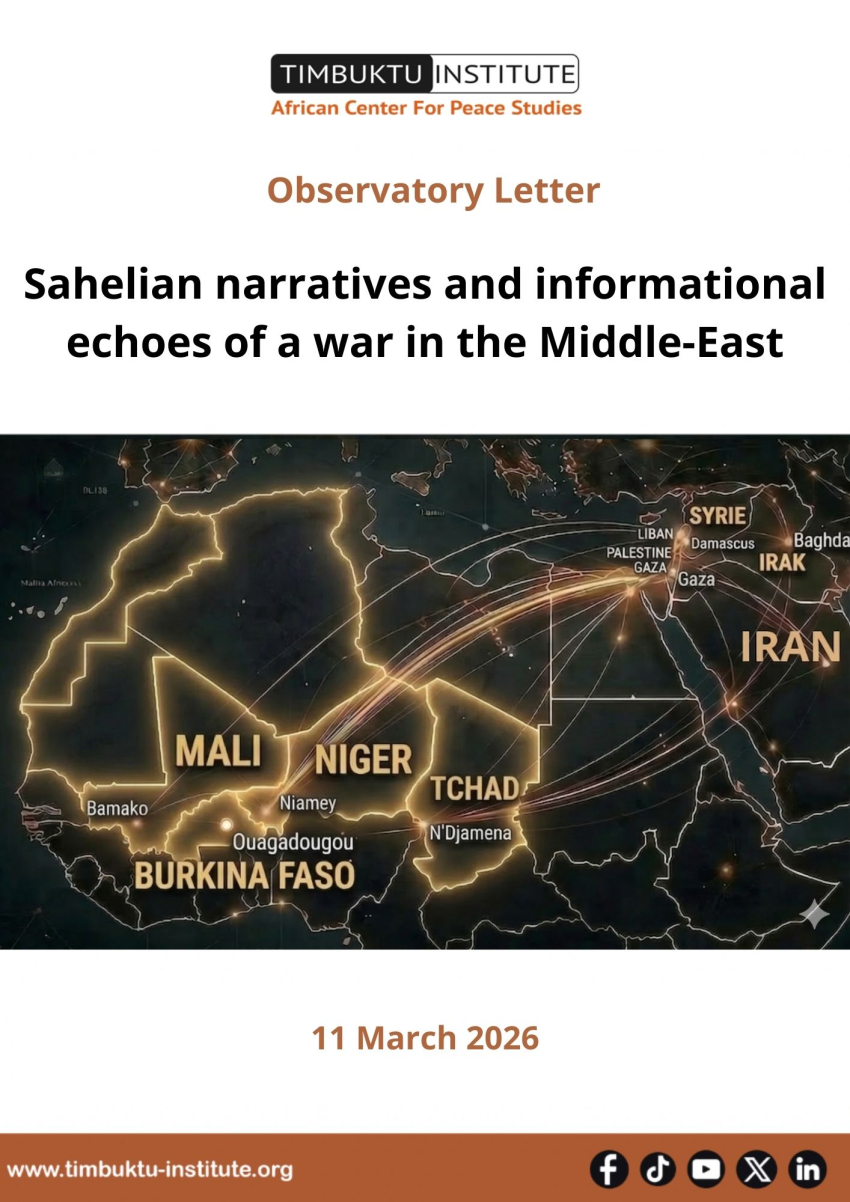
The recent military escalation between Israel, the United States and Iran has sparked a wave of reactions around the world, mobilising both governments and public opinion in various geopolitical contexts. Although in a less assertive and more wait-and-see manner, West Africa and the Sahel have been no exception. Beyond statements of support or condemnation depending on the country, West African public opinion has not failed to seize on the conflict, framing it within its own geopolitical narratives. In this regard, the particular geopolitical configuration in which many countries in the region operate provides a key to understanding these reactions.
In a context of reconfiguring alliances, public opinion has actively reconstructed a narrative of national ‘sovereignty’ centred on “resistance” to what they refer to as ‘Western imperialism’. It is in this logic that conflicts between ‘the West’ (the United States, Israel, France, etc.) and a country of the ‘global South’ are reinterpreted through the prism of their own trajectories of rupture. Thus, with this conflict, Iran symbolically occupies a prominent place in the formulation of this imaginary. In this sense, in this representation, the American-Israeli-Iranian conflict is not so much a distant conflict in the Persian Gulf as an extension of a global geopolitical order already subject to criticism in the Sahel and West Africa.
The present analysis, based on different representations and imaginaries, through continuous information monitoring, highlights three narratives: 1) a demystification of Western power centred on the failure of American and Israeli military capabilities in the face of Iran; 2) Iran presented as a model of resistance to Western hegemony; 3) the narrative of double standards and hypocrisy on the part of the international community. Taken together, these narratives shed light on how a large part of West African public opinion projects its own sovereignist aspirations onto the global geopolitical stage.
Sacré-Coeur 3 – BP 15177 CP 10700 Dakar Fann – SENEGAL.
+221 33 827 34 91 / +221 77 637 73 15
contact@timbuktu-institute.org