 French
 Arabic
 English
 Portuguese
 Spanish
 Swahili


Sacré-Coeur 3 – BP 15177 CP 10700 Dakar Fann – SENEGAL.
+221 33 827 34 91 / +221 77 637 73 15
contact@timbuktu-institute.org

 © TRD
© TRD
Timbuktu Institute – Week 2 – March 2026
In March 2026, two issues dominate the news in Togo: the opposition’s scepticism regarding attempts to amend the constitution and the renewal of the state of emergency in the north. This tense atmosphere highlights the complexity of a political system attempting to consolidate its institutions whilst managing increased vulnerability at its borders.
Towards a constitutional conflict: the ‘Don’t Touch My Constitution’ movement is on high alert
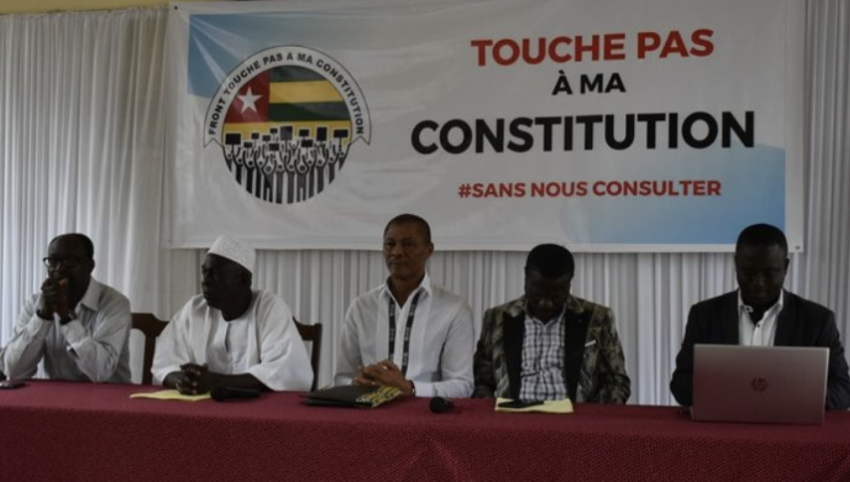
In Togo, political unrest within the opposition has dominated the news. On 11 March 2026, a coalition comprising the “Don’t Touch My Constitution” Front, the Dynamique pour la majorité du peuple (DMP), the Dynamique Monseigneur Kpodzro (DMK) and the Lumière pour le développement dans la paix (LDP) held a joint press conference. These groups outlined a strategy that the regime is reportedly implementing in stages: engaging in discussions with certain opposition members within the Permanent Consultative Framework (CPC), amending the Constitution to specify that the President of the Council must be a member of Parliament, dissolving the National Assembly, organising fraudulent parliamentary elections, and then allowing Faure Gnassingbé to become President of the Council as the new official title of the executive branch.
The stakeholders are calling on Togolese citizens to remain vigilant and are demanding the release of political prisoners, the return of those in exile and the establishment of a genuine democratic transition. If the government proceeds with a further constitutional revision and the dissolution of the National Assembly, it risks triggering social mobilisation similar to that which occurred following the establishment of the Fifth Republic in 2024. Conversely, the opening of a genuine and inclusive dialogue, involving meaningful representation from the opposition and civil society, could provide an honourable way out of the crisis, provided that procedural safeguards are impeccable.
Extension of the state of emergency in the Savanes: a high level of security amid political tension
The opposition harbours mistrust towards institutional reforms, whilst the executive argues for an increase in its powers due to the deteriorating security situation. Caught between the desire for reform in Lomé and the management of the border crisis, the government invokes the defence of the territory to maintain a tight grip on the public sphere. The President of the Council has approved the extension of the security state of emergency in the Savanes region for a further twelve months, effective from 13 March 2026, in accordance with Article 20 of the Constitution of 6 May 2024. For its part, the government cites the ongoing terrorist threat along the country’s northern borders to justify this measure. The extension of the state of security emergency in the Savanes region highlights the dual pressure facing Gnassingbé: he must both consolidate his power within the country and address the need to protect a northern border increasingly exposed to terrorist incursions from Burkina Faso. Nevertheless, securing the Savanes region remains a major challenge requiring sustained attention, without, however, justifying the indefinite restriction of citizens’ freedoms at the national level.
Sacré-Coeur 3 – BP 15177 CP 10700 Dakar Fann – SENEGAL.
+221 33 827 34 91 / +221 77 637 73 15
contact@timbuktu-institute.org