 French
 Arabic
 English
 Portuguese
 Spanish
 Swahili




Sacré-Coeur 3 – BP 15177 CP 10700 Dakar Fann – SENEGAL.
+221 33 827 34 91 / +221 77 637 73 15
contact@timbuktu-institute.org

 © AFP
© AFP
Timbuktu Institute – Week 2 – March 2026
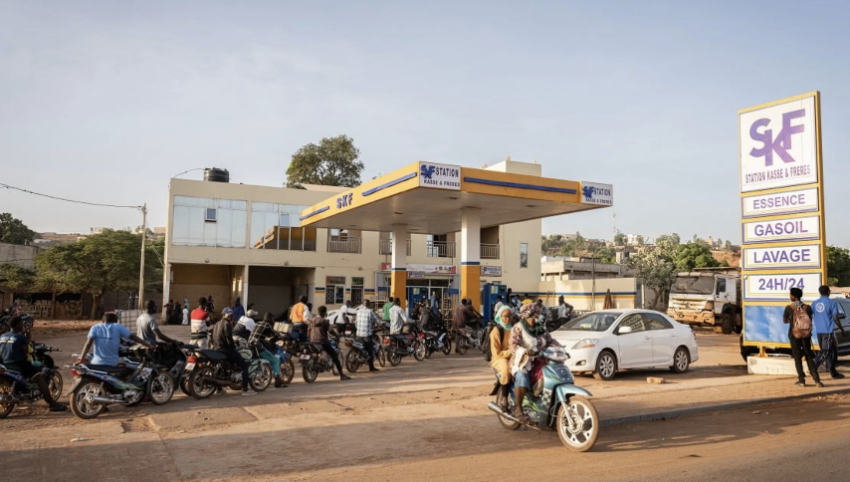
An analysis of the risks posed by the conflict between Iran, the United States and Israel to Mali’s fuel supply highlights the country’s critical dependence on global markets. For a landlocked nation, fuel is not merely an energy resource; it is the lifeblood of the national economy. The strategic concern lies in the vulnerability of Mali’s supply chain: any instability in the Strait of Hormuz triggers an immediate rise in import costs via transit ports such as Dakar or Abidjan. This imported inflation erodes purchasing power and increases domestic transport costs, creating a risk of economic paralysis and social unrest that Bamako struggles to contain with limited budgetary margins. The rise in oil prices is forcing the state to make painful trade-offs between energy subsidies and funding the war effort, a financial equation that is virtually impossible to resolve without massive external aid.
The pragmatic return of US intelligence
The rapprochement between Washington and Bamako regarding the resumption of intelligence operations marks a major geopolitical turning point in March 2026. Despite the junta’s sovereignist rhetoric and the Russian presence of the Africa Corps, this agreement reveals a mutual tactical necessity. For the United States, it is a matter of maintaining a “window” of surveillance over the expansion of Islamic State and Al-Qaeda in the Sahel, thereby preventing the creation of an uncontrollable sanctuary. For Mali, it is an implicit admission that US ISR (Intelligence, Surveillance, Reconnaissance) capabilities, particularly those involving satellites and high-altitude drones, are indispensable for securing the vast expanse of the territory, where Russian partners demonstrate clear technological limitations. This pragmatism highlights that the fight against terrorism necessitates hybrid alliances, transcending the ideological divides displayed by the transitional authorities, creating a unique coexistence between American experts and Russian instructors on Malian soil.
Institutionalisation of the AES Confederation
The expected adoption of the Year II roadmap for the AES Confederation (Alliance of Sahel States) demonstrates a desire to establish this regional bloc as a credible alternative to ECOWAS. The strategic rationale rests on the creation of an area of integrated sovereignty between Mali, Burkina Faso and Niger, aiming for total autonomy. This roadmap is no longer limited to military cooperation against armed groups, but now encompasses projects for economic integration, the creation of a potential common currency and major cross-border infrastructure works. By structuring the AES in this way,the heads of state seek to demonstrate the viability of their model of military governance and to shield themselves from international pressure through strengthened regional solidarity. The challenge is to transform a defensive alliance of convenience into a permanent and influential geopolitical actor in West Africa, capable of negotiating on equal terms with world powers.
The Peace Observatory: a tool for internal mediation
The establishment of a 30-member Observatory for Peace and National Reconciliation is an attempt at a political response to the multidimensional security crisis. Against a backdrop of the breakdown of the Algiers Agreements and the resumption of hostilities with the signatory groups, this body aims to re-establish a space for dialogue between Mali’s various factions. The challenge is to stabilise the home front by addressing local and inter-community grievances that serve as fertile ground for terrorist recruitment. However, the effectiveness of this Observatory will be judged on its actual ability to influence military decisions and to include the marginalised voices of the north and centre of the country. Without a sincere commitment to decentralisation and social justice, this initiative risks remaining a symbolic institutional showcase, disconnected from the violent realities experienced by rural populations who are waiting for concrete evidence of protection and the return of the administration.
The strategic stranglehold on Bamako by JNIM
An analysis of JNIM’s (Group for the Support of Islam and Muslims) control over the roads leading to Bamako reveals an increasingly sophisticated jihadist strategy of “indirect siege”. By controlling vital routes, the insurgents are not seeking a head-on confrontation with the army, but rather the economic collapse of the capital through attrition. This tactic of logistical suffocation highlights the military authorities’ inability to secure freedom of movement over long distances, despite announcements of a build-up in forces. The argument here is psychological and political: by making supplies uncertain, JNIM undermines the legitimacy of the military regime, which has based its credibility on the promise of restored security. The gradual isolation of Bamako is creating explosive social pressure, transforming the security threat into an urban subsistence crisis, where the lack of food and basic necessities could become the main driver of major political instability at the heart of power.
Terror on the roads: execution of lorry drivers
The execution of lorry drivers by an armed Islamist group marks a new level of terror in Mali’s logistics sector. By deliberately targeting civilian workers in the transport sector, the terrorists seek to paralyse the country’s entire commercial and vital network. The strategic rationale is to create a “logistical vacuum”: if drivers refuse to drive for fear of being murdered, markets dry up and food prices skyrocket instantly. This method aims to sever the organic economic links between production regions and the capital. It is a form of total economic warfare in which civilians become legitimate targets to break the state’s resilience. By acting in this way, armed groups force transporters either to pay exorbitant protection taxes, thereby feeding the terrorist war chest, or to cease all activity, plunging urban populations into unbearable food insecurity.
Losses suffered by Malian-Russian forces in Nampala
The devastating attack near Nampala, which claimed the lives of around ten Malian soldiers and Russian instructors, demonstrates the persistent vulnerability of fixed positions and patrols in the face of JNIM’s tactical agility. This defeat starkly highlights that cooperation with Russian forces does not provide immunity against sophisticated ambush tactics and coordinated attacks. Strategically, these regular losses erode troop morale and openly call into question the effectiveness of the current strategy of reclaiming territory through brute force. JNIM is proving that it can strike high-value targets, including foreign partners, with alarming precision and lethality. This forces the Malian military command to undertake a costly and ongoing review of its security protocols, whilst fuelling jihadist propaganda regarding the supposed failure of the Mali-Russia partnership to stabilise the centre of the country, an area that remains the main hotbed of security instability in Mali.
Diesel shortage: the blockade as a weapon of war
The jihadist blockade, leading to a critical diesel shortage in Bamako, is the tactical culmination of a strategy of methodical road strangulation. Diesel is one of the absolute driving forces of the Malian economy, powering both the emergency generators of the company Énergie du Mali (EDM-SA) and goods transport lorries. By creating this artificial shortage through the sabotage of convoys, JNIM is turning the daily lives of Bamako’s residents into a constant ordeal, causing chronic power cuts and stock shortages in shops. The strategic rationale is clear: to demonstrate tangibly that the state no longer controls its vital energy flows.This situation places the transitional government in a strategic impasse, forcing it to divert precious military and logistical resources to escort fuel convoys over hundreds of kilometres, which automatically reduces its offensive capacity on other fronts and exhausts its protective capabilities.
The emergence of suicide drones against the FAMa
The assault on the Malian army using suicide drones and shells marks a major and worrying technological escalation on Malian soil. Non-state armed groups now have access to precision-guided aerial weapons, neutralising the historical advantage of fortifications and trenches. Strategically, the insurgents’ use of ‘low-cost’ drones radically changes the nature of combat: the enemy no longer needs to physically approach bases to inflict massive damage and human casualties. The central argument is the urgent need for the Malian Armed Forces (FAMa) to acquire air defence and electronic warfare capabilities suited to this asymmetric threat from the sky. This development forces ground troops into an extremely costly defensive posture and highlights that technology is no longer the preserve of regular armies. Every outpost, every convoy, becomes a vulnerable target for a devastating attack, making the securing of conquered areas far more complex and uncertain than before.
Massacre near Kayes: the threat to the Senegalese corridor
The brutal execution of 12 drivers near Kayes, including Senegalese citizens, is a severe blow to the Dakar-Bamako trade corridor, the economic lifeline of Mali. Strategically, this attack aims to physically isolate Mali from its main maritime trading partner. The argument put forward by Human Rights Watch constitutes a flagrant violation of humanitarian law, but above all reveals a jihadist intention to sever ties of sub-regional solidarity. By killing foreigners, the terrorists seek to provoke diplomatic tensions between Mali and Senegal, whilst terrorising Senegalese transport companies into ceasing their operations. This directly jeopardises the country’s economic viability, which depends on this lifeline for its imports of essential goods, medicines and industrial equipment. The establishment of a safe haven in the Kayes area, previously spared, indicates a geographical expansion of the conflict towards the west, threatening the country’s last stable supply route.
FLA drone strikes in Gao
The use of suicide drones by the FLA (Azawad Liberation Front) against Malian and Russian forces stationed in Gao confirms the technological symmetrisation of the conflict in the north of the country. Unlike the actions of JNIM, the FLA uses these technologies for political objectives of territorial liberation and to harass forces perceived as “occupiers”. The argument put forward is to demonstrate a capability for surgical strikes on strategic urban centres and airport facilities. This proves that the northern rebels have acquired advanced technical skills and robust supply chains. Gao, a major logistics and command base, is becoming a hotbed of constant insecurity. This situation is forcing Malian forces and their Russian partners to spread their defensive resources thin, proving that control of the skies – once guaranteed by Russian and Turkish aircraft – is now being vigorously contested by insurgent forces, making any airborne operation far more risky.
Sacré-Coeur 3 – BP 15177 CP 10700 Dakar Fann – SENEGAL.
+221 33 827 34 91 / +221 77 637 73 15
contact@timbuktu-institute.org