 French
 Arabic
 English
 Portuguese
 Spanish
 Swahili






Sacré-Coeur 3 – BP 15177 CP 10700 Dakar Fann – SENEGAL.
+221 33 827 34 91 / +221 77 637 73 15
contact@timbuktu-institute.org

 © JORIS BOLOMEY/AFP
Timbuktu Institute – Week 3 – March 2026
Download the full Sahel weather report
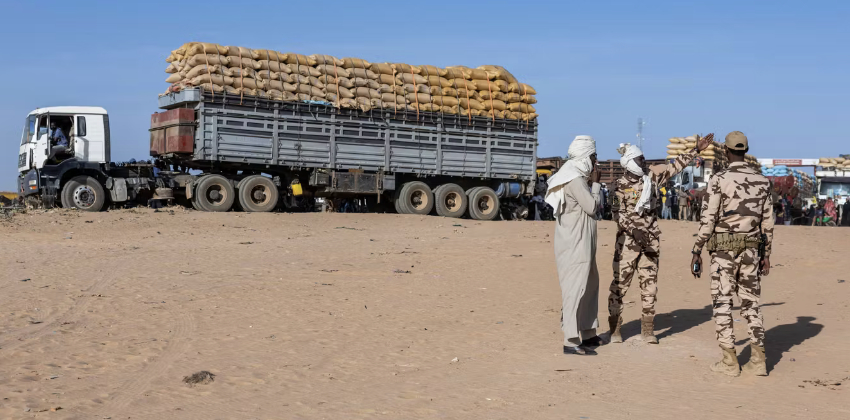
Since the start of the civil war in neighbouring Sudan in 2023, Chad has been on high alert. In the east of the country, the security and humanitarian crisis remains a major challenge for the Chadian authorities. In this regard, the state of alert has undoubtedly been raised to a higher level. On 18 March, a drone from Sudan killed 19 people when it struck the border town of Tiné, in eastern Chad. According to a military source, it was a ‘FSR drone’, referring to the paramilitary force known as the ‘Rapid Support Forces’, a belligerent in the conflict. N’Djamena has not formally commented on the origin of the attack, but Chadian President Mahamat Déby convened a defence and security council overnight, declared the army to be on “maximum alert” and ordered Chadian forces to “retaliate from tonight against any attack originating from Sudan”. Furthermore, the border is completely closed until further notice.
For their part, the RSF deny being behind the attack, shifting the blame onto their rivals in the Sudanese army. In a statement issued on 19 March, the United Nations strongly condemned the attack. Similarly, the organisation urged “the international community to step up its diplomatic efforts for an immediate de-escalation and to strengthen its financial and technical support for stabilisation and humanitarian assistance operations in this already fragile region”. As a reminder, the Sudanese conflict has already led to repeated incursions into Chad, notably in late February, killing 15 soldiers and 8 civilians. The 1,400 km-long Chad-Sudan border, situated in a desert region, remains porous and difficult to secure. Furthermore, the civil war has also caused significant population displacement, with nearly one million Sudanese refugees in Chad according to the UN.
Security: N’Djamena’s primary challenge
At the same time, faced with the multiple security challenges affecting Chad, and more particularly the capital N’Djamena, the authorities are stepping up preventive measures to protect the population and maintain public order. On 18 March 2026, the Chadian National Police announced a ban on the use, manufacture and sale of toys imitating firearms or explosives. The statement emphasises that this measure aims to prevent the risks of confusion, panic and public disorder, particularly in the run-up to major festivals in the markets of N’Djamena and other major cities.
On the international front, Chad is putting into practice its commitment – expressed in 2023 – to provide military and police forces as part of a security mission in Haiti. Indeed, from June, 800 Chadian police officers and gendarmes will be deployed there to support the Haitian police in the fight against armed gangs, following training provided by European and American partners. This initiative forms part of an international security mission, initially announced in 2023, aimed at stabilising the country and restoring public order, at a time when Haiti has been experiencing a persistent security and political crisis since the assassination of President Jovenel Moïse in 2021. Chad thus appears to be adopting a coherent security strategy, combining the management of internal vulnerabilities with diplomatic outreach abroad. This approach reveals the ambitions of a state which, despite its own fragilities, intends to exert influence on regional and international balances of power.
Sacré-Coeur 3 – BP 15177 CP 10700 Dakar Fann – SENEGAL.
+221 33 827 34 91 / +221 77 637 73 15
contact@timbuktu-institute.org