 French
 Arabic
 English
 Portuguese
 Spanish
 Swahili


Sacré-Coeur 3 – BP 15177 CP 10700 Dakar Fann – SENEGAL.
+221 33 827 34 91 / +221 77 637 73 15
contact@timbuktu-institute.org

 © Présidence du Faso
Timbuktu Institute – Week 4 – March 2026
The news was dominated by the conviction of the former Minister for Humanitarian Action, Laure Zongo/Hien, by the High Court of Ouaga 1, for embezzlement of public funds, illicit enrichment and money laundering. The verdict was handed down on 27 March: she was found guilty and sentenced to five years’ imprisonment and a fine of ten million CFA francs. She is currently the subject of an arrest warrant and has a statutory period in which to appeal to the Ouagadougou Court of Appeal. The main defendant in the case, Yé Yaké Camille, a finance manager within the same ministry, received the heaviest sentence: eleven years’ imprisonment and a record fine of over 400 million CFA francs. A third convicted defendant, Issiaka Sangaré, was sentenced to five years’ imprisonment and a fine of 67.5 million CFA francs for complicity in embezzlement. Four other defendants were acquitted, either on the balance of probabilities or because the offences were not proven.
Conviction of former minister Laure Zongo/Hien: a landmark verdict amid the anti-corruption drive and political questions in Burkina Faso
This verdict forms part of the so-called “Tiégnan II” case, proceedings linked to the Amidou Tiégnan case, a civil servant sentenced in December 2024 to 15 years’ imprisonment for embezzlement estimated at over 3 billion CFA francs. These funds, intended for more than two million people displaced by terrorism, had been embezzled through overcharging, fictitious contracts and forged signatures. The Burkinabe state, which joined the proceedings as a civil party, will receive 35 million CFA francs in compensation for the financial loss caused by the former minister. This verdict has been hailed as “historic” by anti-corruption organisations. It demonstrates the new authorities’ stated determination to break with the corrupt practices of previous regimes. However, independent observers question the risk of the judiciary being exploited for political ends, in a context where the independence of the judiciary is difficult to establish under the authority of a military executive.
Protest in Ouagadougou against the European Union: a sovereignist statement and consolidation of the AES’s anti-Western rhetoric
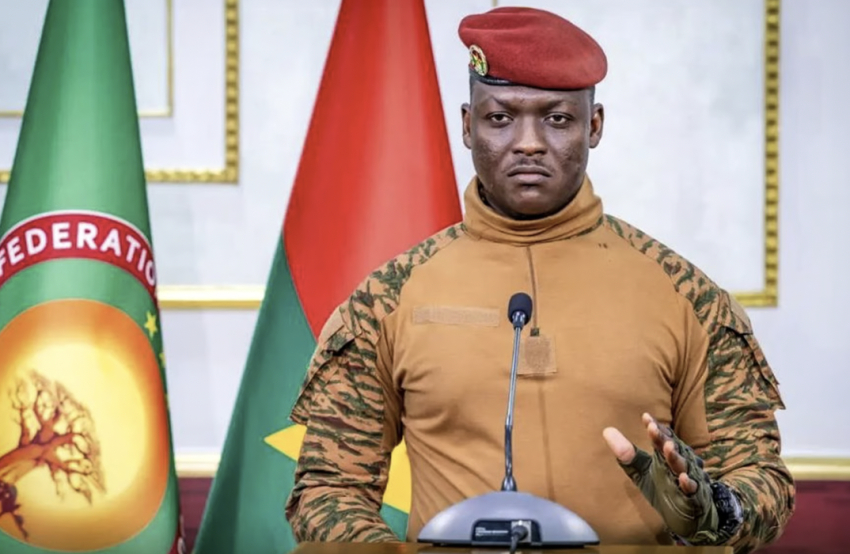
On a different note, on 21 March 2026, a public demonstration took place in Ouagadougou to denounce the resolution adopted on 12 March by the European Parliament, which called for the release of former Nigerien President Mohamed Bazoum. Organised by groups close to the military regime, this demonstration brought together several hundred people. In response, the AES Confederation issued a statement signed by Captain Traoré, in his capacity as acting president, in which he described the European move as “serious, concerted and deliberate interference in the internal affairs of a sovereign state”. Through this statement, the AES reaffirms that it accepts “neither orders nor lessons” on matters of governance. This stance reflects the anti-Western rhetoric that has permeated the regime’s communications since 2022.
This outcry illustrates the profound shift in relations between the Sahel and the European Union, in which sovereignty has become the central pillar of the political legitimacy of AES regimes. By categorically refusing to receive the European Parliament, Captain Traoré is not merely defending a Nigerien ally; he is also enshrining a new model of regional governance that rejects traditional mechanisms of international pressure, such as sanctions, resolutions or calls for human rights. This ‘closed-door’ strategy aims to turn every external criticism into a lever for internal popular mobilisation, thereby consolidating a Sahelian bloc that now seeks its strategic partners outside traditional Western spheres of influence. On the security front, the intensification of attacks by JNIM and ISIL in the east and north of the country confirms the inability of the Burkinabe Armed Forces (FAB) and the Volunteers for the Defence of the Fatherland (VDP) to halt the territorial expansion of armed groups, despite large-scale operations such as ‘Tourbillon Vert 2’. The risk of the conflict spreading to neighbouring countries remains high.
Sacré-Coeur 3 – BP 15177 CP 10700 Dakar Fann – SENEGAL.
+221 33 827 34 91 / +221 77 637 73 15
contact@timbuktu-institute.org