 French
 Arabic
 English
 Portuguese
 Spanish
 Swahili



Sacré-Coeur 3 – BP 15177 CP 10700 Dakar Fann – SENEGAL.
+221 33 827 34 91 / +221 77 637 73 15
contact@timbuktu-institute.org

 © 2025 Prémices Média
Timbuktu Institute - Week 1 - April 2026
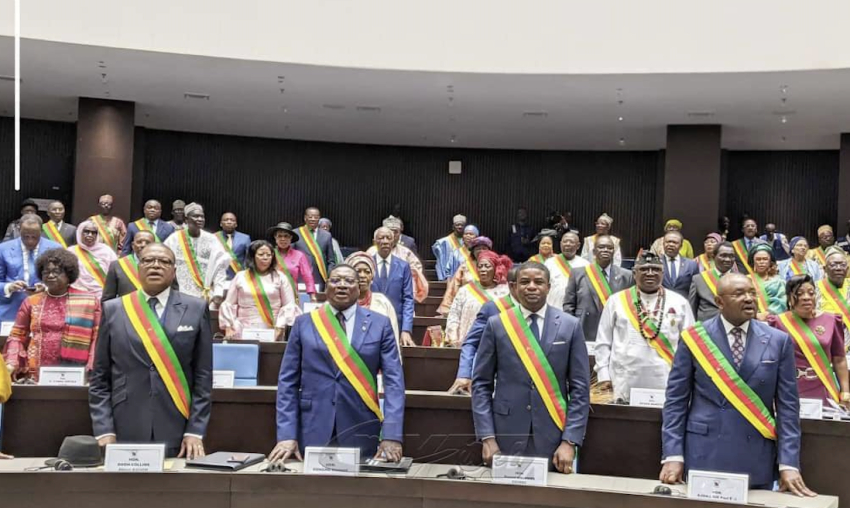
This marks a major institutional overhaul. While the issue had been in the news for several months, it is now official. On April 4, 2026, the Cameroonian Parliament approved a constitutional amendment reintroducing the office of Vice President of the Republic, appointed by President Paul Biya, to ensure succession in the event of a vacancy in the presidency. This reform replaces the previous mechanism under which the President of the Senate served as interim leader. The reform was adopted by a vote of 205 to 16 and is part of a broader institutional restructuring, following the recent replacement of the presidents of both chambers of Parliament. According to Grégoire Owona, deputy secretary-general of the Central Committee of the RDPC (the ruling party), “the tandem to be formed by the president and the vice president (…) should enable the state and our administration to function more effectively.” As might be expected, this justification has fallen flat with the opposition. Issa Tchiroma Bakary, who came in second in the last presidential election, described this reform as a “violation of democratic principles” and an “illegitimate drift toward monarchical power.” Opposition leader Maurice Kamto, for his part, denounced it as an “institutional and constitutional coup d’état” in a video posted on Facebook.
If the creation of this new position is stirring up such strong emotions, it is because, implicitly, the issue of Biya’s succession is at stake. The central issue would therefore be how Biya (93) chooses to organize the transfer of power in Cameroon. In this sense, the creation of this position would mark a new stage in a conservative transition. According to Jeune Afrique, certain names are already being mentioned behind the scenes, depending on various scenarios. Ferdinand Ngoh, secretary-general of the presidency and close to the first lady, is the favorite, but faces internal opposition. Other options include a northerner to balance the regions, an Anglophone to ease the crisis in the Northwest and Southwest, or a southerner such as Samuel Mvondo Ayolo or Louis-Paul Motaze. In addition, the name of Franck Biya (the president’s son) is also being mentioned. For now, Cameroon is hanging on the head of state’s every word; he might choose not to appoint a vice president immediately, to keep uncertainty hanging over his succession.
Migrants in exchange for $30 million
Alongside the political turmoil shaking the country, another issue—this time of a humanitarian nature—is also causing concern among the national and international public. According to a New York Times investigation, in exchange for $30 million paid to the UNHCR (United Nations High Commissioner for Refugees), Yaoundé reportedly agreed to take in migrants deported from the United States, even though none of them are Cameroonian. Since January 2026, at least 17 people have been transferred—often handcuffed and unaware of their destination—and then placed in detention centers without being able to apply for refugee status. The agreement has drawn sharp humanitarian and legal criticism, with some calling it “the sale of human beings.” This arrangement is part of broader pressure from Washington on several African countries, including Ghana and Equatorial Guinea, to take in deported migrants as part of . In this case, the agreement raises significant ethical and humanitarian concerns, with several experts condemning the exploitation of migrant populations and the direct link between financial aid and migration policy. Furthermore, this episode highlights how the migration issue can become a tool for diplomatic and financial pressure.
Sacré-Coeur 3 – BP 15177 CP 10700 Dakar Fann – SENEGAL.
+221 33 827 34 91 / +221 77 637 73 15
contact@timbuktu-institute.org