 French
 Arabic
 English
 Portuguese
 Spanish
 Swahili


Sacré-Coeur 3 – BP 15177 CP 10700 Dakar Fann – SENEGAL.
+221 33 827 34 91 / +221 77 637 73 15
contact@timbuktu-institute.org

 © 2026 Actu Cameroun. Tous droits réservés
Timbuktu Institute – Week 3 – may 2026
Download the full Sahel weather report
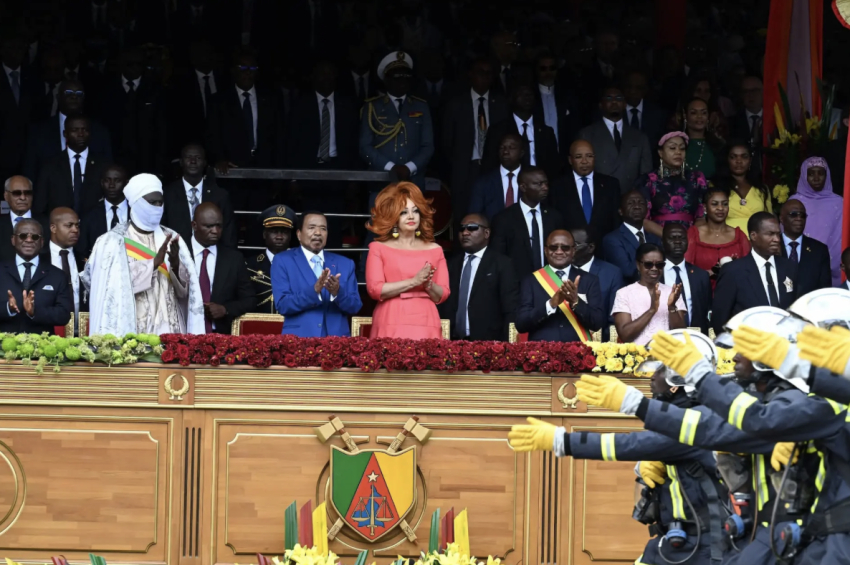
Since 1972, every 20 May, Cameroon has celebrated its National Unity Day. This commemorates the adoption by referendum in 1972 of a state uniting the English-speaking and French-speaking regions, thereby replacing the country’s federal structure. The theme chosen this year was ‘National unity, the pillar of our defence and the foundation of Cameroon’s development ’. As is customary, this grand national ceremony saw President Paul Biya preside over the military and civilian parade on Boulevard du 20 Mai in Yaoundé. However, beyond the pomp and ceremony, the National Unity Day celebrations appear to have painted a picture of Biya’s Cameroon that is both contrasting and true to life. Indeed, several notable signs emerged. First and foremost, the ceremonial position of Franck Biya, the president’s son, who was placed closer to his father than the Secretary-General of the Presidency, Ferdinand Ngoh Ngoh, has reignited speculation about his possible appointment to the post of Vice-President, which was reinstated last April. Furthermore, the surprising absence of the Chief of the Defence Staff, René Claude Meka, did not go unnoticed. Aged 87, Cameroon’s most senior military official had already failed to attend the dress rehearsals for the parade on 18 May, nor the preparatory technical meeting chaired by the Minister of Defence. In early May, a rumour of his death had circulated on social media before being denied by the director of the Yaoundé University Hospital, who confirmed that he had been admitted and subsequently discharged from the facility.
On the military front, Jeune Afrique reports that there had been quiet discontent in the run-up to the ceremonies: several senior officers from the Rapid Intervention Battalion had denounced the misappropriation of bonuses and a lack of equipment, going so far as to threaten to go on strike during the preparations. Payments were only made at the last minute. In the English-speaking regions, the army was on high alert in Buea and Bamenda, with arrests reported in Ekona. Politically, opposition participation remained uneven. Maurice Kamto’s MRC was banned from marching in several towns, whilst Issa Tchiroma Bakary’s FSNC opted for a boycott. Finally, Paul Biya, who appeared visibly frail on screen despite instructions given to national television to limit close-ups of him, is reported to have recently cancelled a medical trip to Switzerland following a warning from allied intelligence services, fuelling further speculation about his state of health.
Strengthening ties with neighbouring Chad
In the wake of the celebrations, military cooperation between Cameroon and Chad has reached a new milestone. Indeed, in Yaoundé, Cameroon’s Minister of Defence, Joseph Beti Assomo, received his Chadian counterpart, General Issakha Malloua Djamous, for a working session focused on the common security challenges facing the sub-region and the implementation of the bilateral defence framework agreement signed in September 2025. This meeting followed on directly from the 20 May celebrations, in which a contingent from Chad’s National and Nomadic Guard had participated as guests of honour at the parade. Discussions focused on strengthening operational cooperation between the two armies, particularly in the face of cross-border threats and Boko Haram’s activities in the Lake Chad basin, which the two nations share along more than 1,100 kilometres of common border.
Ultimately, this year’s Unity Day celebrations have above all highlighted a Cameroonian state in the throes of political turmoil at the highest levels of power, whilst also grappling with security challenges along its borders. In this context, it appears that strengthening regional partnerships is one of the most readily available adjustment mechanisms at Yaoundé’s disposal.
Sacré-Coeur 3 – BP 15177 CP 10700 Dakar Fann – SENEGAL.
+221 33 827 34 91 / +221 77 637 73 15
contact@timbuktu-institute.org