 French
 Arabic
 English
 Portuguese
 Spanish
 Swahili


Sacré-Coeur 3 – BP 15177 CP 10700 Dakar Fann – SENEGAL.
+221 33 827 34 91 / +221 77 637 73 15
contact@timbuktu-institute.org

Timbuktu Institute Week 1 – June 2026
Download the full Sahel weather report
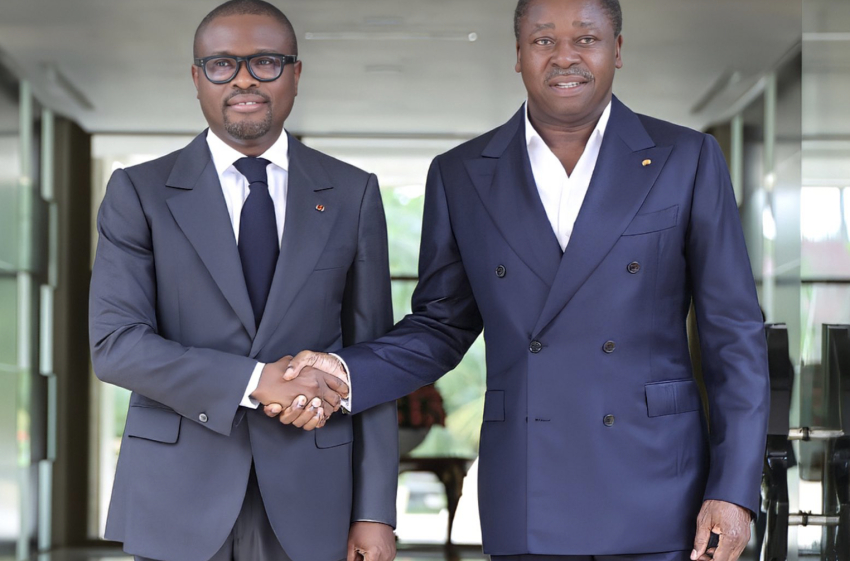
Togo features prominently in the good-neighbourly diplomacy initiated by Benin’s President Romuald Wadagni since his accession to the presidency. During this sub-regional diplomatic tour, Togo’s President Faure Gnassingbé received his Beninese counterpart on 4 June in Lomé. The two leaders reaffirmed their commitment to deepening bilateral ties on several fronts.
On the economic front, they welcomed the growth in trade and agreed to strengthen connectivity infrastructure, improve the flow of cross-border corridors and enhance the attractiveness of the region for private investment. On the security front, they expressed their shared concern regarding the terrorist threat and cross-border crime, committing to intensify their coordination in this area. Both sides also reiterated their commitment to West African integration and to the principle of the free movement of people and goods. The visit concluded with Wadagni inviting Gnassingbé to pay an official visit to Benin, an invitation accepted in principle, the details of which will be finalised through diplomatic channels. Furthermore, it is noteworthy that Togo is endeavouring – relatively speaking – to position itself, like Benin, as a bridge between the Alliance of Sahel States (AES) and ECOWAS. In this regard, Lomé appears to be deriving particular benefit from presenting itself as an alternative logistics hub. Indeed, as West Africa’s only natural deep-water port, the port of Lomé is capturing a growing share of Sahelian trade flows and accounted for 29.5% of transport services related to WAEMU exports in 2024, generating 185 billion CFA francs in revenue.
Further proof, if any were needed, of the country’s desire to position itself as a continental mediator: since 7 June, Lomé has been hosting the biannual review meeting on the mediation process regarding the crisis in eastern DRC, under the auspices of the African Union. Bringing together representatives from the EAC, SADC and ICGLR, the meeting aims to review the AU’s roadmap and harmonise African peace initiatives, against a backdrop of ongoing violence and a resurgence of Ebola in certain parts of the country. The panel of facilitators, which includes former presidents Catherine Samba-Panza and Sahle-Work Zewde, reaffirmed its alignment with the approach of the AU’s designated mediator, Togolese President Faure Gnassingbé, who had already hosted a similar initial meeting in January.
A simmering social unrest
However, Togo – a country whose leaders readily present on the international stage as a logistics hub and a key regional mediator – faces growing social unrest at home. Several opposition and civil society organisations have responded to the call of the 6 June Movement (M66) by launching a day of peaceful protest dubbed “Togo on Hold” on 6 June 2026. The signatories – including the DMK-Originale, the DMP and the “Touche Pas à Ma Constitution” movement – have called on citizens to suspend their activities to protest against rising fuel prices, deteriorating living conditions and what they describe as poor governance and restrictions on freedoms under Faure Gnassingbé’s regime. A “pot-banging protest” was also planned for the night of 5 June as a prelude to this mobilisation. Consequently, contrary to the image of a regional mediator, a more structural challenge continues to emerge for Lomé: reconciling geopolitical ambitions, economic performance and a continuing demand for political participation and social justice.
Sacré-Coeur 3 – BP 15177 CP 10700 Dakar Fann – SENEGAL.
+221 33 827 34 91 / +221 77 637 73 15
contact@timbuktu-institute.org