 French
 Arabic
 English
 Portuguese
 Spanish
 Swahili


Sacré-Coeur 3 – BP 15177 CP 10700 Dakar Fann – SENEGAL.
+221 33 827 34 91 / +221 77 637 73 15
contact@timbuktu-institute.org

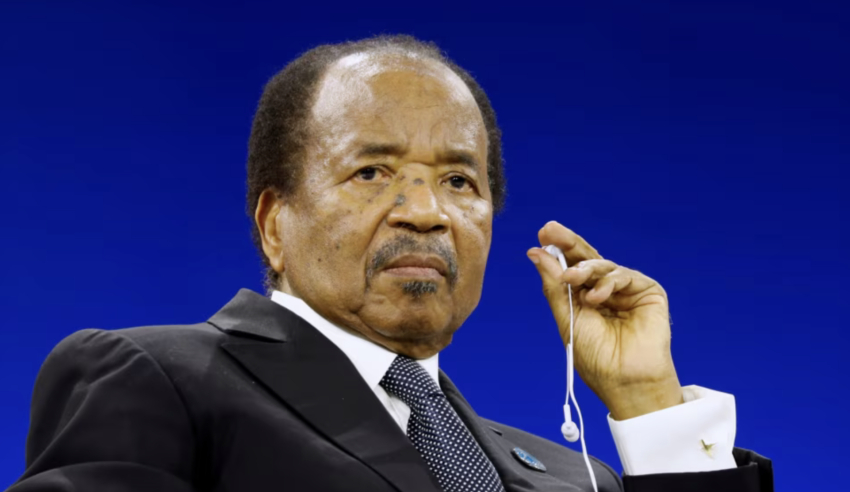 © REUTERS / Charles Platiau
Timbuktu Institute Week 1 – June 2026
Download the full Sahel weather report
This is an unprecedented institutional situation in the country since 1992. Since President Paul Biya’s re-election in October 2025, Cameroon has still not formed a government. Whilst the country remains in limbo, the appointment of a new government team does not appear to be a priority for the Head of State. At least at the highest levels of government, it is the overhaul of the institutional framework that is currently the focus of attention. According to Jeune Afrique, among the projects under consideration are the creation of new ministries and the transformation of certain existing portfolios, such as expanding the Ministry of Justice to include human rights or reorganising the Ministry of State Audit to incorporate public transparency.
Further restructuring is also being considered in the mining, infrastructure and women’s affairs sectors, as well as in higher education and research, with a view to strengthening the coordination and effectiveness of public policies. Furthermore, the institutional overhaul also includes major innovations, notably the possible creation of a post of Deputy Prime Minister and preparations for a future Vice-Presidency of the Republic. Furthermore, projects relate to digital security, with the establishment of a dedicated agency attached to the intelligence services, as well as to territorial reorganisation, including administrative redrawing and a shift in the role of local and traditional authorities withi . Thus, the executive vacuum and apparent stagnation seem to be the silent signs of power struggles in which the balance of power within the regime is at stake and, by extension, the continuity of the Biya system.
Pending this comprehensive reorganisation, on 2 June 2026 the Head of State appointed the members of the High Council of the Judiciary, primarily by reappointing the incumbent members of this body. This decision follows a long period of paralysis lasting nearly six years, during which the Council had not met, which had severely affected the functioning of the judicial system. This deadlock had led to numerous consequences, notably a freeze on the recruitment and induction of magistrates from training colleges, as well as a halt to appointments across the various courts.
An opposition on the wane
Whilst institutional restructuring is well under way in the corridors of power, the political opposition, losing momentum, is struggling to survive. In a statement issued on 3 June, opposition figure Maurice Kamto announced that he had referred the matter to the Constitutional Council to challenge the legality of the presidential decree extending the term of office of municipal councillors until April 2027. According to him, this decision constitutes a violation of the Constitution. In his petition, the MRC president argues that the Head of State has exceeded his powers by unilaterally extending the terms of local elected representatives, describing this measure as a “flouting of the law” and an attack on democratic principles.
Meanwhile, the pre-trial detention of opposition figure Djeukam Tchameni has been extended by six months, until 5 December 2026, a decision contested by his lawyer, who deems it “illegal”. Arrested shortly before the announcement of the results of the presidential election on 12 October 2025 and charged, among other things, with undermining state security, he is currently being held at Kondengui Prison in Yaoundé. The defence argues that this extension is based on an irregular procedure, with no clear progress in the investigation or sufficient justification, which calls into question the exceptional nature of pre-trial detention. Ultimately, the current political situation in Cameroon highlights the position of an opposition that is the victim of a huge imbalance of power in its relations with an executive that has time and institutions at its disposal.
Sacré-Coeur 3 – BP 15177 CP 10700 Dakar Fann – SENEGAL.
+221 33 827 34 91 / +221 77 637 73 15
contact@timbuktu-institute.org