 French
 Arabic
 English
 Portuguese
 Spanish
 Swahili


Sacré-Coeur 3 – BP 15177 CP 10700 Dakar Fann – SENEGAL.
+221 33 827 34 91 / +221 77 637 73 15
contact@timbuktu-institute.org

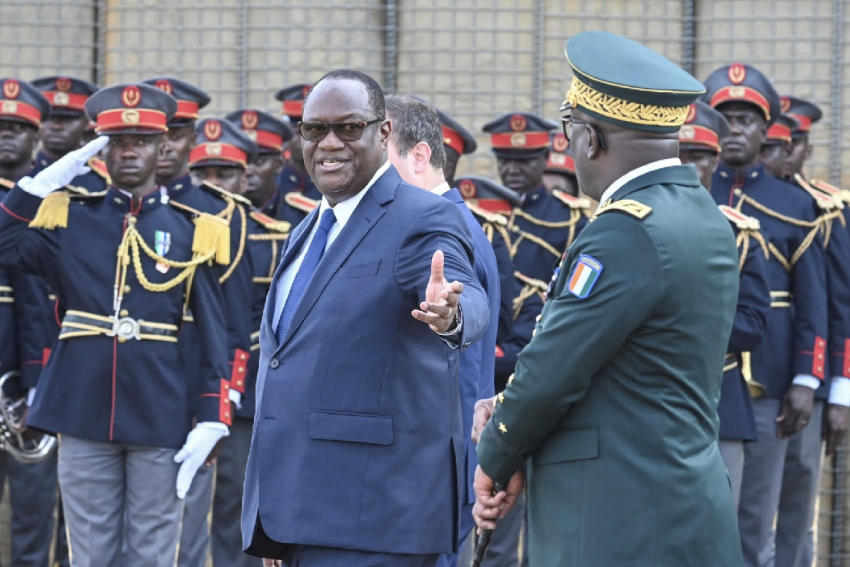 © ISSOUF SANOGO / AFP
Timbuktu Institute Week 3 - June 2026
In West Africa, it certainly appears that the geopolitical climate is one of building bridges and fostering connections, regardless of political differences. The recent diplomatic marathon by Benin’s President Romuald Wadagni already provides a clear example of this. Although it has never truly closed the door to discussions, Côte d’Ivoire is now seeking to establish itself as a key mediator in the regional architecture of stability. Thus, on the sidelines of the Eurosatory defense industry trade show in France, Ivorian Defense Minister Téné Birahima Ouattara stated on June 17 that Abidjan was ready to resume security cooperation with Mali and Burkina Faso, against the backdrop of the persistent terrorist threat in the Sahel. According to him, the fight against armed groups requires a “pooling of forces,” since no single state can tackle the threat on its own. Finally, he raised the possibility of resuming joint operations among the three countries, which, in his words, were “abruptly” halted in 2024. While stating that he is “sincerely ready” to resume this cooperation if Bamako and Ouagadougou express a willingness to do so, the minister reiterated that Côte d’Ivoire continues to rely on a strategy combining military deployment in the north of the country with international cooperation, particularly with France, which he described as a “privileged partner” in the areas of training, intelligence, and equipment. Pending a response from the countries concerned, this offer of cooperation—similar to Benin’s—is good news for security prospects, even if it reflects a more pragmatic approach in which West African countries seem to be “doomed to work together,” as Beninese President Wadagni has repeatedly stated.
Meanwhile, Ivorian Minister Téné Birahima Ouattara was received on June 17 at Matignon by French Prime Minister Sébastien Lecornu, as part of a meeting described as strategic for bilateral relations between Abidjan and Paris. Discussions focused on defense issues and the consolidation of a partnership already considered strong, while paving the way for new opportunities for cooperation. According to both parties, this meeting served to reaffirm the depth of the historical ties between Côte d’Ivoire and France and to explore new avenues for strategic partnership. On this occasion, Téné Birahima Ouattara praised the quality and stability of this cooperation, particularly in the field of defense, confirming Abidjan’s commitment to further strengthening its relations with Paris. This makes the Ivorian stance crystal clear: any partner capable of bolstering the country’s stability is welcome.
Demolitions in Abidjan: An Investigation Launched
For many residents of Abidjan, the month of June began with a series of evictions that, as usual, drew widespread criticism.
After many voices spoke out against the violence of the demolitions, the High Authority for Good Governance (HABG) announced on June 19 the opening of an investigation following the demolition of several homes and businesses in the Campement neighborhood of Koumassi, carried out without authorization by an individual who is currently wanted by authorities. The case raises questions about the legality of the land occupation and the circumstances under which the individual in question, Jacques Brou, could have claimed approximately 34 hectares of land, even though he had previously served as a local elected official. HABG President Épiphane Zoro Bi is particularly concerned about a possible case of “illicit enrichment” or “conflict of interest,” with the investigation set to rely on land titles and administrative records to determine responsibility. Pending the findings, calls have been made—notably by former President Laurent Gbagbo—for support for displaced families through temporary housing solutions.
Sacré-Coeur 3 – BP 15177 CP 10700 Dakar Fann – SENEGAL.
+221 33 827 34 91 / +221 77 637 73 15
contact@timbuktu-institute.org