 French
 Arabic
 English
 Portuguese
 Spanish
 Swahili







Sacré-Coeur 3 – BP 15177 CP 10700 Dakar Fann – SENEGAL.
+221 33 827 34 91 / +221 77 637 73 15
contact@timbuktu-institute.org

 © Copyright | Sud Quotidien
Timbuktu Institute, Week 3, July 2026
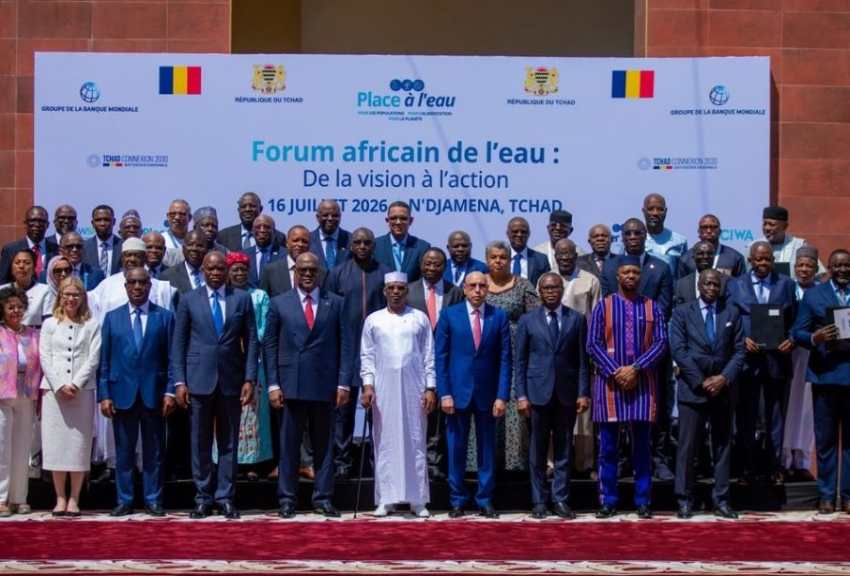
Chad, a country sometimes reduced in image as much as in geography despite its regional importance, appears determined to change the picture. And to do so with dynamism. Over the space of two days, on the occasion of the African Water Forum held in N'Djamena on 15 and 16 July 2026, the country chose to display its most continental ambitions. The forum concluded with the adoption of the N'Djamena Declaration, a roadmap aimed at strengthening water security in Africa. African leaders reaffirmed their determination to accelerate investment, reforms and cooperation to guarantee universal access to drinking water and sanitation. The discussions also highlighted the scale of the continent's water-related challenges. More than 400 million Africans still lack access to drinking water, while climate change threatens available resources. The situation of Lake Chad, whose surface area has shrunk dramatically over recent decades, was presented as a symbol of the environmental vulnerabilities facing Africa. As a reminder, this forum also serves as a preparatory step towards the UN Water Conference scheduled for December 2026 in Abu Dhabi. The chair of the African Ministers' Council on Water (AMCOW), Cheikh Tidiane Dièye, called on African countries to defend a common position at that international gathering, by showcasing their solutions and structuring projects. Through the N'Djamena Declaration, African leaders now aim to move from commitments to concrete action, notably through the development of water infrastructure, improved water governance and stronger regional cooperation. With the National Water Pact signed on 16 July, Déby Itno clearly intends to make water a lever for economic growth and social resilience; the pact confirms Chad's ambition to position itself, on the regional stage, as a country capable of attracting massive external financing to address its structural challenges.
Furthermore, during the Forum, the Chadian president announced the lifting of entry visa requirements for all African nationals starting 1 January 2027, presenting the measure as a “gesture of openness to all of Africa”. An announcement that came as a surprise even within government ranks, at a time when the Ministry of Foreign Affairs had only recently been working on rolling out a generalised e-visa system. According to the authorities, the decision reflects a determination to strengthen African integration and the free movement of people and goods, but also responds to more concrete economic objectives, set out in the national “Chad Connection 2030” plan, which aims to improve the country's appeal to investors and overcome the structural handicap of its landlocked position. By thus joining the continental movement already under way in Benin, Rwanda, Ghana, Togo and Congo, N'Djamena is sending a strong political signal in favour of pan-Africanism, whose effective implementation will nonetheless represent a considerable institutional and security challenge for authorities still in the process of administrative adaptation.
Domestic stability still needs to be consolidated
This diplomatic and economic sequence, driven by a resolutely outward-facing agenda, nonetheless contrasts with a more worrying domestic security reality. According to the UN Office for the Coordination of Humanitarian Affairs (OCHA), Chad recorded, in the first half of 2026, a 40% rise in inter- and intra-community conflicts compared with the same period in 2025, with 35 incidents recorded against 25 a year earlier. While the human toll paradoxically fell (81 dead and 167 wounded, against 136 dead and 166 wounded in 2025), the proliferation of flashpoints remains a cause for concern nonetheless. The Lake and southern provinces each account for 37% of incidents, ahead of the east (23%) and the centre (3%), with intercommunal conflicts linked to access to natural resources (notably in agro-pastoral and land-tenure areas) accounting for 23 of the 35 incidents recorded alone. This violence has caused population displacement, destruction of property and, in some eastern areas such as Kobé and Dar-Tama, restrictions on humanitarian access linked to local tensions. In response, the authorities have stepped up their presence through the deployment of defence forces and the involvement of administrative and customary authorities, without this dispelling OCHA's concerns about the risk of a worsening of the violence.
From these various dynamics, it emerges, at the very least, that Chad finds itself somewhat at the crossroads of two major issues. On one hand, a diplomatic and economic agenda resolutely open to the continent. On the other, a domestic reality in which managing communal tensions remains a precondition for any lasting stability, without which the ambitions on display in N'Djamena risk remaining, to a large extent, an exercise in international communication.
Sacré-Coeur 3 – BP 15177 CP 10700 Dakar Fann – SENEGAL.
+221 33 827 34 91 / +221 77 637 73 15
contact@timbuktu-institute.org