 French
 Arabic
 English
 Portuguese
 Spanish
 Swahili


Sacré-Coeur 3 – BP 15177 CP 10700 Dakar Fann – SENEGAL.
+221 33 827 34 91 / +221 77 637 73 15
contact@timbuktu-institute.org

Source : Sud Quotidien
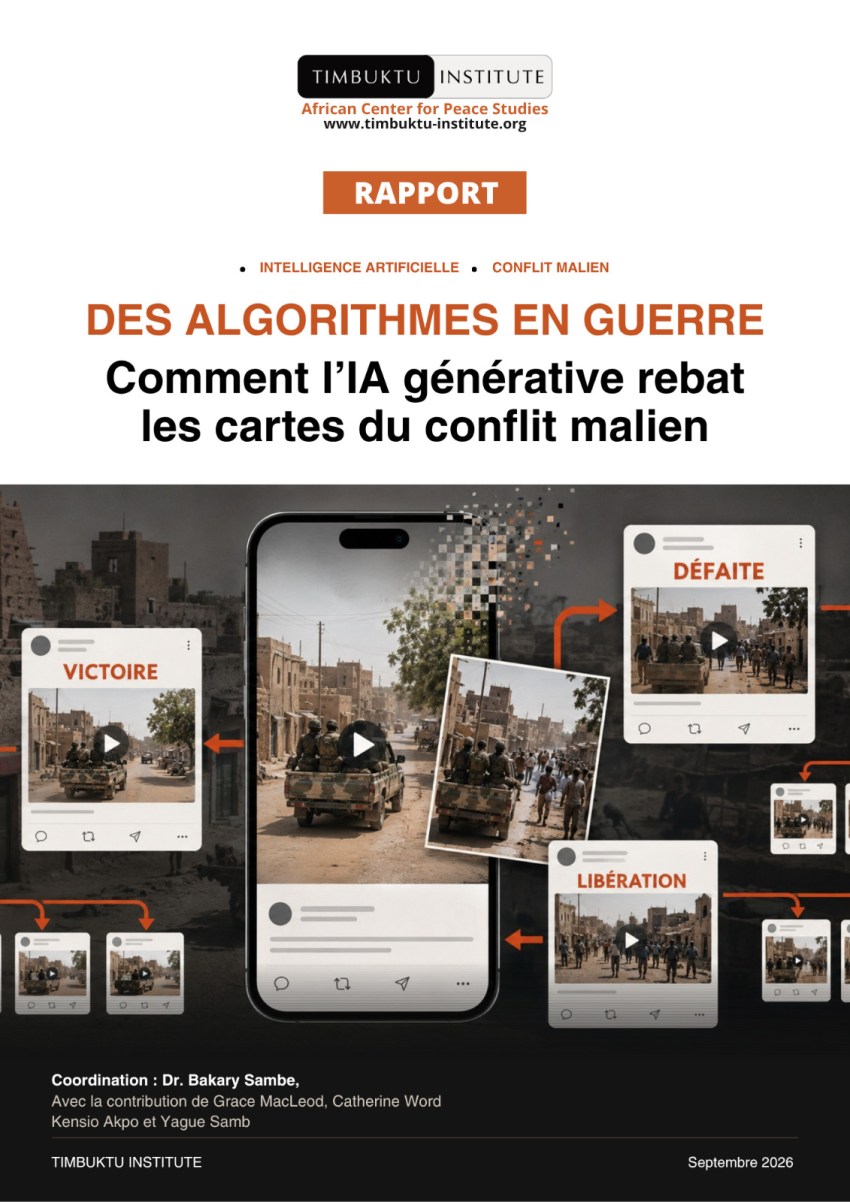
Jihadists, separatists, military authorities and Russian Africa Corps: every belligerent in the Malian conflict has seized on generative artificial intelligence to boost its propaganda. A report by the Timbuktu Institute, titled “Algorithms at War: How Generative AI is Reshaping the Malian Conflict” and published on 9 September 2026, offers an unprecedented overview of these differentiated uses and warns of a major risk: the line between the real and the fabricated is growing blurrier by the day, even as terrorist groups’ recruitment capabilities keep expanding.
For more than a decade, Mali has been the theatre of a multidimensional conflict. Alliances form and dissolve according to shifting strategic interests. The tactical alliance forged in 2025 between the jihadist group JNIM, affiliated with Al-Qaeda, and the Azawad Liberation Front (FLA), a predominantly Tuareg separatist movement, is the most recent illustration of this pattern. Their coordinated assaults in April 2026 dealt a severe blow to the Malian army and to its Russian Africa Corps allies. But another transformation is under way – less visible, yet just as decisive. The information space has become a battlefield in its own right. And on this new front, generative artificial intelligence (GenAI) is starting to rewrite the rules of the game. The Dakar-based research centre Timbuktu Institute has devoted a report to this phenomenon, titled “Algorithms at War.” Published on 9 September 2026, it examines how each actor in the conflict is appropriating this technology according to its capabilities, resources and objectives.
Jnim: a still-timid experiment with ai
Among the four parties examined, JNIM shows the most limited use of generative AI. So far, the group has confined itself to producing visual material to accompany its propaganda. In June 2026, its media arm Az-Zallaqa circulated AI-generated posters announcing the release of videos commemorating the “victorious” attacks of April 2026. These posters, which depicted fighters in combat, bore the telltale marks of AI generation: buildings and vegetation blending into one another, background details reduced to blotches, and an unnaturally smoothed-out image. According to the researchers, JNIM “is still at a limited but potentially evolving experimental stage”. The example of the Islamic State, which already uses AI for multilingual translation, video production and personalised recruitment chatbots, points the way forward. JNIM could, in time, harness AI to translate its messages into some fifteen regional languages (Bambara, Fulfulde, Zarma, Hausa, Tamasheq, etc.) or to dub its propaganda videos into local languages, thereby reaching populations that have so far been excluded from jihadist discourse.
The FLA and its synthetic characters
In contrast to this centralised approach, the FLA and its supporters are pursuing a more decentralised and creative strategy. TikTok accounts run by sympathisers or members of the movement feature recurring synthetic characters. The most famous of them is “Azzghim,” a Tuareg fighter whose fiery statements against the Africa Corps are widely shared. The Timbuktu Institute scrutinised several of his videos. Pixel anomalies, unnatural body movements, strange colouring and audio inconsistencies all betray his artificial nature. Azzghim does not exist. He is a pure algorithmic creation. These AI characters offer the FLA several advantages. They help humanise the movement, tailor messages to specific audiences (a teenage character can more easily reach young people), and facilitate the spread of a narrative favourable to Azawad independence. Above all, they provide unmatched operational security: it is impossible to capture or interrogate a fighter who has no physical existence. The report identifies a network of TikTok accounts that repost and amplify one another, creating the illusion of massive grassroots support. One account, @tawri.n.azawad, with 207,000 followers, is devoted exclusively to reposting and remixing Azzghim’s content. Another, @asnan831, features a teenage boy whose still images likewise show signs of AI generation.
Russia’s africa corps: disinformation at industrial scale
At the other end of the spectrum, the use of generative AI reaches its highest degree of sophistication on the Russian side, through the Africa Corps. Backed by the resources and expertise of the Russian state, the paramilitary group has folded AI into an already well-oiled disinformation apparatus. Several investigations have documented this strategy. In 2024, OpenAI and Meta identified a Russian operation using OpenAI’s models to generate comments, articles and images in English and French, aimed at accounts targeting sub-Saharan Africa. A joint technical report by VIGINUM (France’s agency for vigilance against digital interference), the United Kingdom’s Foreign Office and the European External Action Service exposed an information-manipulation network dubbed “AI-Freak.” This apparatus, run by African Initiative – a media outlet classified as a Russian propaganda platform – relies on a network of fake news sites and AI-generated content. African Initiative is the media arm of the Africa Corps. These Russian operations are not aimed solely at spreading disinformation. As an OpenAI report notes, AI-generated images serve above all to “catch the eye, so as to make articles or social media posts more engaging”. The goal is to saturate the information space, blur the trail and make attribution difficult, thanks to a built-in capacity for plausible deniability.
The malian regime: an attentive pupil
The Malian military regime, increasingly isolated on the international stage and dependent on Russian support, is gradually settling into this ecosystem. According to mapping by the Africa Center for Strategic Studies, the Alliance of Sahel States (AES) – which brings together the juntas of Mali, Burkina Faso and Niger – is the second-largest sponsor of disinformation in Africa, after Russia. Malian authorities have adopted Russian methods as their own. One TikTok account, @6tm_officiel, has amassed more than 436,000 followers by publishing AI-generated content extolling the successes of the Malian Armed Forces (FAMa) and the Africa Corps. One of its videos, showing the recapture of Kidal after the April attacks, reached 4.7 million views. Run by an individual based in Bamako, the account is representative of an “intensive production phenomenon” of content favourable to the regime. By controlling the national media space and leaning on these digital relays, the junta is seeking to shore up its legitimacy and divert attention from the deteriorating security situation.
A full-scale laboratory
Mali, the report concludes, is becoming “a veritable laboratory of AI-assisted information warfare”. Generative AI acts as a force multiplier for every actor involved. It lowers technical barriers, speeds up content-production cycles and makes attribution of messages more complex. It does not create new fault lines, but it amplifies and accelerates those that already exist – whether communal, ideological or geopolitical. The threat is not confined to propaganda. The report raises the possibility that JNIM could use chatbots to tailor its recruitment messages to the psychological profile of each target. It also mentions the use of AI-coupled drones to sharpen military targeting. The Africa Corps, for its part, could integrate autonomous weapons into its operations. The challenge facing Sahelian states and their partners is immense. Traditional strategies for preventing violent extremism, which still rely on collective awareness campaigns, risk being overtaken by AI’s capacity to produce hyper-personalised messages. The response will need to combine stronger digital literacy, enhanced detection capabilities, and prevention strategies adapted to this new technological reality. In a saturated information space, the ability to tell the real from the fabricated is itself becoming a matter of security. And for Malian populations, caught in the crossfire of manipulated narratives, truth has never been more of a weapon of war.
Alioune BA
AI Ethics Specialist
Sacré-Coeur 3 – BP 15177 CP 10700 Dakar Fann – SENEGAL.
+221 33 827 34 91 / +221 77 637 73 15
contact@timbuktu-institute.org