 French
 Arabic
 English
 Portuguese
 Spanish
 Swahili


Sacré-Coeur 3 – BP 15177 CP 10700 Dakar Fann – SENEGAL.
+221 33 827 34 91 / +221 77 637 73 15
contact@timbuktu-institute.org

 © Nadia Ben Mahfoudh/RFI
Analysis Note – Timbuktu Institute – July 2026
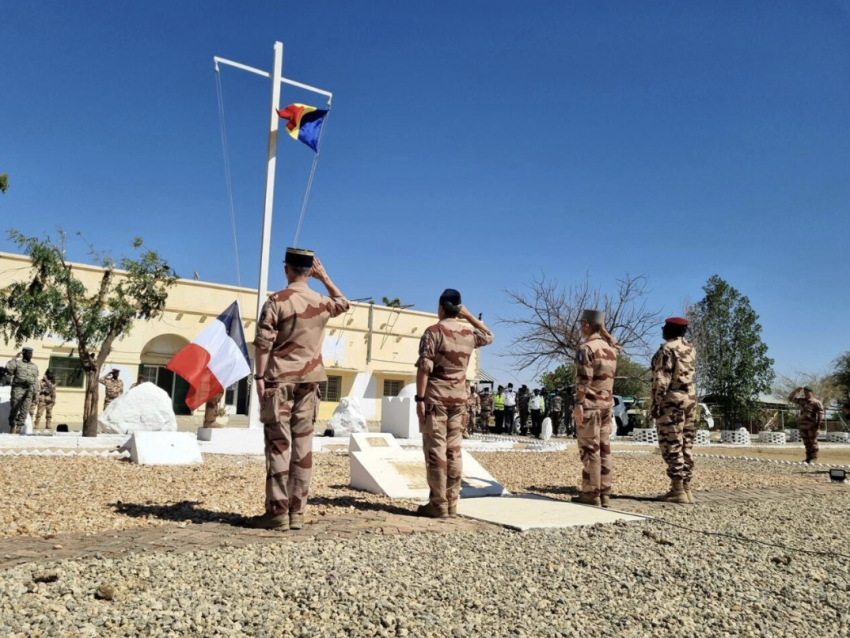
Following a year of tensions between Chad and France, marked by the withdrawal of French troops from Chadian territory, the two countries have decided to turn a new page in their bilateral relations. According to both sides, this development forms part of a ‘revitalised partnership, based on mutual respect and shared interests’. Indeed, this diplomatic thaw also provides an opportunity to redefine the scope of their military cooperation. Under the new arrangements envisaged, Paris could provide intelligence and training support to Chadian forces, without, however, carrying out a large-scale deployment of troops, as was the case in the past. This new approach appears to respond to the geopolitical shifts currently affecting the Sahel. Indeed, Chad, a pivotal country in the Sahel-Saharan region, has been facing a deterioration in its security situation since 2023, particularly along its eastern border as a result of the conflict in Sudan. From a broader perspective, this rapprochement comes at a time when France, forced to end its military presence in Mali, Burkina Faso and Niger, appears to be favouring a more discreet strategy of re-engagement in the region, based in N’Djamena. Unsurprisingly, this development – which could complicate the security balance in the Sahel – is inevitably giving rise to questions and debate.
It is in this sense that the rapprochement between Paris and N’Djamena is viewed with a degree of suspicion, particularly within the countries of the Alliance of Sahel States (AES) and pan-Africanist online circles. Within these circles, it appears to be interpreted as a sign of France’s desire to quietly rebuild a framework for regional influence. Chad is thus presented as a bridgehead, or even a launch pad, intended to enable Paris to regain its capacity for military projection in the Sahel. It is in this context that this paper is situated; it focuses less on the operational reality of this rapprochement than on the reactions and perceptions it has provoked in sub-Saharan digital spaces. More specifically, it seeks to shed light on the main narrative frameworks used to interpret the resumption of Franco-Chadian military cooperation and the political and ideological representations they help to disseminate.
To address this research question, this analysis—which is primarily a study of perceptions—relies on a qualitative approach involving digital monitoring and netnography. A corpus of posts shared on social media and digital platforms was compiled from the main accounts of activists, influencers and so-called pan-Africanist media outlets, followed by a thematic analysis of the content to identify the main discursive registers, the argumentative strategies employed and the associated political imaginaries. Ultimately, this paper aims to shed light on the narrative logics that shape perceptions of this French return to Chad and the symbolic reconfigurations it fosters within the Sahelian information landscape, particularly amongst certain Chadian and other Sahelian actors, regardless of whether or not they are ideologically aligned with the AES’s sovereignist perspective.
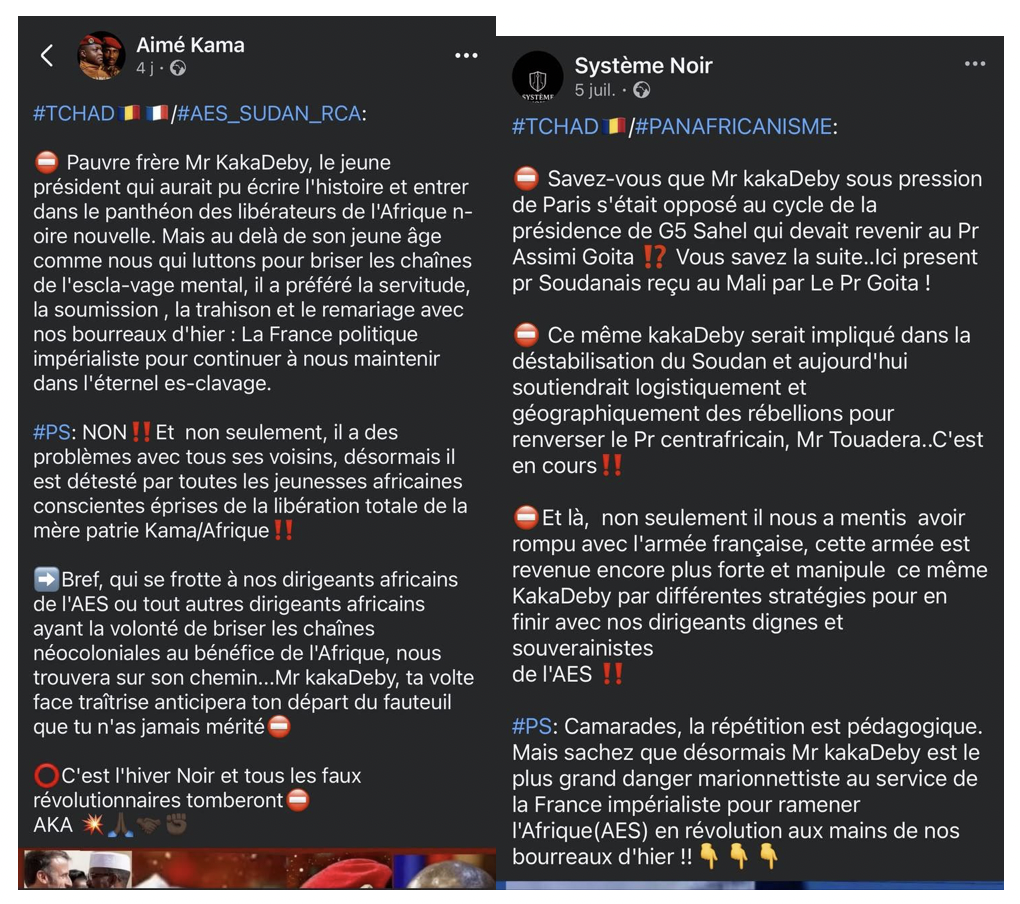
The first discursive sequence identified in the corpus is characterised by a strong personalisation of the criticism directed at the Chadian president, Mahamat Idriss Déby. In this instance, whilst falling within the context of the implications of the Franco-Chadian rapprochement, this narrative tends more towards embodying N’Djamena’s repositioning in the person of Mahamat Déby, around whom accusations of capitulation, dependence and duplicity crystallise. Firstly, the regular use of the nickname ‘Kaka Deby’ or ‘Kaka’ – a play on the president’s nickname – serves as a form of mockery. Thus, according to the activist Système Noir, the Chadian president is “the greatest danger, a puppet in the service of imperialist France, seeking to plunge Africa (AES) back into revolution at the hands of our former oppressors”. By framing the ‘narrative of betrayal’ within the current regional geopolitical context, the influencer accuses President Déby of having, ‘under pressure from Paris, opposed the G5 Sahel presidential rotation, which was due to pass to Assimi Goita’.
In a similar vein, the Burkinabé influencer Aimé Kama laments that the Head of State, according to him, “has preferred servitude, submission, betrayal and a renewed alliance with (…) imperialist France”. Furthermore, the criticism veers into satire, drawing on a literary reference (F. Oyono’s *The Old Negro and the Medal*). In this sense, it alludes to the metaphor of the colonised person who loses himself in servility; Déby is described as a man with “narcissistic tendencies in pursuit of outsized glory”. This interpretation reflects a personalisation of the debate, in which N’Djamena’s geopolitical choices are viewed through a moral lens, making the president the primary target of accusations of dependence and betrayal. Thus, the Chadian activist Hassane Mahamoud lambasts a ‘strategic error by Mahamat Kaka, trapped by the Françafrique syndrome’. In his view, the inauguration last June of the new military command post in Wour (Tibesti province), funded by the European Union, constitutes evidence of the ‘colonial arithmetic’ at play. Furthermore, echoing this line of reasoning, the Burkinabé influencer Aimé Le Sankariste argues that “the police, the gendarmerie, the National Guard, the generals and all financial and diplomatic institutions serve Deby, Macron’s puppet, to the detriment of his own people and of sovereignist Africans”.
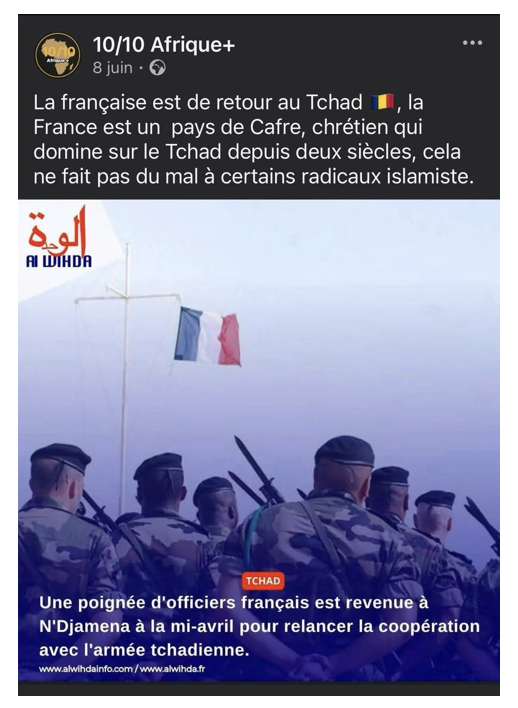
In the same vein, the online activist Gandhi Tchadien believes that “Mahamat Déby may think he is consolidating his power, but [he] has simply set the countdown in motion”. In his view, the Chadian president “could have taken the institutional route. Consult the National Assembly. Call for a political debate. Seek some form of ‘ ’ popular legitimacy’ before formalising the resumption of military cooperation with Paris. Furthermore, a civilisational and religious interpretation of the same nature appears on the ‘10/10 Afrique+’ platform, which reframes Franco-Chadian relations in terms of a supposed centuries-old religious domination. Consequently, ‘France is a country of Christian Kaffirs that has dominated Chad for two centuries; this does not bother certain radical Islamists’.
From this initial analysis, it is clear that the moral figure of Mahamat Déby serves to simplify reality, enabling the geopolitical dynamics at play in the Sahel to be personified. Through this focus, Franco-Chadian relations are interpreted not as the product of converging or diverging strategic interests, but as the expression of a relationship of subordination to Paris, of which the Chadian president is said to be the main vehicle. This personalisation thus helps to situate the rapprochement with France within a broader political narrative—that of the continuity of ‘Françafrique’—and, within this framework, of a betrayal of the ideals of sovereignty championed by pan-Africanist movements.
The second discursive framework identified in the corpus stems from a shift in focus. Whilst the first sought to delegitimise the figure of Mahamat Déby, this one aims to reveal the existence of an underlying strategic framework, within which the Franco-Chadian rapprochement would constitute merely one episode in France’s strategy of gradually re-establishing its presence in the Sahel.
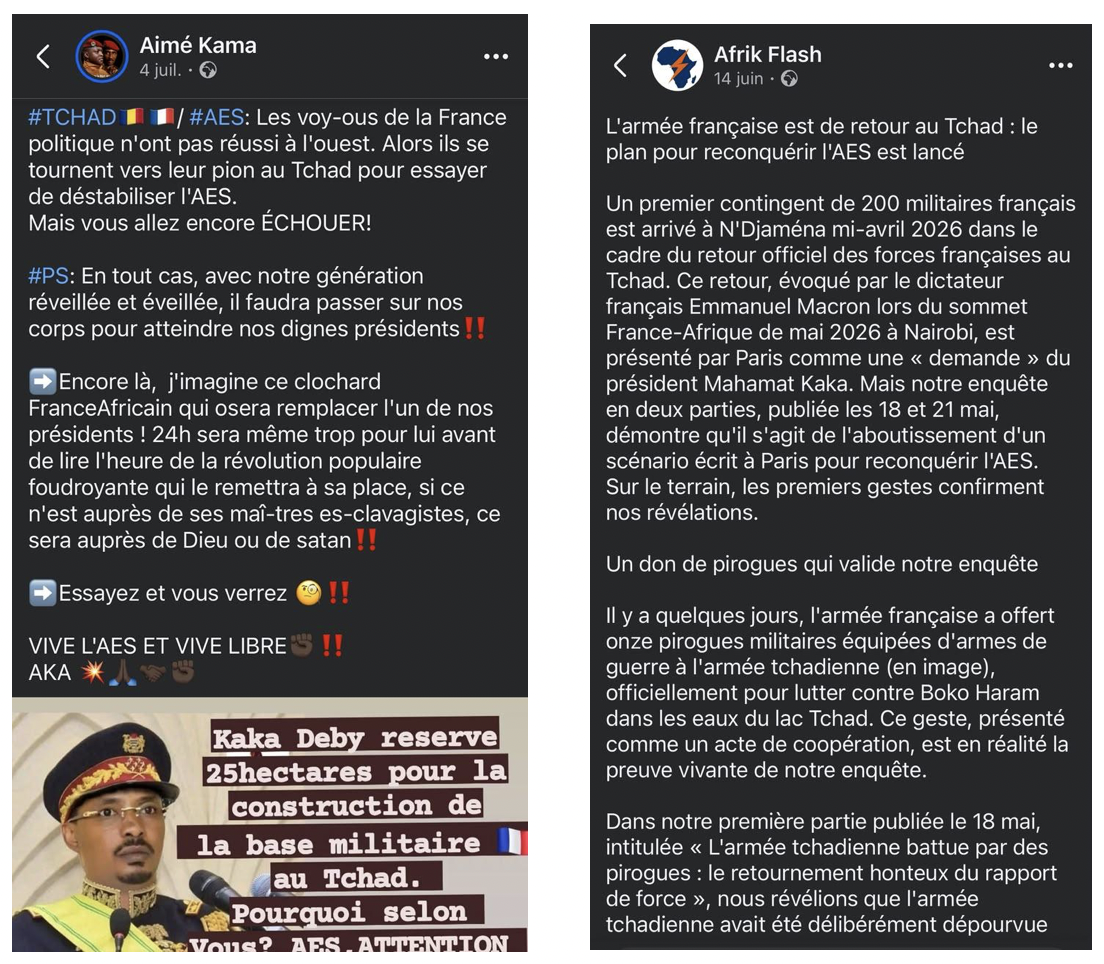
This line of reasoning is exemplified in an opinion piece in the media outlet Afrik Flash, which asserts that ‘the plan to retake the AES has been launched’. According to the narrative set out in this article, France allegedly deliberately deprived the Chadian army of motorised maritime assets (forcing it to confront Boko Haram with makeshift canoes) before staging a theatrical withdrawal in 2025, allowing security chaos to take hold, and then waiting for a ‘cornered’ Déby to beg Paris to return. Thus, French President Emmanuel Macron’s remark last May that it was ‘he [Déby] himself who asked to rebuild a defence relationship’ is cited here as tantamount to an admission in this instance. The same interpretative framework, to varying degrees of elaboration, recurs. For instance, the Burkinabe influencer Aimé Kama adopts this line of argument. Indeed, the “thugs of French politics”, having “failed in the west” in the face of the AES, are now said to be turning to “their pawn in Chad” in an attempt to destabilise the Alliance; the web activist promises that this manoeuvre “will fail”. A key component of the pro-AES digital influence campaign – the BIR-C (Rapid Communication Intervention Battalions) – the influencer Ouédraogo Souleymane Windetoin echoes this line of argument by sharing an (unverified) audio recording presented as a leak of a ‘plan hatched at the Élysée between Macron and Deby to eliminate AES leaders’.
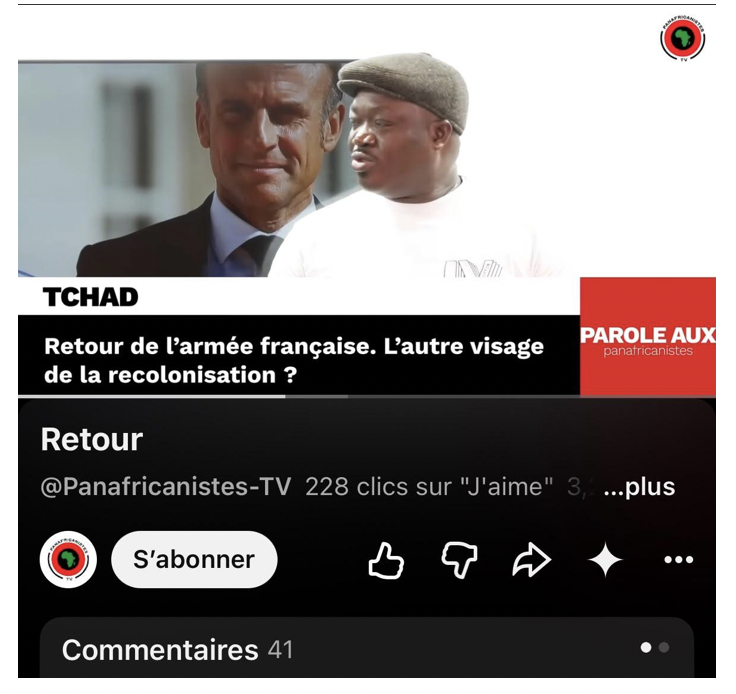
On the other hand, speaking of Chad, the Malian influencer Sissoko Sora Damba asserts that “those who are incapable of carrying out their revolt deserve nothing but pity”. Thus, the web activist believes that Franco-Chadian cooperation forms part of “a plan to reoccupy seven French military bases on Chadian soil”, although no official source has reported such information. On a more socio-economic note, the Chadian platform Wakit Tama Sct politique sets out its interpretation of the rapprochement between Paris and N’Djamena: ‘ensuring the protection of the ruling regime in exchange for the exploitation of the country’s northern natural resources (…) the country is being led straight towards further turmoil and profound misery by the Déby regime’. Building on this, this framework broadens the scope of interpretation by framing the Chadian situation as the first act in a geopolitical realignment that is expected to affect the entire Sahel region. It is in this context that the influencer Ché Habré calls on the AES countries to exercise ‘vigilance’, particularly along the border between Chad and Niger, which he claims is the starting point of a ‘black winter’ in the Sahel region. Furthermore, this interpretative framework took the form of a direct political call to action following Chad’s invitation to AES leaders to attend the African Forum on Water and Energy in N’Djamena on 15 and 16 July. In the wake of this, several pro-AES influencers and activists urged the Alliance’s heads of state not to accept this invitation, which they interpreted as an attempt at diplomatic normalisation likely to serve the interests of France’s repositioning in the region. This position was championed by online activists such as the Malian presenter Boubou Mabel Diawara and the Burkinabe influencer Romy, the latter arguing that “the AES is in danger”. Pan-Africanist activist Nathalie Yamb echoed this sentiment, issuing a warning: “[Mahamat Déby], those with whom you wish to collude to destabilise Niger will one day eliminate you”. In this light, the media outlet Panafricanistes TV asks bluntly: “The return of the French army to Chad: the other face of recolonisation?”.
As part of their opposition to military cooperation between Chad and France, pro-AES influencers have circulated unverified information about an alleged terrorist attack that took place between 15 and 16 July. On the one hand, influencer Sissoko Sora Damba reported a death toll of “123 soldiers killed”. On the other hand, according to the Burkinabe influencer Kbs International, “83 Chadian soldiers were killed by terrorists following the arrival of the French army”. As such information has not been reported by credible Chadian media outlets, it appears to have been fabricated from scratch. The aim is crystal clear: to suggest that, far from stabilising the situation, the French return coincides with its deterioration.
Following the attacks claimed by Boko Haram in the Lake Chad region on 6 and 7 May, France expressed its support for the Chadian authorities. This stance was taken up by the pan-Africanist influencer Franklin Nyamsi, who linked it to an interview given by an AQIM leader to France 24 in March 2023. He commented: “Well, Chad has got what it deserves. The very same people who make their official media available to terrorist groups condemn their actions in Chad, whilst applauding them in Mali. ’ By drawing this parallel, he aims to denounce what he describes as Paris’s ‘double standards’, suggesting a contradiction between the media coverage granted to certain terrorist groups and the official condemnations to which they are otherwise subject. This rhetoric thus helps to fuel a narrative according to which France maintains an ambiguous, or even opportunistic, stance towards jihadist violence in the Sahel.
Finally, a tactic that speaks volumes: it concerns allegations of ‘rapes of minors’ against the French MEP Christophe Gomart, allegedly committed during past military deployments b s in Libya and Chad. Given that there are currently no official charges or judicial investigations into such matters, this piece of fake news (which is not backed up by any verifiable sources) appears to be intended to discredit the former general, who is regarded as a political opponent. However, this fake news fits into a Sahelian context where cases of alleged abuses, of which French armed forces have been accused during their presence in the Sahel, do not appear to have been followed up. As a reminder, Christophe Gomart has recently faced criticism in the AES countries following his resolution of 12 March 2026 in the European Parliament, demanding the immediate and unconditional release of the ousted Nigerien President Mohamed Bazoum, who has been detained since the 2023 coup. This move was then regarded by some as an intolerable form of interference.
Taken as a whole, these reactions and perceptions reveal, in particular, a narrative framework in which the coherence of the story tends to take precedence over the verifiability of the information used. Security incidents, diplomatic initiatives, international positions and unsubstantiated allegations are thus integrated into a single interpretative framework, the function of which is less to establish the factual reality than to reinforce a pre-existing representation of relations between France and the Sahel. Consequently, this dynamic contributes to the consolidation of a geopolitical narrative within which the resumption of Franco-Chadian cooperation is inevitably reinterpreted as the expression of a broader ‘reconquest’ strategy; with events now being understood less for their individual characteristics than for their ability to confirm a narrative already widely shared within certain parts of sub-Saharan digital ecosystems.
In short, it appears that in Sahelian digital spaces, the diplomatic renewal between Chad and France is the site of a reconfiguration into an object of symbolic-political confrontation, where diverse and even competing representations of sovereignty, the French presence and the ongoing geopolitical realignments in the Sahel are crystallising. In this sense, France’s return to Chad is understood not only in terms of its actual operational arrangements but also, and above all, through the political meanings attributed to it.
In doing so, the responses and perceptions identified appear to converge towards a single interpretative framework. On the one hand, they embody the Franco-Chadian rapprochement by making Mahamat Idriss Déby the emblematic figure of a supposed continuity of ‘Françafrique’. On the other hand, they situate this cooperation within a broader geopolitical framework, presenting Chad as the main foothold for a French strategy to re-engage in the Sahel following its withdrawal from the AES countries. This gives rise to a discursive framework that lends coherence to the narratives, by more or less effectively interweaving the themes of ‘betrayal’, ‘interference’, ‘recolonisation’ and ‘regional destabilisation’.
Beyond the case of Chad, this sequence illustrates how issues of foreign policy and security cooperation are now, more than ever, playing out in the digital sphere, fuelling competing interpretations of the regional geopolitical order. Facts, official statements and even unverified content are incorporated into pre-existing interpretative frameworks that tend to reinforce already entrenched perceptions rather than opening up a well-documented space for discussion on the reality of the developments observed. France’ e return to Chad thus appears to be indicative of the ongoing realignments accompanying the redefinition of power relations in the Sahel, where the battle over narratives is now an integral part of the unfolding geopolitical dynamics.
Sacré-Coeur 3 – BP 15177 CP 10700 Dakar Fann – SENEGAL.
+221 33 827 34 91 / +221 77 637 73 15
contact@timbuktu-institute.org