 French
 Arabic
 English
 Portuguese
 Spanish
 Swahili


Sacré-Coeur 3 – BP 15177 CP 10700 Dakar Fann – SENEGAL.
+221 33 827 34 91 / +221 77 637 73 15
contact@timbuktu-institute.org

 © TDR
© TDR
Timbuktu Institute - Week 3, Septembre 2026
Relations between the Cameroonian State and some of its economic partners are becoming increasingly contentious. Behind the growing number of contractual disputes lies a more sensitive question: the cost these disputes could ultimately impose on public finances. 446 billion CFA francs within three months: this is the cumulative amount of the awards made against the Cameroonian State by international courts. A sum that must be paid to three foreign companies operating in the oil, construction and mining sectors.
The succession of these rulings is raising concern among politicians and civil society actors, who are questioning the cost of these disputes for public finances. The economist Serge Alain Goddong attributes this accumulation notably to governance practices and to the failure to honour certain contractual commitments under international standards. The various cases indeed relate to commercial partnerships concluded with foreign companies and now brought before judicial or arbitral bodies.
The Cameroonian press has reported in particular on rulings involving the Nigerian oil company Sahara Energy, the Italian group Gruppo Officine Piccini and the Australian mining company Sundance Resources. Beyond the staggering size of the amount, it is therefore the way in which the State manages and secures its contractual commitments that is being called into question. The government’s silence on this string of rulings is also fuelling questions, while several other proceedings are still pending and could further increase the bill.
The Far North, a permanent security front
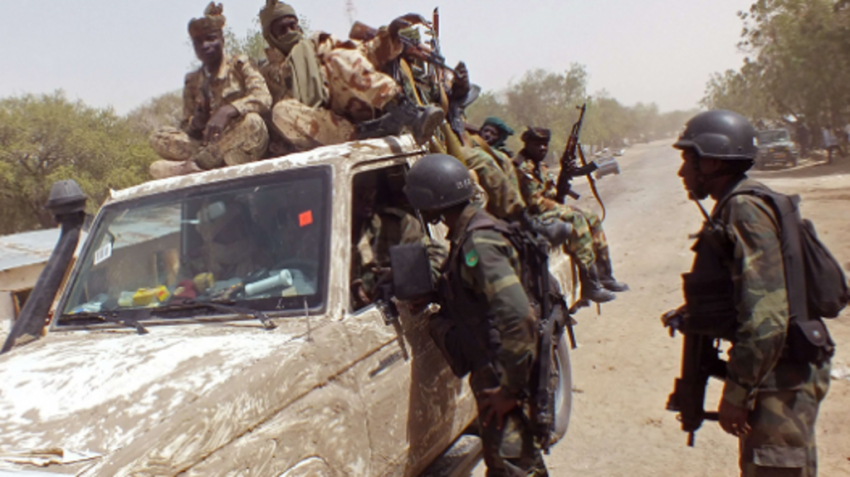
This financial pressure comes as the security front remains particularly worrying in the Far North. During the night of 16 to 17 September, the village of Madegoua, in the Logone-et-Chari department, was hit by an attack that left 15 dead and three injured. Heavily armed men burst into the locality at around 2 a.m., before dragging several residents out of their homes, tying them up and then executing them. The attack has not been claimed. While ISWAP is particularly active in the area, local sources also suggest the possibility of a punitive action, following the seizure of ammunition allegedly hidden in the area and handed over to the authorities by a vigilance committee. This hypothesis has not, however, been established. The gravity of the attack, one of the deadliest against civilians in the Far North in recent years, also lies in its circumstances. The attackers reportedly met no resistance during their incursion, even though a military base is located about eight kilometres from the village.
Upheaval within the MRC
On the political front, Maurice Kamto’s recent resignation as president of the MRC (Cameroon Renaissance Movement) appears to have opened a particularly sensitive transition period for the opposition party. The new leadership is due to be elected at an extraordinary convention scheduled for 10 October, while several candidacies are already emerging, including that of Pierre Emmanuel Binyam. In this succession phase, Mamadou Mota sought to set the limits of what, in his view, the political line of the party’s future president should be. He notably declared that any reconciliation with Willy Mengue (the dissident behind the lawsuit against the MRC) and his associates would be an “absolute and non-negotiable red line”. He also denounced any collaboration with the Ministry of Territorial Administration (MINAT), which he accuses of acting against the MRC’s aspirations.
These statements come as the party itself is engaged in a legal battle over its governance. Party members Willy Mengue, Laure Noutchang and Sébastien Mbala Wouria II had brought the case before the Yaoundé-Ekounou Court of First Instance, seeking in particular the appointment of an ad hoc judicial administrator tasked with “normalising” the party’s functioning and challenging the conditions of Maurice Kamto’s return to its leadership in December 2025. On 17 September, the court declared itself incompetent to rule in summary proceedings. The decision ends this urgent procedure without settling the substantive disputes over the MRC’s governance. As if further proof were needed that tensions within the opposition party are palpable, the party had to deny a fake statement circulating on social media announcing the creation of a new political party by its former president. The party stated that no such initiative had been undertaken by Maurice Kamto, who has not publicly reacted to the document.
Cameroon thus displays two distinct forms of attrition, raising the question: what becomes of a political order when certain crises seem remarkable for their permanence? In the Far North, the persistence of the threat sustains a zone of vulnerability that is no longer limited to the question of attacks alone; in the political arena, unfinished realignments prolong constant uncertainty. Meanwhile, political parties are gearing up for hypothetical legislative and municipal elections, normally scheduled for early 2027.
Sacré-Coeur 3 – BP 15177 CP 10700 Dakar Fann – SENEGAL.
+221 33 827 34 91 / +221 77 637 73 15
contact@timbuktu-institute.org