 French
 Arabic
 English
 Portuguese
 Spanish
 Swahili



Sacré-Coeur 3 – BP 15177 CP 10700 Dakar Fann – SENEGAL.
+221 33 827 34 91 / +221 77 637 73 15
contact@timbuktu-institute.org

ADE/ASB
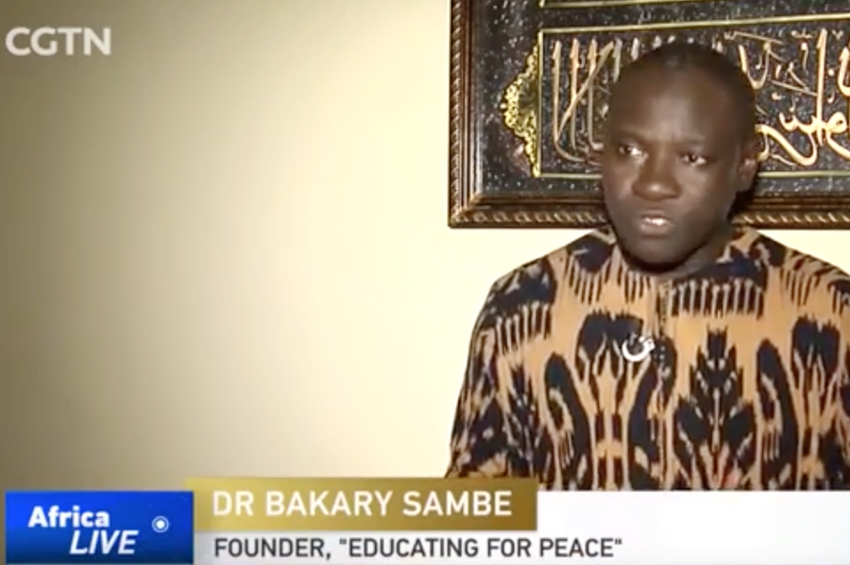
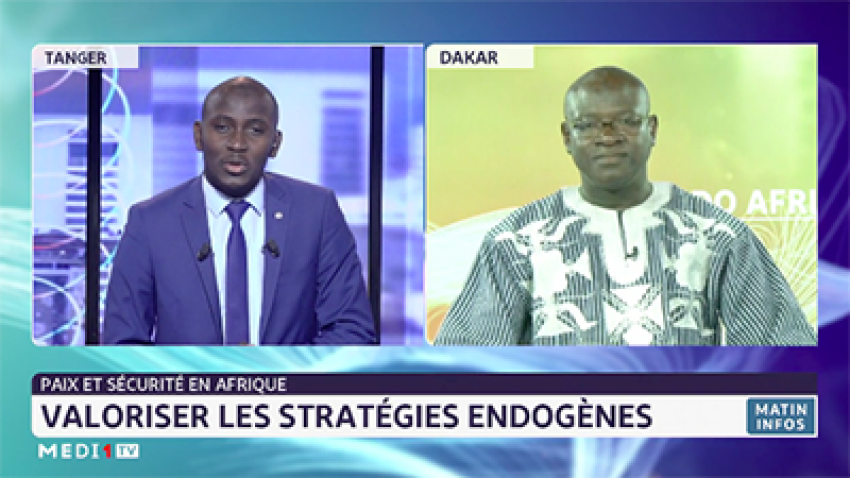
Timbuktu institute est en train de mettre en place des stratégies de formation au profit des jeunes sénégalais, notamment leur autonomisation. Cela, quelle que soit la couche sociale à laquelle ils appartiennent, a signalé son directeur, le Dr Bakary Sambe, enseignant-chercheur au Centre d’études des religions (Cer) de l’Université Gaston Berger de Saint-Louis.
En partenariat avec le centre marocain Annajah (réussite en arabe), une formation a été organisée pour inciter les jeunes à être capables de se prendre en charge et à être responsables dans le cadre de l’entreprenariat et de l’auto-emploi, les problèmes les plus cruciaux auxquels les Etats de l’Afrique de l’Ouest font face. « Aujourd’hui, nous formons des jeunes issus de toutes les couches sociales, des universités, des lycées, des porteurs de projets, entre autres, pour leur faire bénéficier d’une prise de conscience de leurs capacités à s’approprier les dispositifs que l’Etat sénégalais a mis en place comme l’Anpej, le Fongip, etc. », a déclaré Bakary Sambe, enseignant-chercheur au Centre d’études des religions (Cer) de l’Université Gaston Berger de Saint-Louis.
L’idée, selon le directeur de Timbuktu institute, c’est de faire en sorte que les jeunes puissent prendre conscience de leur potentiel en présentant des projets viables et à être autonomes. Il a relevé que le Sénégal, tout comme les autres pays du continent, pourrait bénéficier du dividende démographique si les jeunes sont formés. En plus des jeunes scolarisés en français, la formation est également destinée à ceux formés en langue arabe qui, parfois, se retrouvent sans offre d’emploi.
Pour l’adjoint au préfet du département de Mbour, Alseyni Bangoura, qui a assisté au démarrage de cette formation, « depuis 2012, le président de la République, Macky Sall, a fait des efforts en créant le Baccalauréat arabe permettant aux bacheliers en arabe d’accéder aux universités et en ouvrant une section qui leur est dédiée à l’Ecole nationale d’administration (Ena) ». Dr Bakary Sambe a ajouté : « Nous voulons, dans le cadre de cette initiative, renforcer cela, pour que les arabisants puissent trouver leur place sur l’échiquier politique, économique et social ».
Justifiant leur présence à Mbour, il a souligné qu’elle entre dans une perspective de décentralisation. « Après deux sessions de formation qui se sont tenues respectivement à Dakar et Tivaouane, nous avons voulu faire dans la décentralisation en venant à Mbour qui se trouve être un endroit réputé pour ses activités touristiques, avec beaucoup d’incitations et de risques, mais aussi pour une meilleure insertion des cadres arabophones », a dit M. Sambe. Il a fait part d’un projet en gestation à Mbour en partenariat avec l’ambassade de France au Sénégal, le Conseil départemental de Mbour et les organisations sportives et de jeunes.
« Partout où nous avons organisé des formations, les jeunes ne sont plus les mêmes au niveau de leur mentalité et de leur possibilité de se prendre en charge, mais aussi d’une responsabilisation et de s’engager en tant que citoyens modèles qui se demandent certes qu’est-ce que l’Etat peut faire pour eux, mais aussi ce qu’ils pourraient faire pour l’Etat et pour leur pays », a ajouté Bakary Sambe.
L’adjoint au préfet du département de Mbour a déclaré que cette formation dont les bénéficiaires sont constitués majoritairement de jeunes est « une initiative capitale et sûre » en phase avec la politique du gouvernement du Sénégal qui ne saurait prospérer sans une bonne formation des jeunes.
Source : .lesoleil.sn
Written in the style of an open letter from one global citizen to another, « Moi, musulman, je n’ai pas à me justifier » by Seydi Diamil Niane seeks to steer the confusing and politically charged conversation about Muslims and their relation to violent extremism away from the damaging blame game towards a call for a spiritual Islam compatible with humanist values. Moreover, while Diamil Niane’s condemnation of extremism is absolute, he rejects the notion that he or any other Muslim ought to apologize or distinguish him or herself as one of the ‘good guys’ in the wake of a terrorist incident. On page 35, Diamil Niane writes: “If I decide to take up the pen to denounce the violent extremism of certain groups claiming to share in my own religion, then it is by personal choice and not by obligation.”
More interesting still, is Diamil Niane’s rationale for refusing to give in to the pressure to defend one’s religion every time these heinous acts perpetrated by a tiny minority – who disproportionately kill other Muslims - are brought up. Logically, it makes sense that one person cannot be held in any way responsible for an act they did not commit themselves. However, today’s media climate reflects a double standard whereby Muslims are expected to justify their faith after terrorist attacks when the same courtesy does not apply to other groups, religious or otherwise. For example, Christians are hardly ever called upon to excuse themselves for the war in Iraq, even though George Bush identified as a Christian. In a similar vein, media pundits do not demand that every French citizen beg for forgiveness for the atrocities committed by their government during the colonial period.
Given the book’s target audience of “global citizens”, Diamil Niane does a commendable job of linking Islamophobia, that is, a prejudice against Muslims which is completely separate from justified criticisms of Islamic thought and practice, to other forms of racisms that persist in 21st century in France. By so doing, the book is able to connect to a larger audience by drawing the connection between Islamophobia and other social justice issues such as the French strain of anti-Semitism that has placed Jews under the microscope for centuries as easy scapegoats (case in point, the Dreyfus Affair) and led to the characterization of an entire religious community as somehow less trustworthy than other French citizens.
Indeed, for me the book’s most touching moment came early on in the dedication page. In addition to two tributes to the author’s mother and a former teacher, the book is dedicated to Rosa Parks, or, in the author’s own words, “She who refused to explain herself.” This tribute reminded me that whether a people are fighting for justice on the basis of religion or race, it is never up to society at large to dictate the terms of their so-called equal treatment. Muslims do not have to apologize profusely for practicing their faith to make non-Muslims feel safer, nor should Americans to dictate what black Americans can or cannot speak out against because their “Black Lives Matter” protests make parts of white America uneasy.
Yet, the book’s title begs the question, if Muslims are not obligated to constantly explain or justify their faith, then what can they do to fight back against the tide of criticisms against their religion? For the author, the answer to this question is to show the beauty of Islam through their exemplary behavior and acts of kindness. Dialogue, particularly interfaith dialogue, is also stressed as essential to promoting understanding and counteracting intolerance against a religion that is so deeply misunderstood by many, particularly in the West. And while I wholeheartedly agree that interfaith dialogue is necessary to counteract Islamophobia, I worry that this sort of interpersonal connection is not always possible.
Granted, my perception is a little skewed. I live in a country with a population of 323 million of which an estimated 3.5 million individuals identify as Muslim. It is not uncommon, especially in rural areas, for a fully mature adult to not know a single Muslim person. Speaking from personal experience, before attending university I knew only a handful of Muslim families in my small town which was mostly made up of the descendants of Irish or Italian immigrants. Still, after every incident of radical Islamic terrorism the same scenario plays out on U.S. television screens. A so-called “expert” on Islam gets on a national news network such as Fox News to denounce Islam as inherently violent. Oftentimes, they produce one verse of the Qur’an that alludes to physical retaliation of some sort, completely isolated from both its historical context and its surrounding verses of course, and wave it around to evoke fear and suspicion of Muslims residing in the U.S. My point is, that it is much easier to fear and otherize Islam when you have no personal experience whatsoever interacting with Muslims. Moreover, in the same way that it is unreasonable to ask a Muslim to justify their faith after a terrorist incident, we cannot burden the relatively small number of Muslim-Americans with the task of educating the masses of non-Muslims whose knowledge of Islamic is next to nothing. This presents quite the dilemma for countries without a sizable Muslim minority such as the United States. Although the book provides fascinating insights for Muslims on how to internalize the core values of their faith and walk along the path of Sufism, I was left wondering what the author’s recommendations for non-Muslims to promote tolerance and interreligious understanding would be.
Aoife Croucher
Research Intern at Timbuktu Institute –African Center for Peace Studies
On Monday, director of the Timbuktu Institute Bakary Sambe invited authorities to put in place an “inclusive national strategy” to prevent and counter violent extremism.
“This is a solemn call to the Senegalese government to institute an inclusive national strategy to prevent and counter violent extremism,” he declared.
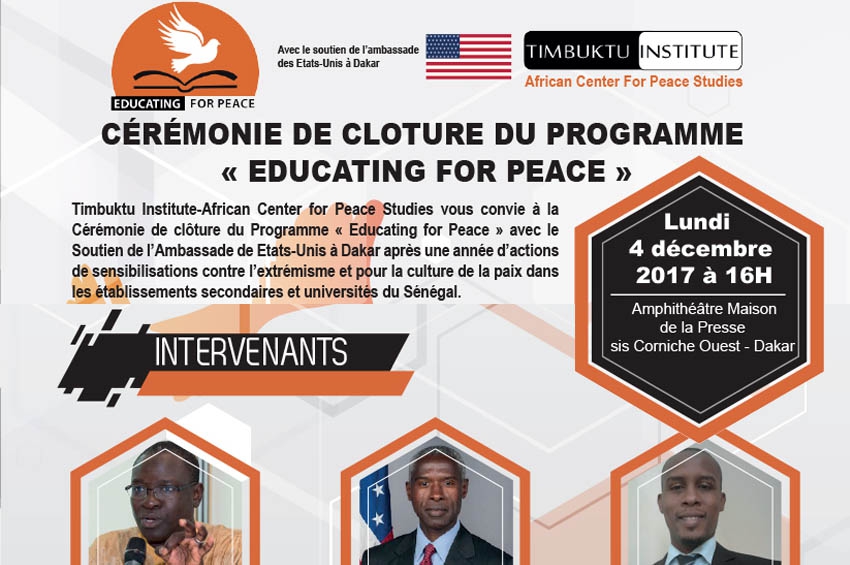
Dr. Sambe’s remarks were part of a speech given at the closing ceremony of the Institute’s “Educating for Peace” program, which was conducted with the support of the American embassy.
For him, it is urgent to develop such a strategy “considering the constant mutation of the terrorism phenomenon.” He elaborated the Senegalese plan should be “part of a broader sub regional network,” and that authorities should not “neglect to integrate regional systems of cooperation” into the plan.
Dr. Sambe also indicated that the creation of the strategy should involve religious and civil society leaders as well as researchers, and should use education as a central policy pillar.
“The Institute implores Senegalese authorities to work with their African and International partners to put in place and operationalize a collaborative platform to anticipate risks,” said Sambe.
Specifically, Sambe cited homegrown terrorism, a risk all countries in the region are working to counter and prevent.
Tulinabo Salama Mushingi, United States Ambassador to Senegal, “by emphasizing dialogue and interaction, a new generation will understand the value of of the exchange of beliefs, thoughts, and ideas.”
His Excellency continued, “tolerance does not imply a lack of engagement in regards to the beliefs of others, rather, it condemns the oppression and persecution of other’s beliefs.”
He concluded “in this program [Educating for Peace], it is not a question of changing another’s opinion. Instead, it seeks to understand the perspectives of others in order to live peacefully.”
In this Lettre de l’Observatoire des Radicalismes, the Timbuktu Institute seeks to “document a theme largely debated beyond suppositions and hypotheses, specifically on Salafism’s force and real impact amongst young people.”
“The analysis of online messaging from this sect’s principal predicators has been particularly instructive regarding the dangers or lack thereof surrounding these discourses which, contrary to popular belief, are as varied as they are contradictory,” emphasized Bakary Sambe.
Considering the prevalence of internet and social media use by extremist groups to recruit members, the Timbuktu Institute seeks to add to the debate surrounding online recruitment with this case study, based on months of following Salafist Youtube personalities.
The study is particularly interested in Salafist digital strategies in regards to messaging content, chosen targets, and opposition to Sufi brotherhoods as part of wider recruitment tactics.
The director of the Institute specified “the methodology adopted for the study necessitated analysis by researchers who are not familiar with Senegalese Salafist discourse, in order to avoid any and all forms of bias. The study was performed by our American research assistant Stephanie L. Schmitt, allowing for a new perspective from a curious and driven member of the team. A French version of the article will soon be available.”
The report Salafist Online Messaging and Digital Strategies in Senegal can be read via the attached link, or under the ‘Publications’ section of our website.
Download the report by clicking on the following link Salafist Online Messaging and Digital strategies in Senegal
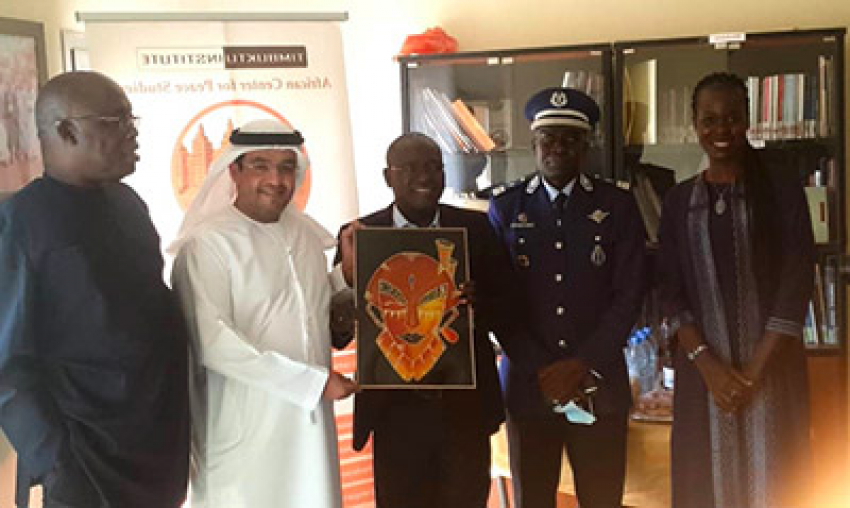
On Friday, the 16th of February, the Timbuktu Institute African Center for Peace Studies welcomed Ambassador Stephan Röken of Germany.
His Excellency expressed an interest in the Institute after having read the director BakarySambe’s column in JeuneAfrique, “Les Kalashnikovs n’ontjamaisvaincu les ideologues.” Agreeing that education and other preventative measures are the solution to growing violent extremism across the Sahel, Ambassador Röken sought to learn more about the mission of the Timbuktu Institute; the promotion of African cultural resources in order to resolve and prevent conflict in all forms.
In particular, Sambe and Röken discussed the current educational divide in Senegal. Like many other countries in the Sahel, Senegalese students are split between an ‘official’, French, and secular education, and Koranic schools. Sambe sees this a divide with great potential for danger, as the political elite have all been products of the French system since independence. The lack of valorization of the Koranic schools and those who hold an Arabic baccalaureate could lead to more than political ramifications.
In turn, Ambassador Röken spoke of Germany’s future role in conflict prevention. He noted that Germany has a growing interest in Sahel security due to domestic politics surrounding migration. He praised the work produced by the Timbuktu institute through partnerships with German institutions like the Konrad Adenauer Foundation, and Rosa Luxembourg.
His excellency expressed his hope that such partnerships would continue, that other German institutions would become involved, and noted that he looked forward to potential future partnerships between the Timbuktu Institute and the German Embassy.
Mohamed Maiga est malien de nationalité, historien de formation, auteur de plusieurs communications sur la crise au Mali. Actuellement étudiant-chercheur en fin de deuxième cycle à l’UFR CRAC de l’UGB spécialisation gestion du patrimoine culturel. Par ailleurs, il est membre fondateur du réseau international pour le culte du débat, plusieurs fois champion d’Afrique, collaborateur du Timbuktu institute patrimoine et paix. Dans cet entretien qu’il nous a accordé avec la collaboration de l’Institut Français de Saint-Louis dans le cadre des « Débats d’idées », il revient sur l’ouvrage de Seydi Djamil Niane intitulé « Moi musulman, je n’ai pas à me justifier »
Comment appréciez-vous cet ouvrage ?
En vérité c’est le meilleur ouvrage que j’ai lu en 2018 ; heureusement que nous sommes au mois de février et du coup j’espère que j’aurai l’occasion d’en lire d’autres. On perçoit que Djamil est un citoyen du monde qui a décidé de s’exprimer en tant que citoyen français, musulman d’origine africaine. Il porte sa veste d’universitaire tout en ne prenant pas position, en dehors de son appartenance confrérique qu’il montre dans chaque partie de son ouvrage. En effet on sent qu’il est un fervent disciple de la confrérie Tidianya. On sent qu’il est passé de la Chahada à la Mouchahada à travers cet ouvrage qui doit être lu par tous les français. Je parle surtout de ces français qui pensent comprendre l’islam, de ces français qui ne font pas le distinguo entre l’intégrisme religieux, le terrorisme et la République et surtout le caractère laïc de la République. Donc Djamil s’est présenté comme un citoyen du monde qui vient apporter un message. Don son message on sent son indignation. Djamil est à l’image de ces écrivains qui dénoncent comme Frantz Fanon, Mariama Ba …. Le plus important est qu’il invite les citoyens du monde à ne pas confondre l’extrémisme violent à l’islam.
Quel commentaire faites-vous du titre de l’ouvrage de Djamil?
Le titre est assez provocateur à l’image du livre d’Amadou Krouma » Allah n’est pas obligé ». Il est assez provocateur non seulement pour les musulmans, mais aussi pour les islamophobes, les nérgrophobes et les francophobes, parce qu’en lisant le titre on a l’impression que Djamil veut nous inviter à voir l’islam d’une autre façon. Et pour mieux comprendre le titre il faut forcément lire l’ouvrage. Au tout début, l’auteur du dit » tout a commencé lorsque la question « que penses-tu des attentats? » s’est transformée à « qu’avez-vous fait encore? », après les attaques du Bataclan. On s’en qu’on lui a demandé quelque chose qu’il n’a pas voulu et il dit qu’il n’a pas à se justifier. Le sous-titre « Manifeste pour un islam retrouvé » donne de l’espoir.
Pensez-vous que ce manifeste puisse permettre à l’islam de retrouver sa place dans la société occidentale ?
Pour répondre à votre question je vais paraphraser Djamil à la page 117 où il dit : « Mon intime conviction est que la grandeur de l’islam et de la France ne saurait être chantée que si chacun des deux se considère surtout et avant tout comme partie composante de l’humanité ». Voici un message de paix. Ce livre est tellement parlant surtout pour les musulmans de France. Je dirais que ce manifeste va permettre à ceux qui veulent comprendre de comprendre, à tous les musulmans de la France qui n’ont pas à se justifier et même aux musulmans du monde qui n’ont pas à se justifier devant des actes perpétrés ou commandités par des gens qui se réclament d’Allah. Ce livre permettra à l’Islam de retrouver sa place si et seulement si l’occident veut que l’Islam retrouve sa place, parce qu’en lisant Djamil on se rend compte par exemple que dans l’éducation nationale en France, il ya de l’islamophobie. Il ya également une grande ignorance dans les débats autour de l’islam.
L’auteur parle d’humanisme théocentrée. Qu’est-ce que cela suggère pour vous?
D’abord il faudrait rappeler ce que c’est que le théocentrisme. C’est une tendance à considérer Dieu et la religion comme étant la condition sinequano, la clef de la compréhension du monde et de l’histoire de l’humanité. N’oublions pas que l’humanisme est une affaire européenne, particulièrement italienne qui a vu le jour au 15eme siècle. Quand Djamil parle d’humanisme théocentré en précisant que pour que cet humanisme soit une réussite il faut revenir à la conception Soufi de l’unicité. Mais il se trouve que cette humanité est constituée de plusieurs éléments dont le soufisme; alors si vous proposez un humanisme théocentré qui n’a pas pour objectif de diviniser l’homme, mais de considérer Dieu comme étant partout, de considérer que Dieu est en nous, ce serait vraiment des bémols pour l’humanité. Pourquoi? Parce que d’abord vous avez un occident qui se dit civilisateur du monde qui prône le mariage gai, qui pense que la laïcité n’est pas compatible avec l’islam, qui pense que la démocratie et les droits de l’homme doivent prévaloir partout et qui pense que cette démocratie c’est de l’import-export, qui dit aux religieux de ne pas se mêler à la chose publique. Vous conviendrez avec moi alors que cet humanisme sera difficile à théocentrer, mais si on se fie à la conception soufie, c’est réalisable.
« Face à ceux qui déshumanisent la vie, osons chers musulmans, l’humanisme théocentré pour être à la hauteur du message coranique » Quel commentaire vous suggère ce passage?
C’est un message fort, il est tellement fort que je reproche à Djamil de l’avoir adressé seulement aux musulmans. Ce message devrait être adressé à l’humanité, surtout aux puissances occidentales pour qu’ils comprennent que c’est la seule alternative pour éradiquer ceux qui déshumanisent la vie, c’est à dire les groupuscules terroristes. Si on porte les lunettes de Djamil on se rend compte que l’humanisme théocentré qu’il prône est une solution. Il dit lui-même qu’on n’a pas besoin de maitriser le coran ou les hadiths du Prophète (PSL) pour voir les fruits de cet humanisme théocentré. Mais je précise qu’il faut préalable comprendre la conception soufi de l’unicité.
Quelle est la place du dialogue islamo-chrétien dont on parle souvent dans l’ouvrage?
Ce dialogue est au cœur de ce livre. C’est vrai au tout début Djamil critique, accuse et s’indigne mais au fur et à mesure qu’on avance dans la lecture on note qu’il transmet un message de paix entre musulmans et chrétiens en donnant des exemples d’actes odieux commis par des chrétiens qui n’ont pas à se justifier à cause de leur religiosité. Du côté du monde musulman il cite les pétromonarchies qui essayent de faire rayer le Yémen de la carte du monde devant le silence et la bénédiction des puissances occidentales. Il rajoute que le dialogue est possible et pour le rendre tangible, il donne l’exemple de l’Association Internationale dont il est membre fondateur et qui appelle à la coexistence active. A la page 119, il dit: » mon dernier vœux est qu’ensemble par-delà nos convictions religieuses ou philosophiques, au-delà de nos couleurs de peaux et d’orientation sexuelle, nous nous mobilisons pour rayer le mot désespoir du vocabulaire humain, désespoir qu’il faut rayer et faire appel à la coexistence active.
Que pensez-vous du style d’écriture de Djamil ?
Je voudrais d’abord dire que Seydi Djamil Niane est un intellectuel qui a beaucoup lu. Il ya chez lui plusieurs influences notamment celles de Frantz Fanon, Éric Geoffroy, Bakary Samb, Krumah, Amadou Ampaté Ba. Ce livre est du genre lettre ouverte qui s’adresse à l’humanité tout entière.
Entretien réalisé par Momar Alice NIANG
Source : http://ndarmag.com
Dans une récente tribune de Jeune Afrique (n°2979), le Directeur de Timbuktu Institute-African center for Peace Studies, Dr. Bakary Sambe, revient sur une « archéologie de la crise sécuritaire au Sahel » montrant que les racines profondes de la crise sont à trouver dans les inconséquences des politiques imposées aux pays du Sahel dans les années 90 mais aussi d’un retard de 40 ans accusée, depuis les sécheresses des années 70, par la communauté internationale dans son intervention au Sahel. Il appuie l’idée des solutions préventives par l’éducation mais pointe des incohérences qu’il faudrait éviter pour ne pas répéter les erreurs du passé. Voici in extenso cette tribune intitulée « Les kalachnikonvs n’ont jamais vaincu les idéologues »
« Un éminent leader religieux du Sahel me confiait qu’il fallait chercher les causes de la radicalisation dans la combinaison entre « l’arrogance des injustes et l’ignorance de ceux qui se sentent victimes ». De fait, la communauté internationale a quarante ans de retard par rapport aux réseaux qu’elle combat : lors des sécheresses des années 1970, ni l’Europe ni les États-Unis, rudement frappés par la crise pétrolière, ne pouvait nous aider. Ceux qui le pouvaient exportaient du pétrole, des pétrodollars et… des idéologies. Puis la communauté internationale imposa, dans les années 1990, des politiques d’ajustement structurel à des pays sommés d’emprunter le chemin du libéralisme en investissant le moins possible dans l’éducation, la santé et le social… Tandis que les exportateurs d’idéologies construisaient au Sahel des méderssas et y implantaient des ONG dites « islamiques » – lesquelles ont remplacé l’État et délégitimer les nouveaux missionnaires de la démocratie.
Début février, Dakar a accueilli le Partenariat Mondial pour l’Éducation. Mais j’aurais voulu rappeler à Macky Sall, Emmanuel Macron et même à Rihanna que de nombreux pays du Sahel souffrent encore d’une dualité, voire d’un éclatement du système éducatif, avec d’un côté l’école « officielle » francophone et, de l’autre, une multitude d’écoles coraniques. Les États sahéliens ne saisissent pas les enjeux d’une telle dynamique et n’ont jamais intégré cette dimension du choc des modèles religieux et citoyens par le biais de l’éducation dans le cadre global d’une politique de sécurité.
Le terrorisme a surgi au milieu de cet espace après avoir été vu, pendant longtemps, comme un phénomène lointain, et son caractère imprévisible n’a pas laissé de place à des stratégies en amont. Il a imposé une approche réactive. Confrontés à l’urgence, les pays du Sahel et leurs partenaires internationaux n’ont pu répondre que par le sécuritaire comme le fit Serval, dont il faut bien reconnaître qu’elle a stoppé les djihadistes sur leur route de Bamako. Mais en a découlé une conception strictement sécuritaire d’un phénomène nécessitant une approche holistique.
L’échec des solutions strictement militaires est une réalité irréfutable. Il ne fallait pas s’attendre à voir des kalachnikov défaire une idéologie. Les Américains sont restés plus de quinze ans en Afghanistan et les Talibans y sont encore. Serval a vécu, remplacée par Barkhane, qui est incapable d’en finir avec les terroristes dans le nord du Mali. Les groupes armés y prospèrent et le front s’est élargi vers le centre du pays avec le Front de libération du Macina, débordant jusqu’au Burkina Faso.
Les solutions militaires sont certes un mal nécessaire pour endiguer la menace grandissante, mais elles ne sont ni efficaces ni durables. Elles ont même inspiré les djihadistes ! Plus besoin de stratégies globales et de coordination risquées : il suffit de créer des zones d’instabilité et de mettre une couverture « islamique » sur toutes sortes de conflits pour susciter l’intervention occidentale qui, avec leurs bavures et leurs ratés, nourriront frustrations et révoltes – un terreau idéal pour recruter de nouveaux combattants.
Nous sommes devenus une vraie communauté internationale : pays riches ou pays pauvres, d’Afrique ou d’Europe, nous avons la vulnérabilité en partage. Gao, Maïduguri ou Tazalit sont aussi exposées que Paris, Bruxelles ou Miami. Ce qui se passe sous nos tropiques concerne aussi les puissants membres du Conseil de Sécurité et il est urgent de trouver ses solutions concertées. Or il y a un hiatus entre les approches globales, préconisées par nos partenaires internationaux, et les perceptions locales. Il est temps de donner leur dignité de « solutions » aux possibilités endogènes. Il y a cinq ans, je disais à des responsables de la Commission européenne que dans certains de nos villages l’achat d’un char vieux modèle coûtait plus cher que la construction d’une école. Deux choix s’offrent à nous avec la chance de pouvoir les coupler : prévenir aujourd’hui par l’éducation et la justice sociale ou se préparer, militairement, à intervenir indéfiniment et continuellement, demain, sans gage de réussite et avec le risque de reproduire les causes du mal que l’on cherche à combattre.
(Source Jeune Afrique n° 2979)
Sacré-Coeur 3 – BP 15177 CP 10700 Dakar Fann – SENEGAL.
+221 33 827 34 91 / +221 77 637 73 15
contact@timbuktu-institute.org