 French
 Arabic
 English
 Portuguese
 Spanish
 Swahili

Sacré-Coeur 3 – BP 15177 CP 10700 Dakar Fann – SENEGAL.
+221 33 827 34 91 / +221 77 637 73 15
contact@timbuktu-institute.org

Timbuktu Institute – May 20, 2026
In an in-depth and previously unpublished analysis by the Timbuktu Institute, media coverage of the coordinated attacks of April 25, 2026, within the Russian information ecosystem was meticulously examined. These attacks, carried out jointly by the Group for the Support of Islam and Muslims (JNIM) and the Azawad Liberation Front (FLA) against several Malian towns, resulted in the death of the Malian Minister of Defense, General Sadio Camara, and dealt a serious blow to government forces and their Russian partners in the Africa Corps. The full study demonstrates how an event that could have potentially destabilized Russia’s image in the Sahel was transformed into a narrative opportunity by a well-oiled information apparatus.
A layered and coordinated information ecosystem
The analysis begins with a detailed mapping of the mobilized Russian media ecosystem. At the heart of the apparatus are major state-run channels such as Rossiya-1, Pervy Kanal, and NTV, which provided rapid and structured coverage starting on April 26. Rossiya-1, with experienced war correspondents such as Evgeny Poddubny, played a central role in the official narrative. The study revealed that these traditional media outlets are joined by specialized digital actors: the widely read news site Lenta.ru, and above all the African Initiative agency, a veritable pro-Kremlin “narrative laboratory” dedicated to Africa. This agency produces content in French and Russian (articles, opinion pieces, and documentaries) intended to feed the entire Russian information ecosystem. Finally, channels on the Telegram app (Africa Corps 2.0 and Oncles Blancs en Afrique) serve as operational relays and hubs for activist cohesion, disseminating images and talking points with remarkable speed. This architecture enables impressive editorial convergence: the same narrative spreads across national channels, online sites, and social media within a matter of hours.
First narrative thread: the Africa Corps, Mali’s invincible shield
In the Timbuktu Institute’s study, the dominant narrative presents the Africa Corps as an effective bulwark despite setbacks. As early as April 26, Rossiya-1 and Lenta.ru claimed that Russian forces had “repelled the largest Islamist attack ever launched in Mali” and prevented a coup orchestrated by the West. Instead of admitting a military retreat, pro-Kremlin media transformed it into a noble tactical choice: “The Africa Corps withdrew to save the lives of Malian soldiers,” according to an op-ed by Artiom Kureyev of African Initiative. Images of the bodies of slain attackers are widely circulated on Telegram to attest to Russian effectiveness.
Second narrative thread: Western interference and the Franco-Ukrainian conspiracy
Meanwhile, according to the Timbuktu Institute’s analysis, the attacks are systematically framed within a broader geopolitical confrontation. Beyond France, which is traditionally singled out, Russian media denounce a “coordinated Western media campaign” aimed at discrediting the Russian presence.
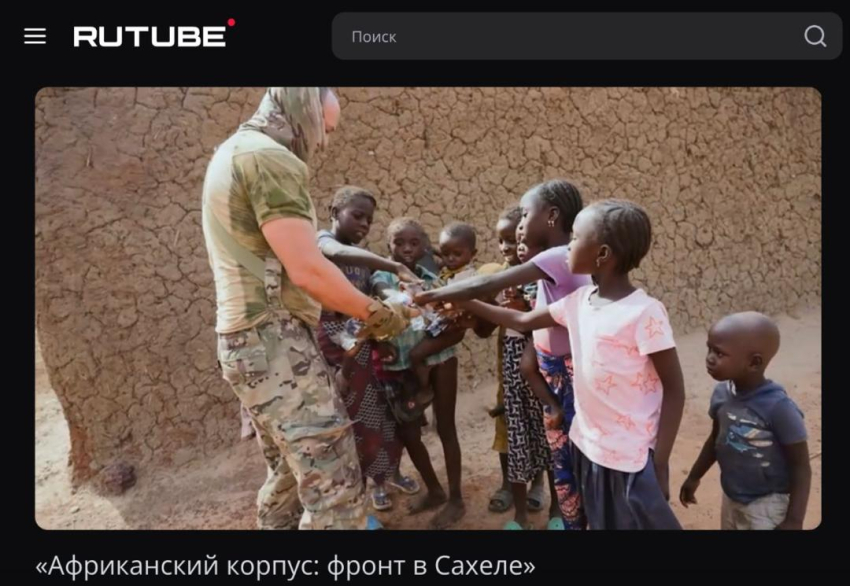
The narrative goes further by explicitly accusing France and Ukraine of having prepared and supported the attackers: training fighters by Ukrainian instructors, supplying Western weapons (Stinger and Mistral MANPADS), and even coordinating intelligence. In the same vein, African Initiative publishes what it presents as evidence (Ukrainian military intelligence—GUR—insignia), elements that turn out to be photomontages. A 45-minute documentary titled “Africa Corps: The Front in the Sahel,” aired in early May, summarizes this perspective by linking Russia’s presence to a “shared destiny” with Mali in the face of external interference. The study subtly highlights the gray zone strategy: the Russian narrative skillfully blends partially verified facts (the presence of certain Ukrainian elements in the Sahel reported by Western sources) with fabricated elements, creating uncertainty that benefits the most sensational version.
Dissenting Voices: A Crack in a Narrative Perceived as Monolithic?
Despite the dominance of the official narrative, the Timbuktu Institute’s study highlights the existence of counter-narratives promoted by independent Russian-language media in exile. For instance, the channel Dojd (TV Rain) referred to a “Russian defeat in Mali” and raised questions about a possible withdrawal of the Africa Corps. The Russian-language media outlet Meduza, for its part, emphasized the scale of the attacks—such as the loss of a Russian helicopter—and the difficulties faced by the Malian junta, while maintaining a more rigorous factual framework. This diversity, though still tentative, serves as a reminder that the Russian-language information landscape is not entirely monolithic and highlights both the scale of the narrative-building efforts undertaken by the Kremlin and the analytical work required to achieve a comprehensive understanding free from preconceptions.
Conclusion and Lessons
The attacks of April 25 constituted a true test of resilience for the Russian information apparatus in Mali and the Sahel more broadly. The analysis concludes that the strength of the system lies less in the mere fabrication of narratives than in its ability to rapidly reframe an unfavorable reality into a framework of interpretation favorable to Russian interests and strategic positioning in Mali and the Sahel.
Three main lessons emerge from the Timbuktu Institute’s study: Finally, the study emphasizes a methodological requirement: in this context of information warfare, only a granular and rigorous verification of facts allows for distinguishing discursive constructions from documented realities. This groundbreaking study constitutes an important contribution to understanding the dynamics of influence and disinformation in the Sahel, as well as the ongoing geopolitical shifts in which information warfare plays a central role.
Finally, the study emphasizes a methodological requirement: in this context of information warfare, only a granular and rigorous verification of facts allows us to distinguish discursive constructs from documented realities. This groundbreaking study makes a significant contribution to our understanding of the dynamics of influence and disinformation in the Sahel, as well as the ongoing geopolitical shifts in which information warfare plays a central role.
Prepared by Katrina Brazhnikov & Kensio Akpo
Sacré-Coeur 3 – BP 15177 CP 10700 Dakar Fann – SENEGAL.
+221 33 827 34 91 / +221 77 637 73 15
contact@timbuktu-institute.org